You buy land, develop, and sell apartments. Some of you also file building applications for other developers as a consulting service on the side. And you have the same problem I keep hearing on discovery calls: everyone in the office is using Copilot, ChatGPT, and Notion AI all the time, but nothing is connected, and the year-end books tell you which project lost money 18 months after you could have done anything about it.
One Oslo-based developer I spoke with described it roughly like this: they have all the information, they know exactly what's going on and how much money has been spent, but they can't combine the systems and get an easy output. That's the whole problem in one sentence. Your firm is not short on AI. Your firm is short on the wiring between the tools.
So this is a use-case-by-use-case playbook: where AI pays back fast for a small dev firm, where it will burn your time, and when the right answer is that you need somebody to build you a small custom pipeline instead of buying another SaaS seat.
The jobs where AI pays back for a small dev firm
Here are the jobs I keep seeing come up, in rough order of "shortest path to money saved":
- Sorting and extracting data from invoice PDFs into your project ledger
- Drafting and repurposing building application text (project description, cover letter, repeat form fields)
- Project margin and cash-flow reporting across Tripletex, Monday.com, and Excel
- Lead follow-up and sales-funnel reminders (for both dev projects and the consulting side)
Each of these is boring. That's kind of the point - the flashy AI demos on LinkedIn are not where the money is for a firm your size.
1. Invoice sorting and cost capture
If you run a 5-40 person firm doing renovations and dev projects, someone on your team is manually reading PDF invoices, categorizing them, and putting the numbers into an Excel or a project sheet. One construction lead I spoke with described it as basically hand work - reading each invoice, figuring out which project it belongs to, categorizing it, retyping the numbers. Multiply that by hundreds of invoices per project and you have a full-time person's worth of clicking.
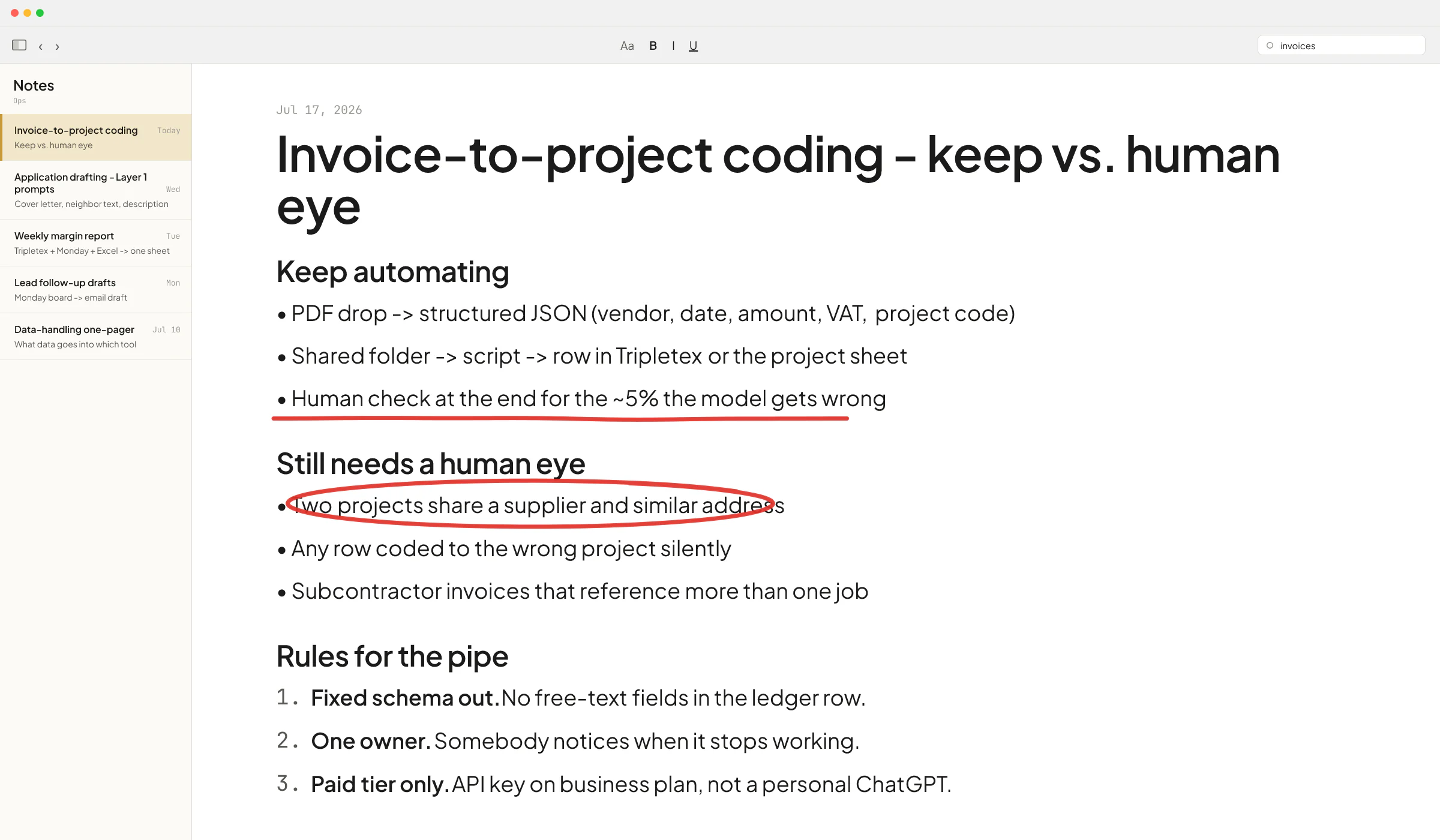
This is where AI genuinely earns its seat, because the job fits modern models well: unstructured input (PDFs of every layout), a small fixed output schema (vendor, date, amount, VAT, project code), and a human check at the end that catches the ~5% the model gets wrong.
What works today: - A simple ChatGPT or Claude workflow where someone drops a PDF in, gets structured JSON out, and pastes it into your sheet. Zero code. Good for testing whether this is worth automating for you at all. - A slightly more built version: an inbox or a shared folder where invoices land, a small script hits an LLM API, and the row appears in your Tripletex or your Google Sheet already coded to the project.
I built the "not just Q&A" version of this thinking during my two years as an AI engineer at Sellify AI - the pest-control AI startup where CEO Thomas K. Lundberg wrote in his LinkedIn recommendation that I was "trusted with important tasks" and "always been able to get creative and deliver." The same discipline applies here: an AI that reads an invoice PDF is easy; an AI you can hand a folder to and trust to code it against the right project without checking every row is a real engineering job.
Watch out for: invoices that reference the wrong project because two of your projects share a supplier and a similar address. Any pipeline that codes to the wrong project silently is worse than typing by hand. For the general logic of when this pays back, see extract data from PDF to Excel.
2. Building application drafting
For firms that also do the consulting side (writing and submitting building applications to the municipality via DiBK and Altinn), this is where AI is already helping and can help a lot more.
The pattern I've seen: your architect drafts the project description, throws it into Copilot or ChatGPT to tighten the wording and get less repetition, pastes back, edits, sends. Fine as a starting point. Where it breaks down is repeat forms. Every application asks for a lot of the same information - name, numbers, project description, cover letter to the case handler - and one CEO I spoke with described how much time his team spends copying the same content across form after form.
I'd break the AI part of this job into two layers.
- Layer 1 (easy, do this now): a set of well-designed prompts in ChatGPT Team or Claude Team, wired to your firm's tone of voice, that turn one paragraph of project facts into the cover letter, the neighbor-notification text, and the description block. Any of your architects can run it.
- Layer 2 (custom build, worth it once you know the pattern): a small internal tool where you paste project facts once and it fills out the repeatable text across every form your firm uses - keeping the actual submission to Altinn a human action.
Don't skip Layer 1. If you buy or build Layer 2 before your team has written 30-50 applications with an LLM in the loop, you will build the wrong thing. That's the same mistake Ove André Remme, founder of Terapivakten, described in his video testimonial: "I tried a guy and he did some work on creating a ChatGPT agent and I noticed that Vlad's signature was: you cannot make this through a chat agent. You need to do this." The first freelancer had jumped straight to building. It didn't work.
Watch out for: AI-generated application text that sounds fluent but drops a required detail. Municipal case handlers reject applications for exactly this. A checklist that runs after the draft ("does this application mention setback, height, use category, plot number") catches most of it.
3. Project margin and cash-flow reporting
This one keeps coming up on every real-estate call I do. Your CEO wants to know, this week, which project is making money and which project is bleeding. Right now the answer for most small firms is that nobody really knows until the books close, and by then it's way too late.
You already have all the data. Time entries in Tripletex, contract values in Monday or Notion, invoices in a folder, subcontractor costs in Excel. What's missing is the pipe that pulls them into one dashboard.
For a small firm, the cheapest working version of this is not "buy an AI dashboard." It looks more like:
- A weekly script (30-60 seconds of runtime, unattended) that pulls Tripletex time entries per project, matches them to contract value and invoice totals, and writes a single Google Sheet: one row per active project, columns for budget, spent-to-date, committed, projected margin.
- An LLM step at the end that summarizes the movers (e.g. "Project 7000 is 12% over budget on labor this week, driven by three specific subs") and drops it into a Slack channel or an email.
The AI part here is small - the value is 90% plumbing, 10% LLM summary. Which is exactly why buying an "AI project analytics for developers" SaaS rarely works for firms your size: the SaaS is designed for the average firm's data schema, and your firm's Tripletex categories and Monday board layout are not the average.
I built a similar pipeline for a recruitment AI startup I contract with. The constraint there was different (latency vs. quality on hundreds of job postings per recruiter), but the lesson generalizes - for a small business, a small custom pipeline that fits your actual data beats a generic SaaS that almost fits. Small models, fixed outputs, one owner who can debug it. See the general pattern in AI weekly report generator.
Watch out for hallucinated numbers. Any report that includes a dollar amount the CEO acts on must be assembled by code (a SUM in a sheet), and the LLM only narrates numbers the code produced. I trace this back to something the recruitment client's team learned the hard way when they had LangChain writing SQL directly against their database - keeping AI out of the number-producing path is what gives you reliability.
4. Lead follow-up and sales-funnel reporting
If you run Google Ads to bring in consulting leads on the application side, or you have a broker network feeding you land opportunities, the follow-up problem is universal. One architect at a firm I spoke with described sending "hi, how are you?" follow-ups by hand every Monday, checking the Monday.com board to see who was due.
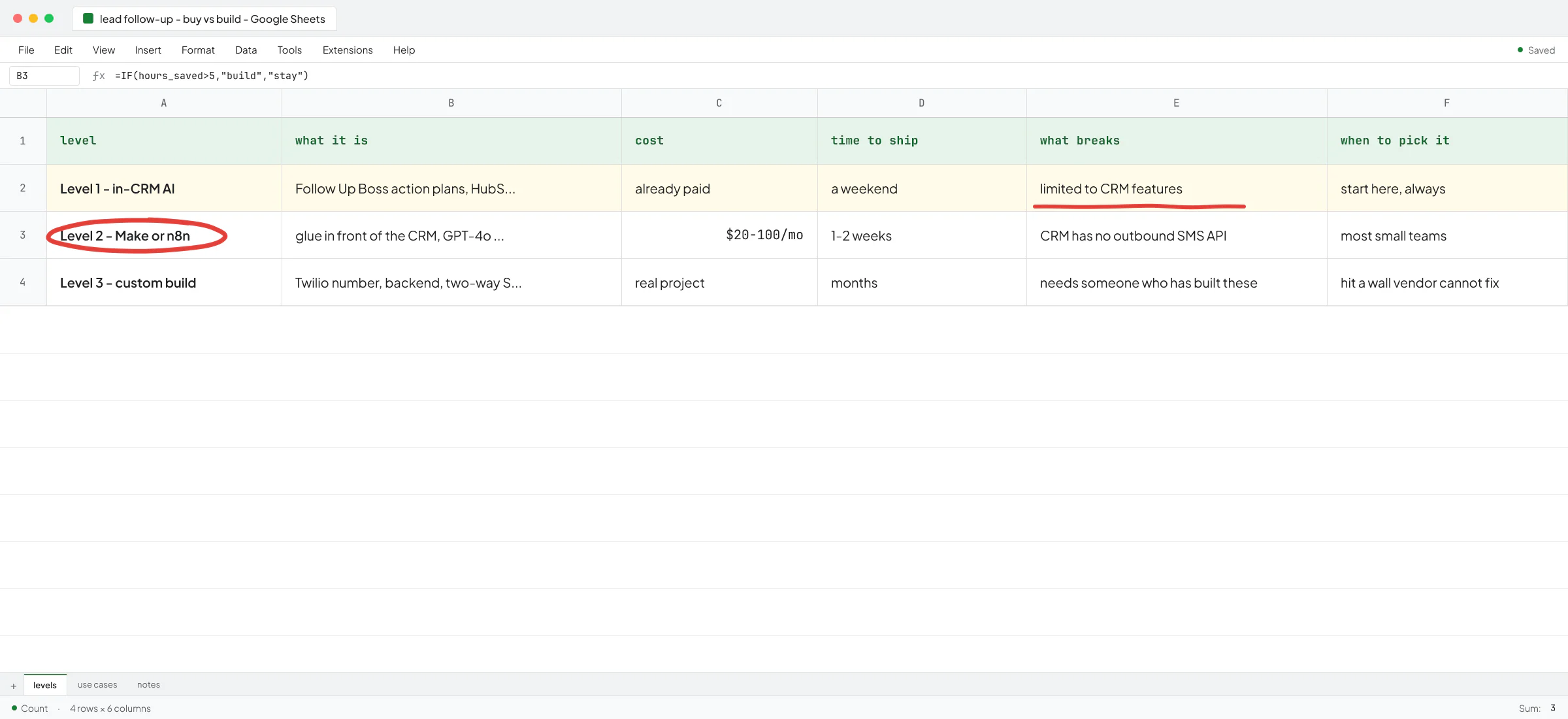
The cheap working version: - A simple automation in Make or n8n reads your Monday board, checks the last-contact date, and drafts a follow-up email in your voice via an LLM. A human on your team clicks send. - A weekly Slack summary: how many new leads, how many follow-ups sent, how many rejected, how many converted to a proposal.
What NOT to try first (even if LinkedIn says you should)
The reason your firm has "AI everywhere but nothing connected" is that most AI content on LinkedIn is optimized for hooks, not for what pays back at a 5-40 person real-estate developer. Here are the projects I would tell you to skip in year one:
- A full "AI assistant that runs the whole application process end-to-end." This is Layer 2 of use case #2, and doing it before Layer 1 is exactly what Ove described - a working-looking demo that doesn't solve the real problem. Build Layer 1, learn what breaks, then decide.
- Replacing Tripletex or your project system with an "AI-native" alternative. Your Tripletex data model is a moat you already paid for. Ripping it out to get an AI dashboard will cost you a year and a bookkeeper.
- Building a customer-facing AI chatbot for apartment buyers before you've fixed the internal reporting problem. Buyers of a large-ticket apartment want a human, and your ops team wants to know if project 7000 is losing money. Fix the internal problem first.
- Hiring a big-agency AI consultant who produces a strategy deck. If you are 5-40 people and your team is already using AI daily, you don't need a strategy - you need somebody to build the three specific pipes above. See is AI consulting worth it for when the deck is worth paying for.
The data-handling checkpoint
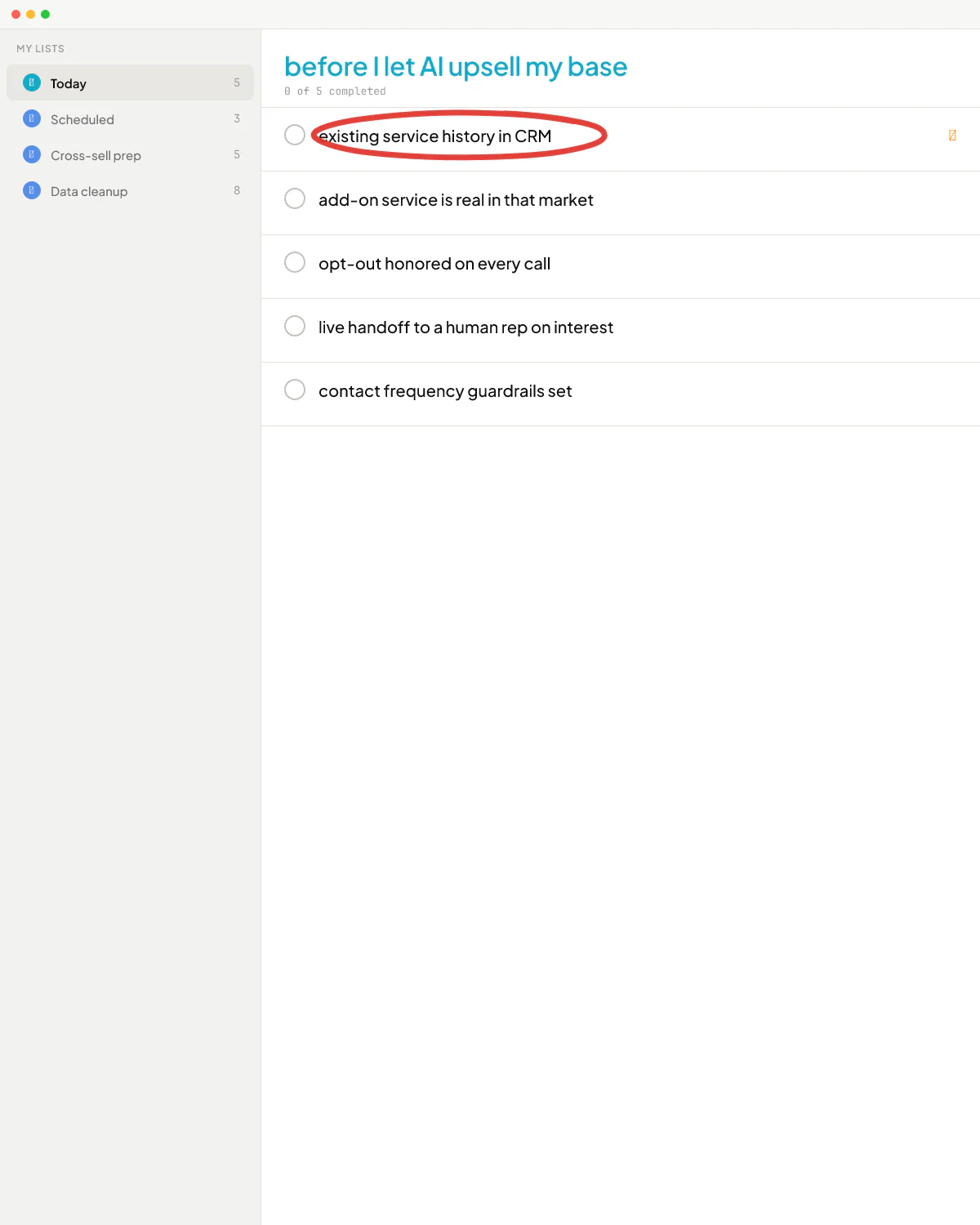
Before you paste anything into an LLM, one rule for a dev firm: personal data on your buyers, seller counterparties, and subcontractors is regulated (GDPR in Europe, similar rules elsewhere). Don't paste it into a personal ChatGPT account.
The minimum working setup for a firm your size: - ChatGPT Team, ChatGPT Enterprise, or Claude Team for everyone who touches client data. These plans exclude your inputs from training by default. Personal free plans do not. - Any custom pipeline (invoice extractor, application drafter, reporting job) goes through an API key on a paid business tier, not a scraped ChatGPT session. - One person in the firm owns the list of what data goes into which tool. It's a one-page document, and it's not optional.
If you want more on the trade-offs between plans, I wrote is ChatGPT safe for confidential information - same logic applies here.
Buy vs. build: the decision rule for a small dev firm
For each of the four use cases above, here's the rule I'd apply:
- Pilot in a chat tool for two weeks. If your architect can do the job by pasting into ChatGPT Team and the output is 70%+ usable, keep it there and don't build.
- If the job is boring, repetitive, runs 20+ times a week, and everyone doing it is copy-pasting between the same 3 systems, it's worth automating with a small custom pipeline.
- If the job needs data from Tripletex, Monday.com, or SharePoint pulled together in a way no off-the-shelf tool understands, you need somebody to write ~200 lines of code, and not another SaaS seat.
- If the job is customer-facing and a wrong answer costs you a lawsuit, a lost sale, or a rejected permit, don't automate it end-to-end. AI drafts, human sends.
The trap I see small dev firms fall into is that they read an AI-tooling roundup, buy three new SaaS seats, none of them connect to their Tripletex, and six months later nothing has changed except the software bill. The Oslo CEO I spoke with put it in a way that stayed with me - his team is using AI all the time, but it isn't an overall strategy because none of it is connected. Adding another disconnected tool doesn't fix that.
When to hire someone to build the pipes
You're ready to pay someone to build (not to consult, to build) when three things are true:
- Your team has already run the manual version of the job with ChatGPT or Copilot for a month, so you know exactly what "done" looks like.
- The job costs you at least 8-10 hours a week of somebody's time, or one avoidable margin surprise per quarter.
- You have one person inside the firm who will own the tool after it's built - not necessarily technical, but someone who will notice when it stops working.
If all three are true, the return on a small custom build for a real-estate dev firm is normally very fast, because the alternative isn't "hire a junior" - the alternative is to keep losing money on the project you can't see.
If you're at that point and you want a second pair of eyes on which pipe to build first, book a call with Vlad. Bring the specific job you're doing by hand and the tools you're pulling it from. You'll leave with a call-length answer of what to build, what to skip, and roughly what the pipeline should look like.
FAQ
What is the fastest AI win for a small real estate developer?
Extracting data from vendor invoice PDFs into your project ledger. It's boring, it repeats hundreds of times per project, and the schema is fixed. Every other use case has more edge cases, so start there.
Can I replace Tripletex or my project management system with an AI tool?
No, and you shouldn't try. Your Tripletex data model is the record of your business. AI adds value by reading from and writing to your existing systems, and not by replacing them. The firms I see get burned are the ones that rip out working accounting software to chase an "AI-native" dashboard.
Is ChatGPT safe for building application text that includes buyer data?
Only on ChatGPT Team, ChatGPT Enterprise, or Claude Team - those plans exclude your inputs from model training by default. Don't paste personal data into a free personal account. If you're in the EU, also make sure your data-processing agreement is signed. See is ChatGPT safe for confidential information.
Do I need an AI consultant or someone who builds?
If your team is already using ChatGPT and Copilot daily and the problem is that nothing is connected, you need somebody who builds. A small custom pipeline that reads Tripletex, Monday.com, and an invoice folder and writes one weekly report solves that. A consultant who produces a strategy deck does not. More on this in AI consultant vs AI engineer.
How much of the building permit application process can AI actually handle?
Drafting - a lot. Cover letters, project descriptions, and repeat form fields are exactly what LLMs are good at. Submission and legal responsibility - none, because the architect signs and submits through Altinn. Treat AI as a fast first-draft writer, not as the person who owns the application.
Can AI tell me which of my projects is losing money in real time?
Yes, but only if you build the pipe. The number itself has to come from code that reads Tripletex and your cost sheet, and the LLM only writes the summary paragraph on top of it. Never let AI produce a dollar figure the CEO will act on - assemble numbers with code, then narrate with AI.
My team is using AI all the time already but nothing is connected. What now?
That's the exact situation this playbook is written for. The fix is not more tools. Pick the one job that costs you the most hours per week (usually invoice sorting or weekly project reporting), automate that one, then move to the next. Six months of that beats another year of feature-shopping.