You've been pitched by an AI consultant or two. The deck looked nice. The price did not. And the part of you that's been burned by SaaS demos before is wondering if you're about to pay for slideware.
Short version: AI consulting tends to be worth it when you can describe a real workflow in one sentence, you have a clear way to know if it's working a month later, and the consultant ships code (or works side by side with someone who does). It tends to underdeliver when the engagement ends in a slide deck, when the firm is still figuring out what it does day-to-day, or when the team won't change how they work.
The longer version is below - with the conditions, the failure modes I see most often, and a cheap way to test before you commit.
When AI consulting pays back
A few conditions have to hold at the same time. If any one is missing, the engagement tends to underdeliver.
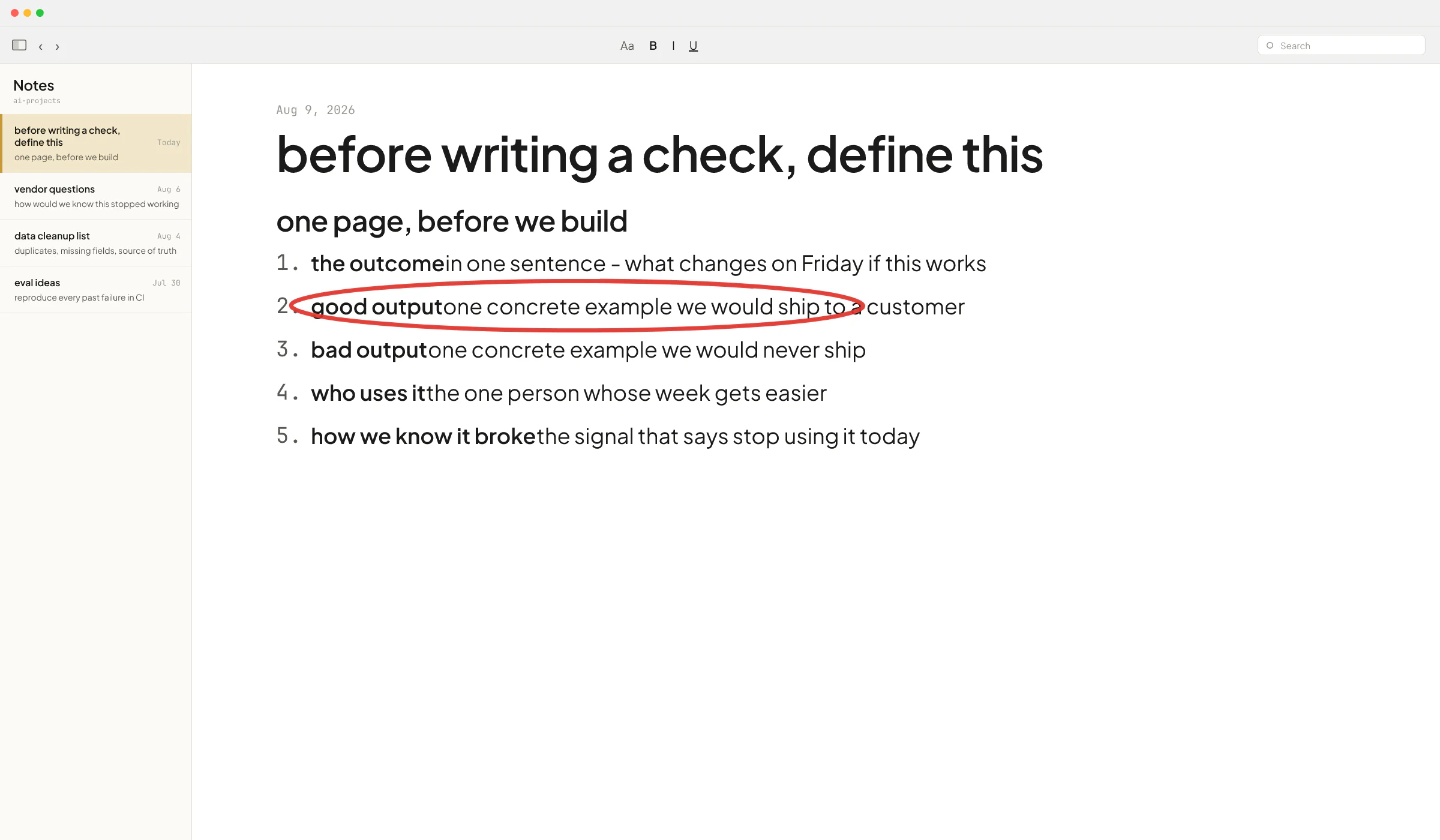
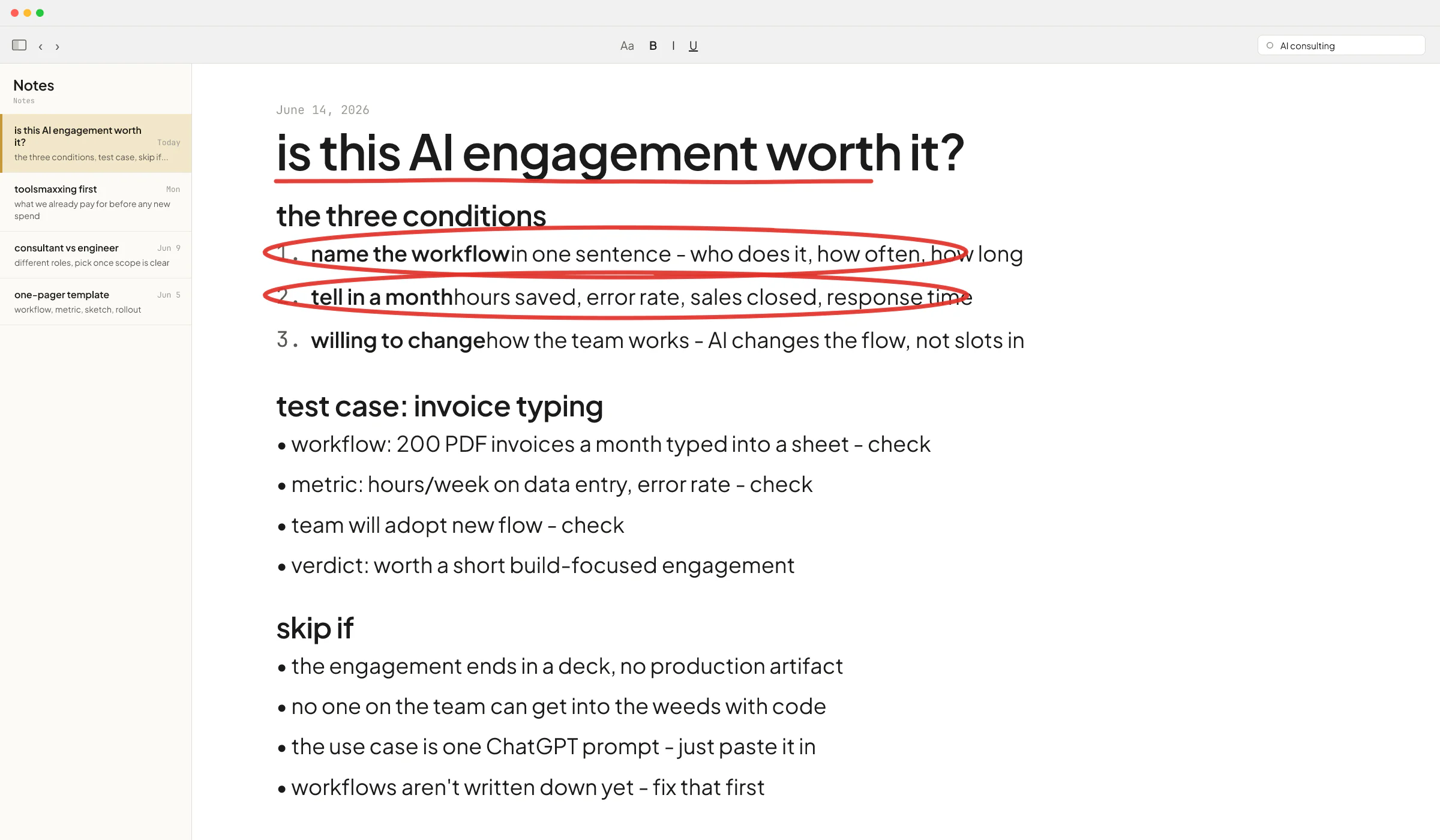
You can name the workflow in one sentence. Not "we want to leverage AI." Something like "tenants text us about leaks and it takes hours to triage them" or "we get 200 PDF invoices a month and someone types them into a sheet." If you can't name it, no consultant can solve it - you'll pay them to discover it for you, which is the expensive way to do discovery.
You can tell in a month whether it worked. Hours saved per week, error rate, sales closed, response time - something countable. If the success metric is "we feel more modern," the engagement will end with a deck and that's it.
You're willing to change how the team works. AI doesn't slot into the workflow you already have - it changes the workflow. If the team won't adopt the new flow, the consultant ships a tool that gets quietly abandoned in month three. I've seen that kill more projects than any technical issue.
When all of these hold, the math tends to get favorable fast. One pest-control client I worked with at Sellify AI - HomeTeam, a top US operator - generated over $1M in new mosquito-service revenue in a single month from existing customers, after we automated their cross-sell calling. No new sales hires. The workflow was crisp ("call existing customers and offer mosquito service"), the metric was obvious ($), and the operator was willing to let an AI agent named Anna handle the call - to the point customers were calling local branches to confirm Anna was a real person.
When it's not worth it (the failure modes)
Most of the "AI consulting is a scam" feeling comes from one of these patterns:
- The engagement ends in a deck. Strategy decks are easy to write and hard to ship from. A real engagement ends in a working thing - a prompt, a script, an agent, a pipeline. If the proposal has no production artifact in it, the proposal is the product.
- The consultant doesn't write code, and doesn't have someone who does sitting next to them. AI work is part strategy and mostly wrestling with edge cases (a model that hallucinates on the one invoice format you actually care about, an API that times out at 2 PM ET on Tuesdays). If no one on the engagement can get into the weeds, the weeds will eat the project.
- You're paying for "AI literacy training." Your team has ChatGPT and can read. Training a team to "use AI" without a target workflow is a high-priced book club.
- The firm doesn't have its workflows written down. I've sat on discovery calls where the owner couldn't tell me how invoices got from email to QuickBooks because three different people did it three different ways. That's a workflow problem and AI won't fix it. Fix the workflow first, or pick the one consultant who'll do both.
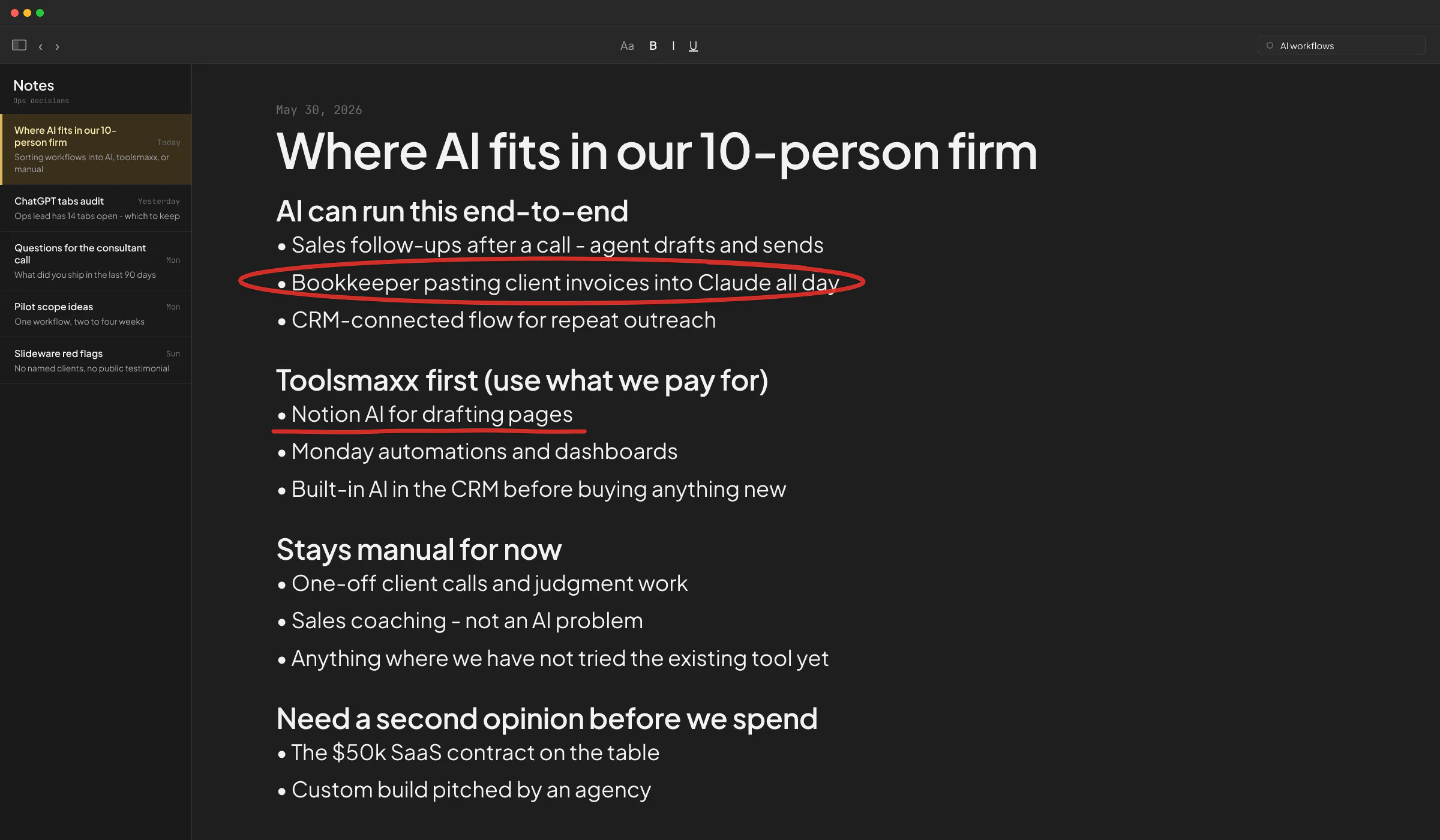
- The use case is a single ChatGPT prompt. If the answer is "open ChatGPT and paste this in," you don't need a consultant. You need to read my piece on toolsmaxxing and use what you already pay for.
The pattern under all of this: AI consulting is worth it when the output is a system that runs without the consultant in the loop. If the output is something you could have read in a blog post, save the money.
What "worth it" usually looks like in dollars
I won't quote a price because pricing is a conversation, not a number. The shape of a worthwhile engagement, though, is pretty consistent. The build either replaces a recurring cost (an admin's time on a repetitive task), unlocks revenue that was sitting in the existing customer base, or removes a hiring decision you were about to make.
Payback inside a quarter is normal for the small-B2B work I see. The HomeTeam mosquito campaign was incremental revenue from customers they already had, with no extra reps and no extra management layer. That's the easiest math: revenue that didn't exist before, against a one-time build cost.
The opposite shape - a six-month engagement with a vague "transformation" outcome - is where founders tend to get burned. The longer the timeline before something runs in production, the less likely it works at all. A short engagement with a working artifact at the end beats a long one with a roadmap.
Whether to hire a consultant or an engineer is the next decision once you've decided AI work is worth doing at all - they're different roles, and picking the wrong one wastes money.
The cheap test before you commit
Before you sign a real engagement, do this.
- Write your top three workflow pains on one page. One sentence each. Who does it, how often, how long it takes.
- Book a 30-minute call with the consultant and ask them to react. A good one will tell you which of the three is a fit for AI, which is a process problem, and which they'd skip. A weak one will pitch all three.
- Ask what gets shipped. Specifically: at the end of the engagement, what runs in production without you calling them? A roadmap is not a shipped thing.
- Ask for one named client and one link. A LinkedIn recommendation, a case study, a public review. Not a logo wall.
If the call moves from generic AI talk to "here's the specific thing I'd build for your situation, here's how I'd know it's working, here's a client I did this for," you have a real shortlist candidate. If it stays abstract, save your money.
A client of mine, Ove André Remme at Terapivakten in Norway, tried this exact filter and got burned on the first try. He hired a freelancer with 20+ five-star reviews to build a course-content generator as a custom ChatGPT. Two weeks in, the build produced content that was 40% too short and went unnatural when pushed for more. He came back and we built the actual application. He recommends the second route now: "If you're looking for someone who understands AI and applies it practically, without wasting time - he's the one." The lesson isn't that ChatGPT is bad. It's that the wrong tool choice (a custom GPT, in his case) was the root issue, and a consultant who pointed at that early would have saved the first round entirely.
What to expect month by month from a worthwhile engagement
Month one: discovery is short (a week, not six), and at the end of it there's a written one-pager - the workflow, the success metric, the architecture sketch, the rollout plan. If discovery takes a month, that's a sign.
Month two: something runs in staging or in a small pilot, with real data and real users and real edge cases. You see the first round of "AI got this wrong" cases, which is the most useful data in the whole engagement - it tells you where the guardrails need to go.
Month three: production with measurement. The metric you picked at the start is now being tracked. If it's moving, you extend. If it isn't, you stop and look at why - usually it's a workflow assumption that turned out to be wrong, and not the AI itself.
That's the loop. It is not glamorous and it is not "AI strategy." It is a small team shipping a working system into a real workflow and watching the numbers go.
Worth it vs. not worth it, by firm stage
A few rough cuts by where the firm is:
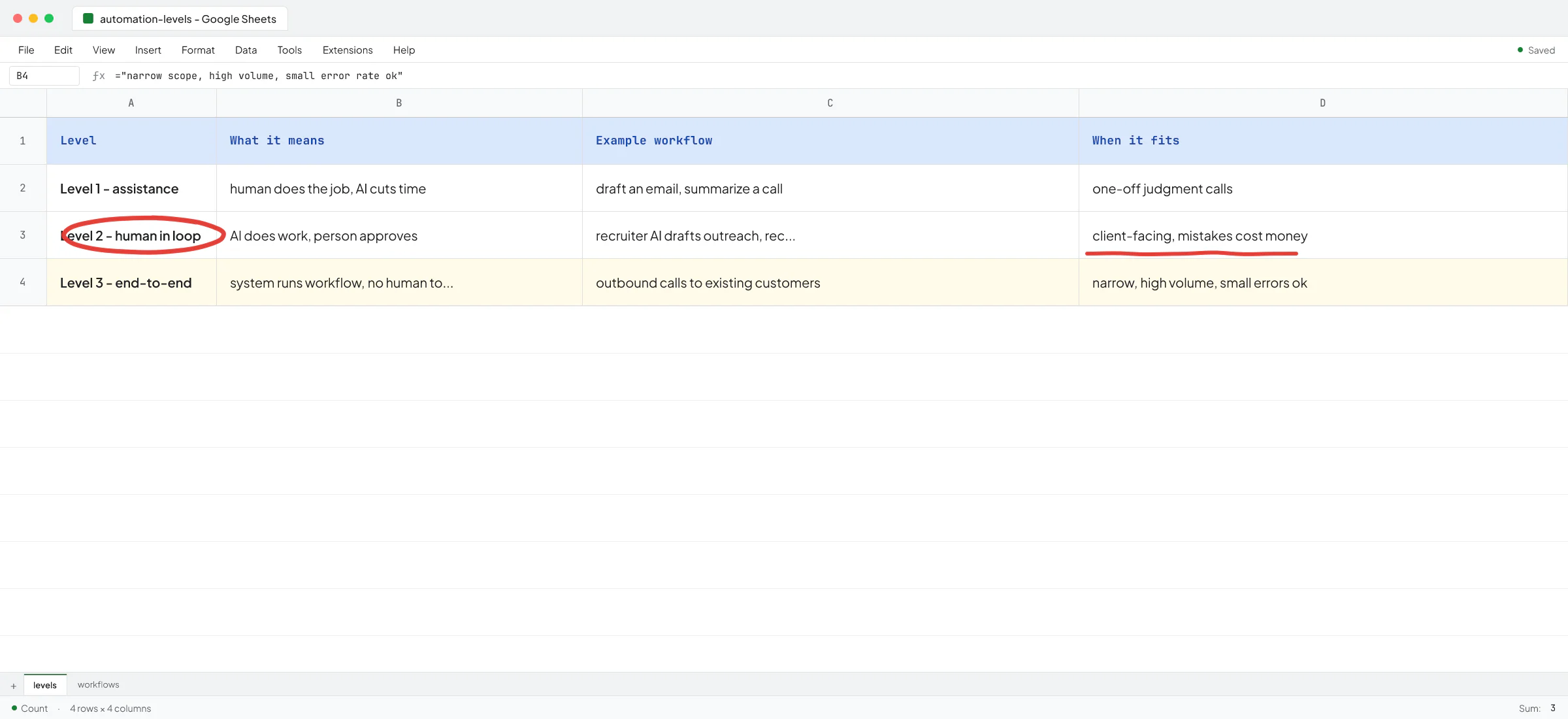
- Solo or 2-3 people, mostly chat-tool users. Not worth a consulting engagement yet. Spend a month on toolsmaxxing what you already pay for. If you still have a clear stuck workflow at the end of that month, then talk to someone.
- 5-15 people with one or two repetitive workflows eating real time. This is the sweet spot. A short build on the worst workflow usually pays back inside a quarter.
- 15-50 people with multiple sister workflows and no IT hire yet. Worth it, and worth scoping past a single workflow - the systems start to share infrastructure (the same data, the same auth, the same observability), and a few connected builds get cheaper per-workflow than the same builds done in isolation.
- 50+ people with an internal engineering team. The question shifts. A consultant is useful for the parts your team hasn't done before (LLM evals, prompt engineering at scale, model routing) and less useful for general AI strategy that your own team can run.
So - is it worth it for you specifically?
If you have a workflow you can name, a metric you can count, and the willingness to change how the team works, AI consulting tends to be one of the highest-ROI line items a small B2B firm can spend on right now. If any of those is missing, fix that part first - the engagement will go better and cost less. And if all three are there, the only remaining question is whether the consultant you're talking to ships, or just talks. The cheap test above sorts that quickly.
If you want a second-opinion call on a workflow you're sitting on - whether it's a real AI fit, what shape the build would take, whether to do it at all - that's what I do on a discovery call. Book one on my calendar and bring the one-pager.
FAQ
Is AI consulting worth it for a small business?
It tends to be worth it when you have a specific workflow eating real hours, a way to measure whether the fix worked, and willingness to change how the team operates. For a firm under 5 people, the cheaper first step is usually making more use of the tools you already pay for. For firms with 5-50 people and at least one painful, repetitive workflow, a short, build-focused engagement usually pays back inside a quarter.
Why do so many AI projects fail?
RAND's research puts the failure rate above 80%. The recurring causes I see in small-firm work: the goal was never measurable to begin with, the team adopted the tool for a week and then drifted back to the old way, the data was messier than discovery assumed, or the engagement ended in a strategy deck with no production artifact. Picking a measurable workflow and insisting on a shipped artifact handles most of these upfront.
How much should AI consulting cost?
Pricing should follow the problem and the shipped outcome, so a number quoted before discovery isn't a useful number. What matters more is the shape: a short engagement (weeks, not quarters) with a working artifact at the end and a clear metric to judge it on. If a consultant quotes a flat retainer for "AI strategy" with no production deliverable, the price is the wrong question to ask - the deliverable is.
How do I know if a consultant is legit?
Ask for one named client, one link to public proof (a LinkedIn recommendation, case study, video testimonial, or public review), and one example of a system they shipped that's running in production. If they pitch frameworks instead of clients, or send a logo wall instead of a link, keep looking. The good ones have public proof from named people - things like Ivan Nikolaichuk's public recommendation on my LinkedIn or the HomeTeam case study from Sellify AI are what you should be asking to see.
Should I hire an AI consultant or an AI engineer?
Different roles for different problems. A consultant fits when you don't yet know what to build and need someone to scope, measure, and write the one-pager. An engineer fits when the scope is clear and you need code shipped. Most small-firm engagements need both, sometimes in the same person. The full breakdown is in AI consultant vs AI engineer.
Can I just use ChatGPT and skip the consultant?
For many tasks, yes - and you should. If the answer to a workflow pain is "paste this into ChatGPT," a consultant is overkill. Consulting starts to be worth it when the workflow needs integration (your CRM, your inbox, your database), reliability (the same answer every time, evaluated against real cases), or scale (hundreds of runs a day instead of a few). Until then, picking the right plan and using it well covers a lot of ground.