You run a 10-person firm. Your ops lead has 14 ChatGPT tabs open, your bookkeeper is pasting client invoices into Claude, and someone on a sales call last week said you should "build an AI agent" for follow-ups. Now you're wondering if you need to hire an AI consultant... or if that's just a fancy way to pay for a slide deck.
This is the question I get on most discovery calls. So let's go through it the way I'd go through it with you on a call - what an AI consultant does, when hiring one pays back, when you should skip it, and how to avoid the people who sell slideware.
What an AI consultant does (and what they don't)
A good AI consultant looks at your real workflows and tells you which ones AI can help with, which ones it can't, and what the cheapest path to a working result looks like. That path is sometimes "use the AI features inside the tools you already pay for" - what I call toolsmaxxing. Sometimes it's a Make or n8n flow. Sometimes it's a custom build because nothing off-the-shelf fits.
What they shouldn't do is hand you a 40-page "AI strategy" PDF with a maturity model and zero shipped work at the end. Ove André Remme, founder of Terapivakten in Norway, hired another freelancer with 20+ five-star reviews before he hired me. That person spent two weeks and delivered a custom GPT that didn't solve the problem - the GPT generated 40% less content than needed, and when Ove asked for more, the output became unnatural. He came back to me after the first attempt failed. You can see him talk about it in the full 6.5-minute interview.
That's the failure mode you're trying to avoid. Someone who sounds smart, charges for advice or builds the wrong thing, then leaves.
The job, when done right, looks more like a doctor's visit than a strategy engagement. The consultant listens to where you're hurting, runs a few tests, and tells you what to do. If the answer is "take ibuprofen and rest," he says that. If the answer is surgery, he says that too - and he can do it.
When hiring an AI consultant pays back
Here are the situations where bringing someone in is worth it.
You're already using AI in ad-hoc ways and want it to actually run something
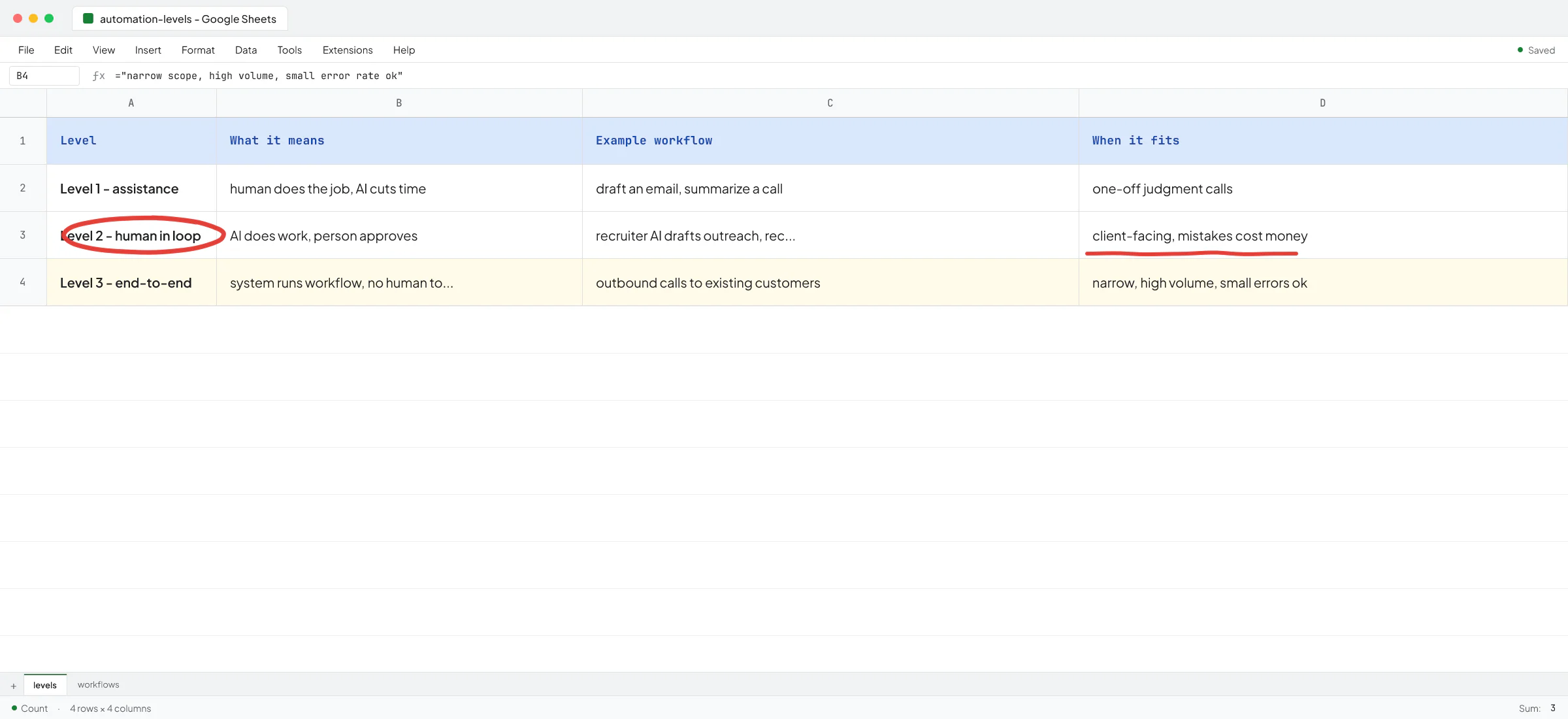
If your team has ChatGPT open all day but nothing in your business is running on AI - no agents, no automated flows, no integrations - you're at the stage where a consultant pays back fast. The work is connecting what you already do manually to a system that does it without you.
One of my recruitment AI clients (a SaaS startup, kept anonymous) had a team with zero AI experience that connected their analytics agent directly to a LangChain SQL library that hit the production database. Row-level access wasn't set up properly. When I got context, I realized the agent only needed to handle five or six real use cases - we replaced the open-ended SQL generation with tool calls and parametrized queries. Reliability went up, debugging time went down, and cost dropped.
You won't see this kind of trade-off if you're shopping tools on G2. You see it when someone who has shipped this work sits with your problem for an hour.
You don't know if you should buy a tool, use what you have, or build something custom
This is the most common reason small firms call me. The CEO of an Oslo real-estate firm I spoke with said it best in his own way - they were using Copilot, ChatGPT, and Notion AI every day, "but it's not an overall strategy, they are not connected." That's the gap a consultant closes.
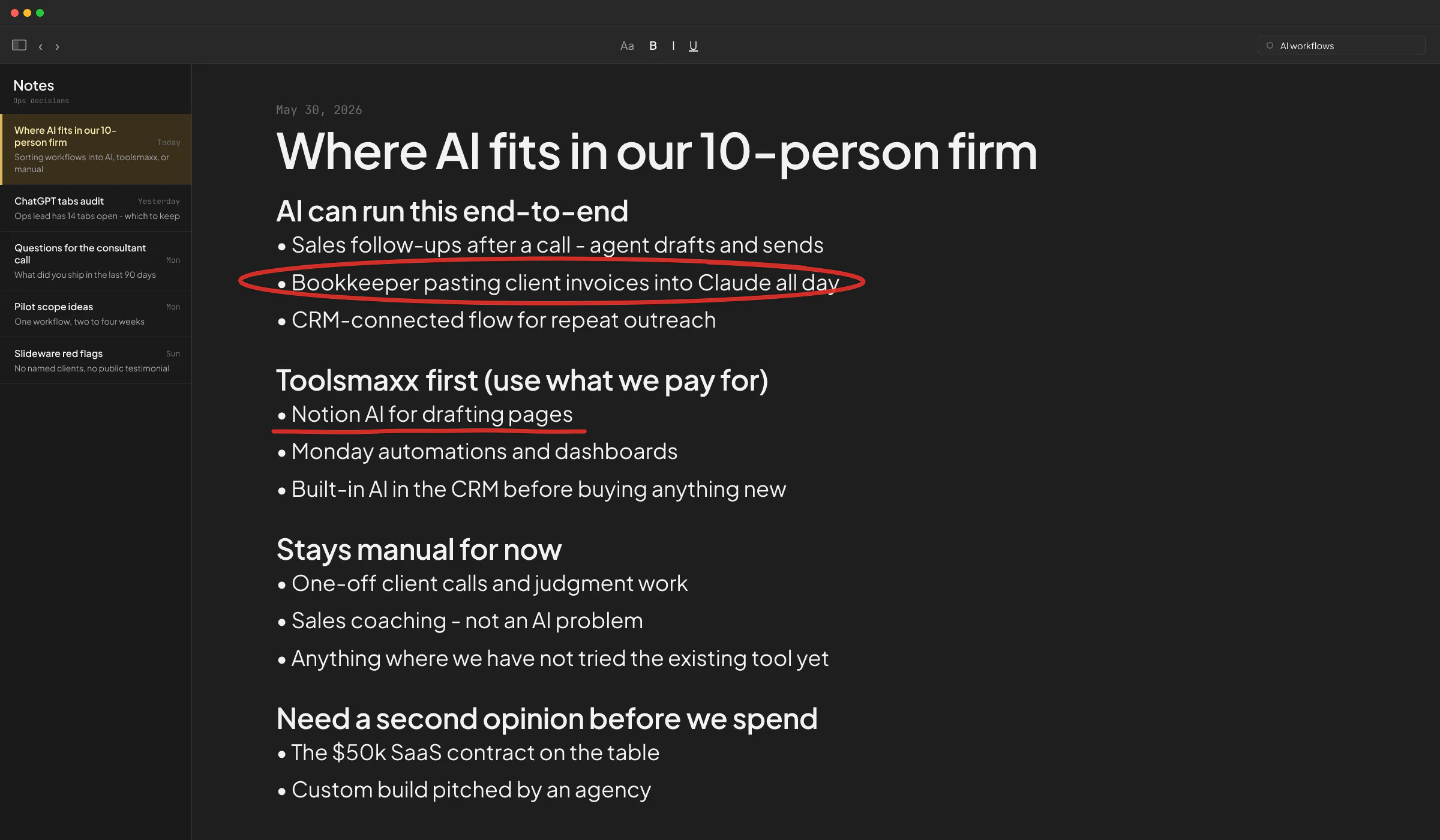
The decision usually breaks into three paths. Buy a SaaS that already does what you need. Use the AI features inside Notion, Monday, or your CRM (toolsmaxxing). Or build something custom because the first two won't fit your workflow. A consultant who has shipped in all three should be able to tell you which one fits your case in 30 minutes. If they can only sell you one of the three, they're not advising - they're selling.
You're about to spend real money and want a second opinion
If you're about to sign a $50k SaaS contract or kick off a custom build with an agency, an hour with someone who has done the work is the cheapest insurance you'll buy. I did a 30-minute consultation with Click Click Marketing where I walked through how I'd structure a Meta ads agent, recommended Claude for copywriting, and handed over an Excalidraw of the MVP architecture. That call probably saved them three months of wrong direction.
Your team is shipping AI features and you want them not to break in production
This is where the consulting work starts looking like engineering. At Sellify AI - the startup where I spent two years as an AI engineer (Founder & CEO Thomas K. Lundberg wrote a public LinkedIn rec and technical co-founder Ivan Nikolaichuk wrote another) - we ran into the real-world problems demo videos skip. Latency spikes. LLM API slowdowns during ET afternoon hours. Models hallucinating on an edge case nobody anticipated.
The result of doing this work properly was the kind Sellify published as a case study with HomeTeam Pest Defense - over $1M in new mosquito service revenue in a single campaign month, with zero new hires. That came from the system being reliable enough to trust at scale, which only happens after a lot of unglamorous engineering work.
"Vlad has been incredible to work with. Very sharp and understands the intricacies and needs of our company. Have trusted him with important tasks, and he's always been able to get creative and deliver." - Thomas K. Lundberg, Co-Owner Fox Pest (350M exit to Rollins), CEO Sellify AI (source)
When you should skip hiring a consultant
A few cases where I'd tell you not to bother.
- You haven't tried the AI features in the tools you already pay for. Notion has built-in AI for drafting pages. Monday has automations and dashboards. Your CRM probably has something. Try those first. If they cover the use case, you saved the consulting fee.
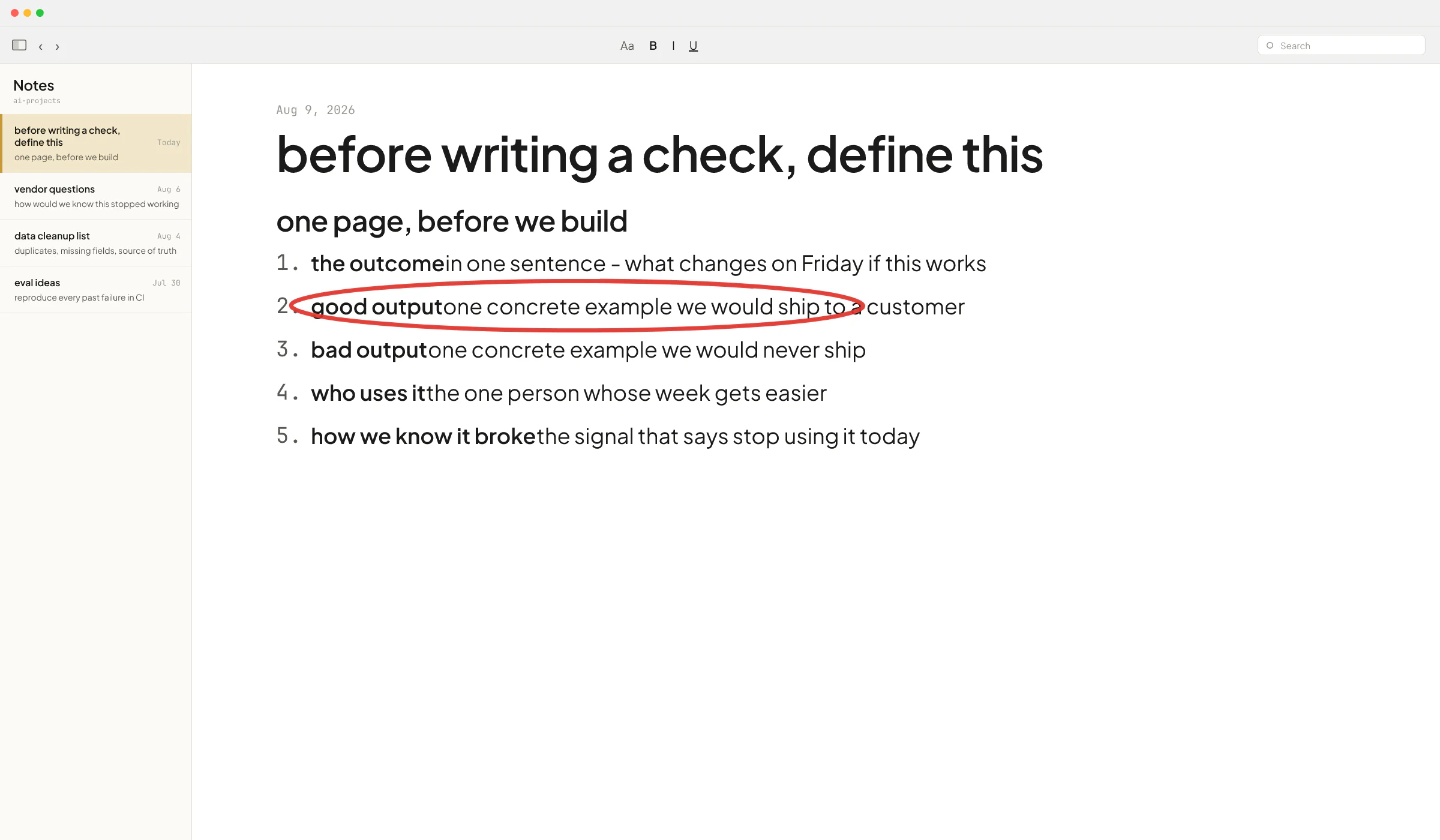
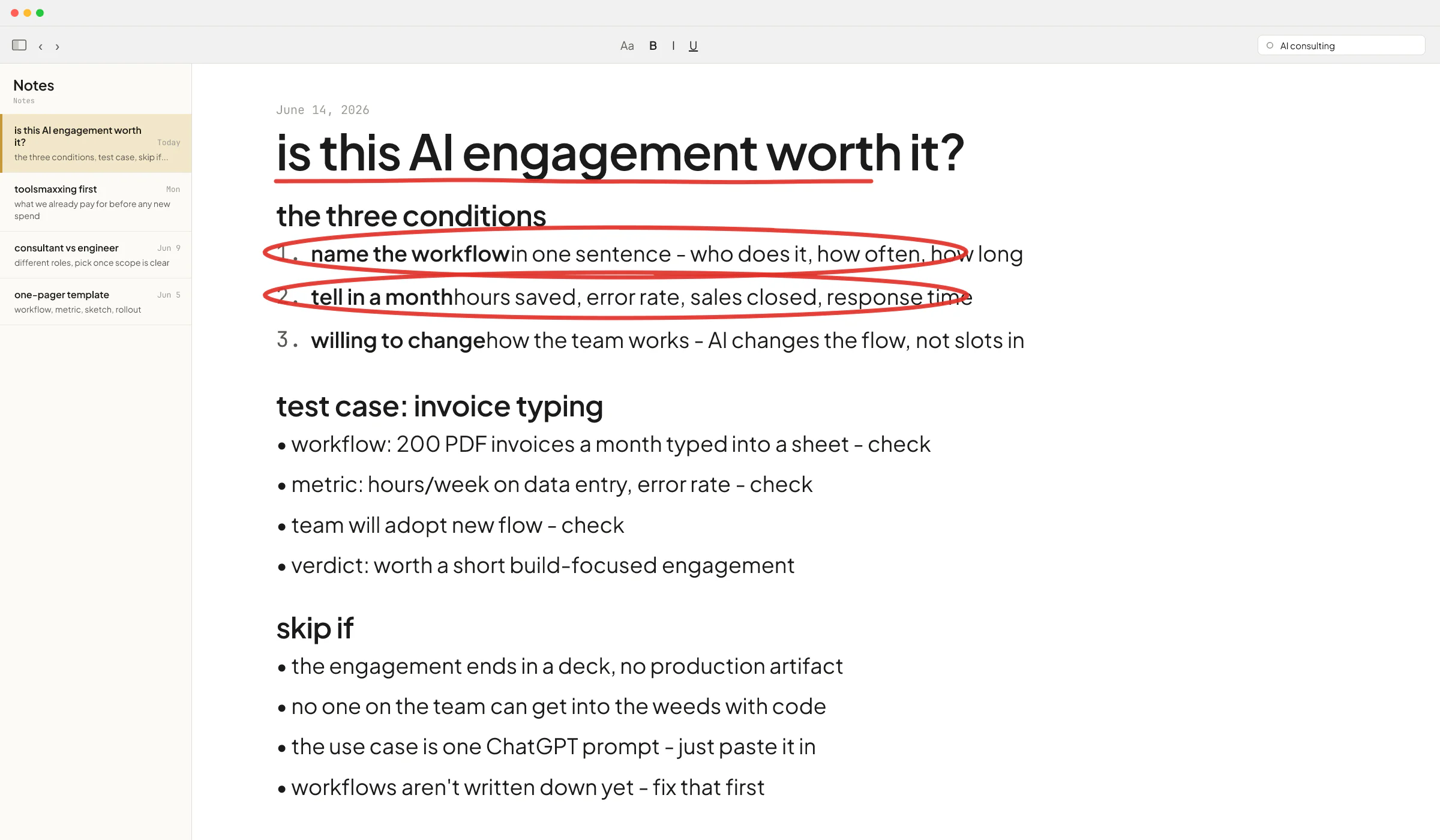
- You're asking for "an AI strategy" with no specific workflow in mind. A strategy doc without a workflow attached is the kind of deliverable nobody reads after week two. Wait until you have a concrete problem.
- You're a one-person business and your bottleneck is sales, not ops. A consultant won't fix that. Go talk to a sales coach.
- You want someone to validate a decision you've already made. If you've already picked the tool and the budget, you're not hiring a consultant, you're hiring a yes-man. Be honest about which one you want.
How to spot the slideware sellers
A few signals I'd look for before paying anyone.
- Ask them what they shipped in the last 90 days. Specific clients, specific features, specific outcomes. If the answer is "I help companies leverage AI" with no named work, walk away.
- Ask for a public testimonial you can read. LinkedIn recommendations, video interviews, case studies on the client's own site. Vague claims of "100+ Fortune 500 engagements" with no link mean nothing.
- Ask what they'd say no to. A consultant who will take any project is not advising you on fit; they're selling you whatever you'll buy.
- Ask them to draw the architecture. Even for a 30-minute consult, someone who has built these systems can sketch the boxes and arrows on the spot. Someone who hasn't will dodge.
Ove, from Terapivakten, picked me partly because I told him in the initial messages that what he wanted couldn't be done as a ChatGPT custom GPT - and the first freelancer he hired learned that the hard way. "You were directly pointing to the issue that I experienced," he said in the video interview (clip). Honest answers up front save you the two weeks you'd otherwise lose.
What a good first engagement looks like
If you're hiring for the first time, keep the scope small. A 30-minute to 1-hour consultation where the consultant looks at one specific workflow and tells you the three or four ways you could approach it, with trade-offs. No deck. No "discovery phase." Just a working answer you can act on.
If you like how the person thinks, the next step is usually a small pilot - one workflow, two to four weeks, a working result at the end. That's how my engagement with Ove started. He described the business problem; I picked the architecture, the UX, and shipped a working product. Non-technical client, real result. He called the content quality "perfect" and said "Vlad saw what I was trying to create before I'd even fully explained it. He just got it. If you're looking for someone who understands AI and applies it practically, without wasting time - he's the one." (source)
The thing to avoid is the giant multi-month strategy engagement with a deliverable at the end called "AI Roadmap." Roadmaps are easy to write and hard to ship from. Pilots are the opposite, and that's what you want.
What it looks like working with me
A discovery call is free. You bring the workflow you're stuck on - the one your team is doing manually, or the one you tried to automate and it broke. I'll tell you on the call whether AI fits, what I'd build, and which of the three paths (buy / toolsmaxx / custom) is right for your case. If we're a fit, we scope a small pilot.
If you're an owner-operator at a small B2B firm and the ChatGPT tabs are piling up, book a call and let's go through the actual workflow.
FAQ
What does an AI consultant do for a small business?
He looks at your real workflows, tells you which ones AI can help with, and recommends the cheapest path to a working result - whether that's using the AI features in the tools you already pay for, an automation in Make or n8n, or a custom build. A good one ships working pilots, not roadmap decks.
How is an AI consultant different from an AI engineer?
A consultant figures out what to build and whether to build it. An engineer builds it. Some people (including me) do both, which works well for small firms because there's no handoff. I wrote a longer breakdown in AI consultant vs AI engineer.
Do I need an AI consultant if my team is already using ChatGPT?
Not necessarily. If ChatGPT plus the AI features in your existing tools cover your use cases, you're fine. You need a consultant when you want AI to run something end-to-end (an agent, an integration, an automated flow) and nobody on your team has shipped that before.
How long does a first engagement usually take?
A discovery call is 30 minutes. A small pilot - one workflow, working result - is usually two to four weeks. The giant multi-month strategy engagement is the format to avoid; small scoped pilots ship and teach you whether the consultant is worth keeping.
Can't I just use ChatGPT or Claude on my own?
For drafting, summarizing, and one-off questions, yes - and you should. Where you hit a wall is when you want AI to do something repeatedly, on a schedule, connected to your CRM or inbox or database. That's where a consultant earns his fee. If you're worried about what's safe to paste in the meantime, see is ChatGPT safe for confidential information.
What should I ask a consultant before hiring?
Ask what they shipped in the last 90 days, with named clients and outcomes. Ask for a public testimonial you can read - LinkedIn rec, video, case study. Ask them to sketch the architecture for your problem on the call. If they can't do any of those, you're paying for slideware.