If you run a small marketing agency, half your team's week is already touching AI somewhere. Someone is drafting ad copy in ChatGPT, someone else is asking Claude to summarize a sales call, and the account manager is pasting a Google Sheet into an LLM to guess why one ad set tanked.
The question is not whether to use AI. It's which parts of your agency work pay back, which ones waste hours, and when the "just use ChatGPT" answer stops being enough.
Here's the playbook I'd hand a 2 to 30-person agency running Meta Ads, Google Ads, content, and client calls. Use case by use case, with the honest limits.
Ad reporting: the first win, and the first ceiling
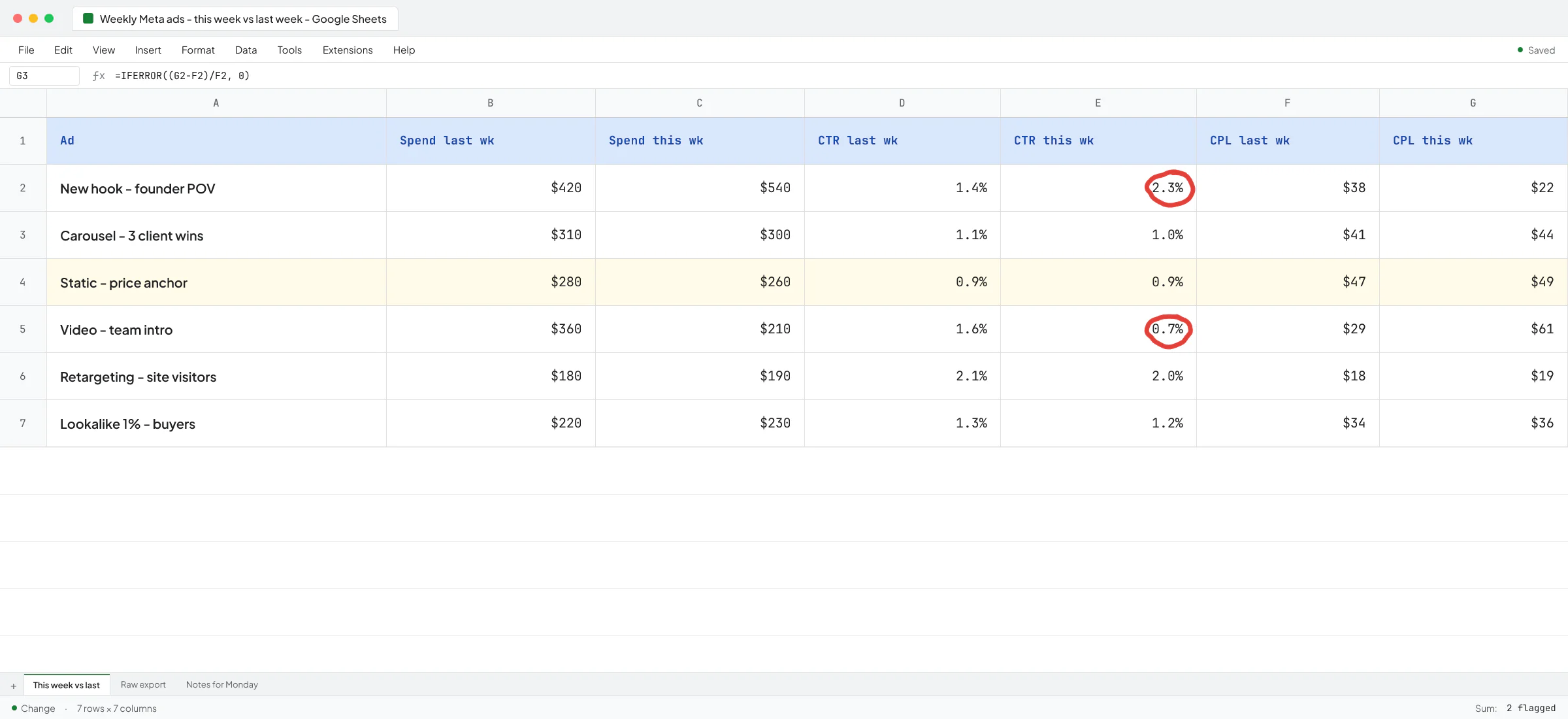
Weekly ad reports are the highest-ROI place to start. You already have the data. You just don't have time to look at it every Monday.
A US fitness coaching founder I spoke with described the pain in almost the same words I hear from every small agency owner. He wanted a weekly summary of how new ads are doing so the creative team can keep optimizing the messaging, and he wanted it without someone hand-building the report every Monday.
At the "just use ChatGPT" tier, this works well:
- Export the last 7 days from Meta Ads Manager as CSV.
- Paste into ChatGPT (or Claude) with a prompt like "compare this week to last week, flag the 3 ads that changed most and why."
- Get a first-draft narrative you edit in 5 minutes instead of writing from scratch.
The ceiling hits fast. Once you have more than a couple of clients, someone still has to do the exports, paste them in, and post the summary in the right Slack channel. That's when Make or n8n starts to earn its seat - a scheduled workflow pulls the Meta Ads Insights data, sends it through Claude, and drops the summary into a client Slack channel every Monday at 8am. If you're weighing the two automation tools, I wrote a comparison of n8n vs Make for small B2B firms that gets into the pricing and hosting differences.
Where it breaks: multi-touch attribution across Meta, Google, and TikTok, with brand and creative variables to compare. LLMs will happily invent causal stories from noisy data. If your report needs to say "the new hook drove the CTR lift," you need proper creative tagging and enough sample size before the AI can help.
Sales call analysis: past the single-call summary
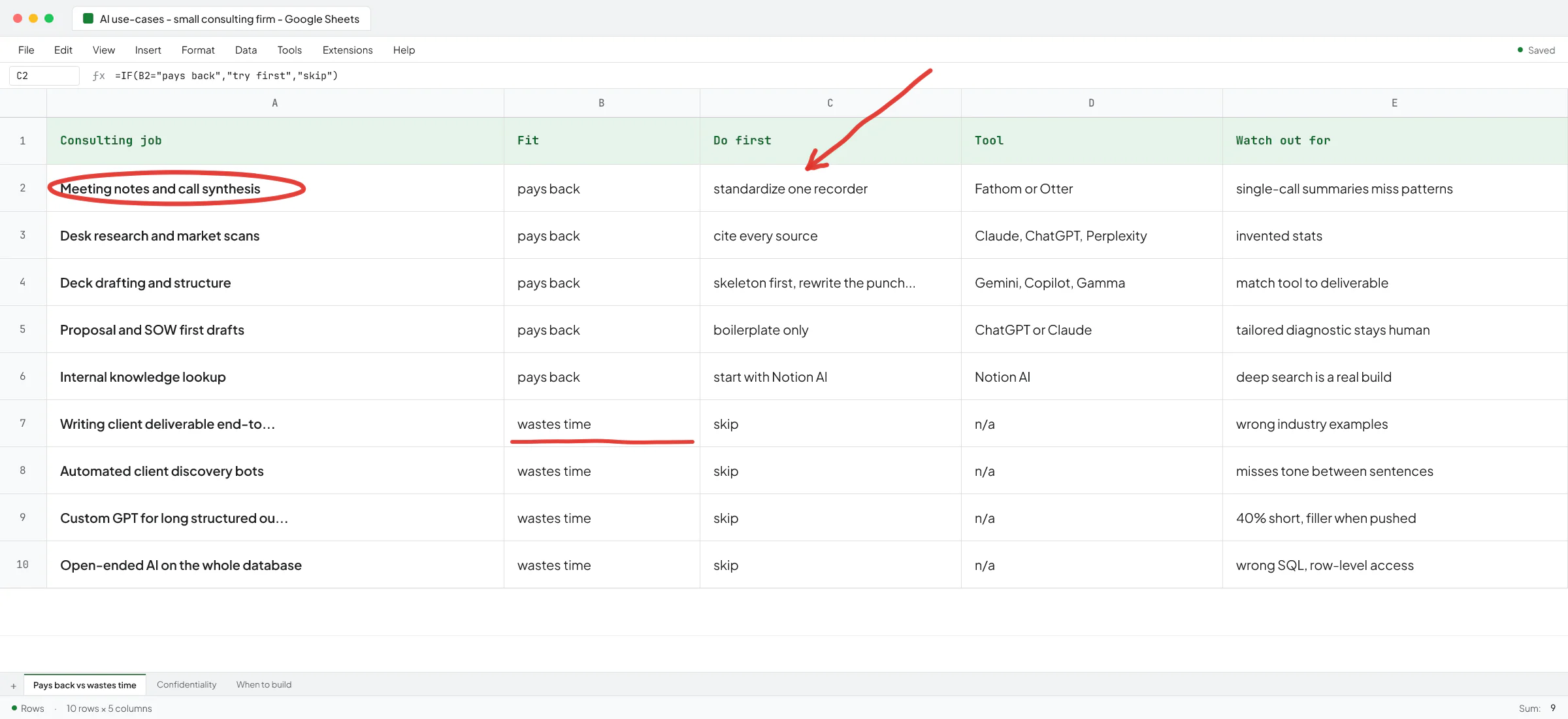
Fathom and Otter both give you AI summaries of individual calls out of the box. On Fathom's free plan you get unlimited recordings and instant AI summaries; the $20/month Premium tier adds action items and a conversational assistant. For most small agencies, that covers a call at a time.
What it doesn't cover is what the fitness founder above was asking for. He could see individual call summaries in Fathom, but he had no way to see patterns across the 100+ calls his team had done. Who are these customers, what objections keep coming up, what language do they use.
That aggregate view is where a small custom pipeline pays back within a quarter. Export the transcripts, run them through Claude in batch with a stable analysis prompt, and post a weekly digest with the recurring patterns to Slack. I wrote up how it works in AI sales call analysis for small B2B firms.
One quiet gotcha: your call recorder is sending transcripts to a vendor's cloud. If any of your clients handle sensitive data (health, finance, legal), review the recorder's data-processing agreement before you standardize on it. I covered the ChatGPT side of this in is ChatGPT safe for confidential information and the same reasoning applies to Fathom, Otter, and any AI notetaker.
Content: drafts fast, brand voice slow
Every small agency is already using AI for first-draft blog posts, ad copy variants, and social captions. The value is real - 30-minute drafts instead of 3-hour ones. The trap is thinking the first draft is the deliverable.
A Denmark-based health company I worked with had used AI to write blog posts and hated the output. It read like AI, and it was in Danish, which most models handle badly. The insight that made it work: if a human can imitate AI's style, AI can imitate one specific human's style. Give the model a real writer's samples as a reference, and the output scores 0% on AI detectors while staying on topic. Full walkthrough with the tool running live against a third-party detector: from 'obviously AI' to 0% on AI detectors.
The takeaway for your agency: brand voice is a solvable problem, but it's not solved by prompting harder. You solve it by feeding the model concrete examples of the specific voice you want, and by picking the right base model for the language.
Competitor and creative research
The Meta Ad Library is a public, searchable archive of every ad currently running on Facebook and Instagram. Most agencies use it manually - open the tab, search a competitor, scroll.
An AI agent can do this at scale. For one of my clients (a recruitment AI startup), I built an end-to-end Meta agent that creates ad campaigns from a vacancy description, generates images, and does competitor ad research through the Ad Library to improve the copy before launch. The client had zero Facebook Ads expertise on the team, and the agent gave them a full campaign pipeline.
For a marketing agency, the same pattern works for account audits: point the agent at 10 competitors in a client's niche, ask it to cluster the recurring hooks, and hand your creative team a one-page brief before they write the next batch of variants. This is squarely in "custom build" territory - there's no off-the-shelf SaaS that does it well for your specific client mix.
Weekly reports, client updates, and Slack digests
Beyond ads, most of what an account manager does on a Monday is stitching numbers from 4 places into one client update. GA4, Meta, HubSpot, and the call recorder each have their own tab. This is the sweetest spot for automation.
I wrote a full guide on this in AI weekly report generator for small B2B firms. The short version: for one client, a scheduled Make or n8n workflow is enough. Past 5 clients, or once the report needs to compare projects and pull custom metrics, you're better off with a small custom pipeline that a developer can debug when a source API changes its schema (which they do, quietly, all the time).
The confidentiality checkpoint
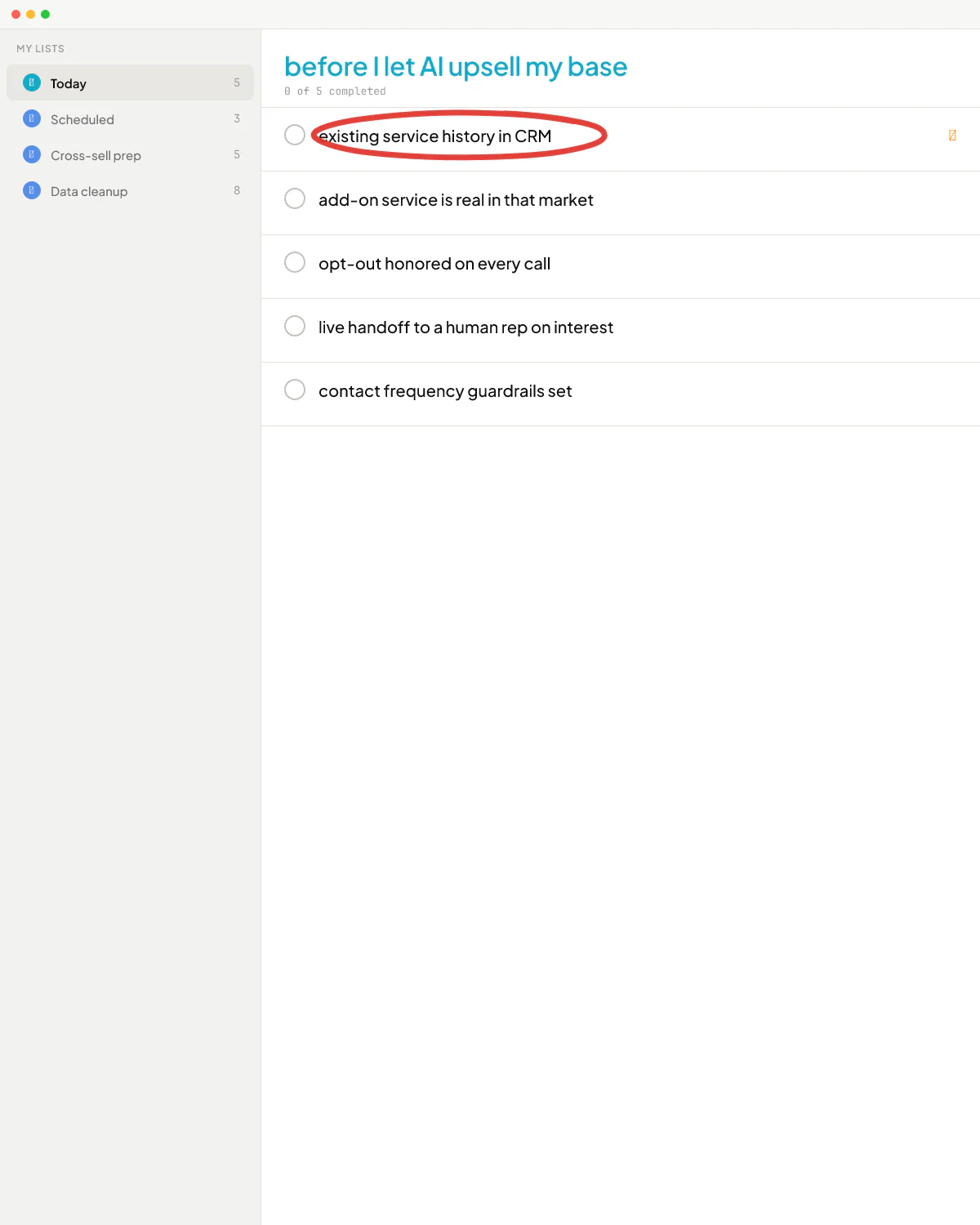
If your agency has any client contract with a confidentiality clause (most do), do this before rolling out AI further:
- Move the team from personal ChatGPT accounts to a Business or Team plan where the vendor commits in writing not to train on your inputs. I break this down by plan in ChatGPT for small business pricing.
- Same check for your call recorder and any workflow tool that touches client data. Read the data processing addendum, not the marketing page.
- If a client is under a stricter compliance regime (HIPAA, GDPR-sensitive categories, financial regulated), stop using consumer-tier AI on their work entirely, and price the custom setup into the engagement.
Why this matters practically: a client finding out you pasted their unreleased campaign into a personal ChatGPT is a fireable event. Not because ChatGPT leaked it - almost certainly it didn't - but because you can't prove it didn't.
The buy-vs-build decision, for your agency
Here's the rule I use when a small agency owner asks me whether to buy another SaaS or build something custom:
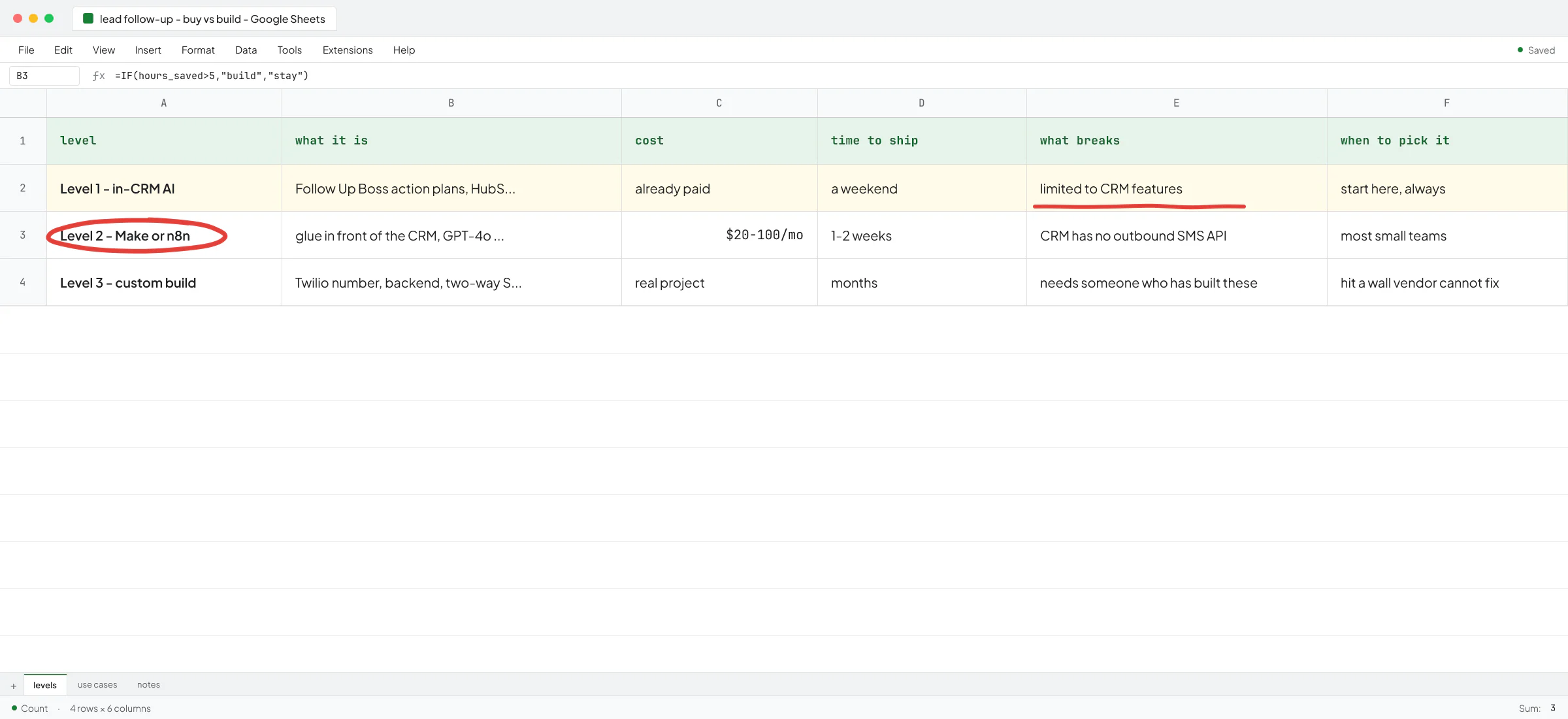
- Buy (or toolsmax what you already pay for) if the job is generic: transcribing a call, drafting one ad, summarizing one meeting. There's a good product for it, and your competitors use the same one. See toolsmaxxing for how to squeeze more out of your existing stack first.
- Wire it with Make or n8n if the job is stitching 2-3 SaaS tools you already own and running it on a schedule. Weekly ad summary to Slack, new lead from a form triggering a HubSpot task, that kind of work.
- Build custom when the workflow is specific to your agency's edge (your creative-brief format, your reporting standard, your competitor-research angle), when off-the-shelf tools would leak client data, or when you're stitching more than 3 tools with real logic between them.
The failure mode I see most often is the middle one. An agency owner keeps buying the next AI SaaS hoping it will click, ends up with 8 subscriptions no one uses, and never invests in the one custom pipeline that would change the numbers. A Norwegian real-estate developer I spoke with described his own version of this - his team is using AI all the time but it's not connected into any overall strategy. Same pattern in agencies.
Ove André Remme, founder of Terapivakten in Norway, hit this on a course-builder project before he hired me. He first tried a freelancer who built a custom GPT agent. It looked fine in the demo and broke on the real workload. In his video testimonial he says: "You were directly pointing to the issue that I experienced." The point isn't that custom GPTs are bad. It's that if the job doesn't fit the tool, no amount of prompting rescues it. Marketing agencies hit this a lot: someone tries to make one custom GPT do the whole reporting workflow, it works for 3 clients and dies on the 4th.
When to bring someone in
You don't need an AI person the moment you install ChatGPT. You probably do need one when:
- You have a repeated agency workflow (weekly ad reports for 5+ clients, call analysis, competitor research) that eats 5+ hours per week across the team.
- Two or more of your automation attempts have stalled at "we set it up, it broke, and nobody wants to touch it."
- A client's compliance requirements make consumer AI a non-starter for their work.
- You want to turn one of your internal workflows into a productized service you charge for.
If that sounds like your agency, that's the conversation I'd want to have. If your team is stuck in the "8 subscriptions, none of them stick" pattern, book a call and we'll figure out what's worth building.
FAQ
What is the best AI tool for a small marketing agency to start with?
Start with whichever chatbot your team will use every day - ChatGPT Team or Claude for Teams. Add Fathom or Otter for call recording. Don't buy a third AI tool until you've squeezed real work out of those two. Most agencies over-buy before they over-use.
Can AI replace an account manager or media buyer?
Not in 2026. AI is very good at drafting reports, summarizing calls, and generating creative variants. It's bad at reading a client's mood on a call, negotiating scope, and knowing when to push back on a bad brief. Use AI to give your account managers 5 extra hours a week, not to replace them.
Is it safe to paste client data into ChatGPT?
Only on a Business, Team, or Enterprise plan where the vendor commits not to train on your inputs. Never on a personal Plus account. And never for clients in regulated industries - HIPAA, financial data, or GDPR-sensitive categories need a stricter setup. See my guide on ChatGPT confidentiality for B2B firms.
How much does it cost to build a custom AI workflow for an agency?
It depends entirely on what you're stitching together and how much of it already exists. A weekly-report pipeline is a small project; a full competitor-research agent that pulls the Meta Ad Library and clusters hooks is a bigger one. Pricing belongs on a discovery call once I've seen your workflow - anything I quote in an FAQ would be wrong for your situation.
Should my agency use Make, n8n, or Zapier for AI workflows?
For most small agencies, Make or n8n. Zapier is fine but its per-task pricing gets expensive fast on AI workflows that fire hundreds of steps a day. I compared the two closest options in n8n vs Make for small B2B firms - the short version is n8n if you're comfortable self-hosting or want to run more complex logic, Make if you want the easier UI and don't mind the SaaS pricing.