You run a pest control company. You have thousands of active accounts in PestPac, ServSuite, or FieldRoutes. Your sales reps are chasing new customers, so nobody is calling the existing base about mosquito, termite, or rodent add-ons. When you do run an upsell push, it's manual dialing and the numbers are small. Then a competitor starts climbing the PCT Top 100, and you find out they've been using AI.
This is the piece I want to write about. Where AI actually earns its keep in a PCO, where it burns time and money, and when a subscription tool is enough versus when you need someone to build.
At Sellify AI I spent two years building CRM-integrated AI sales and support agents for the pest control industry - Thomas K. Lundberg (Co-Owner of Fox Pest before the $350M exit to Rollins in April 2023, now CEO of Sellify AI) wrote the recommendation. One of Sellify's customers, HomeTeam Pest Defense, generated over $1M in new mosquito revenue in a single campaign month with zero new hires. So the numbers below aren't theoretical.
Where AI pays back in a pest control company
I'll go use case by use case. For each one: what it looks like, when it works, when it doesn't.
Cross-sell and upsell to your existing customer base
If you take one thing from this article, take this one.
Most PCOs I've seen have the same pattern. The sales team is 100% focused on new logos - that's where their comp is. Add-on services like mosquito, termite, or rodent get sold when a rep happens to remember, or during a manual push. In big markets like Phoenix, the local team writes off mosquito entirely with "we don't have mosquitoes here."
Mike Johnson, VP of Operations at HomeTeam, said on the Sellify case study page: "The lack of manpower to conduct cross-sell, upsell campaigns. No doubt about it."
An AI voice agent that calls into your existing base changes the economics. It runs the campaign every day, at scale, and reps stay on new acquisition. HomeTeam sold mosquito in Phoenix - the market they'd written off - and did over $1M in incremental mosquito revenue in a single campaign month. That's upside from customers they already owned.
The reason it works in pest control specifically: your CRM already has the account history. The AI knows which customers have quarterly general pest but no mosquito, which ones canceled two years ago, which ones added a service last spring. The pitch is warm because the relationship exists (very different from cold outbound where AI often struggles).
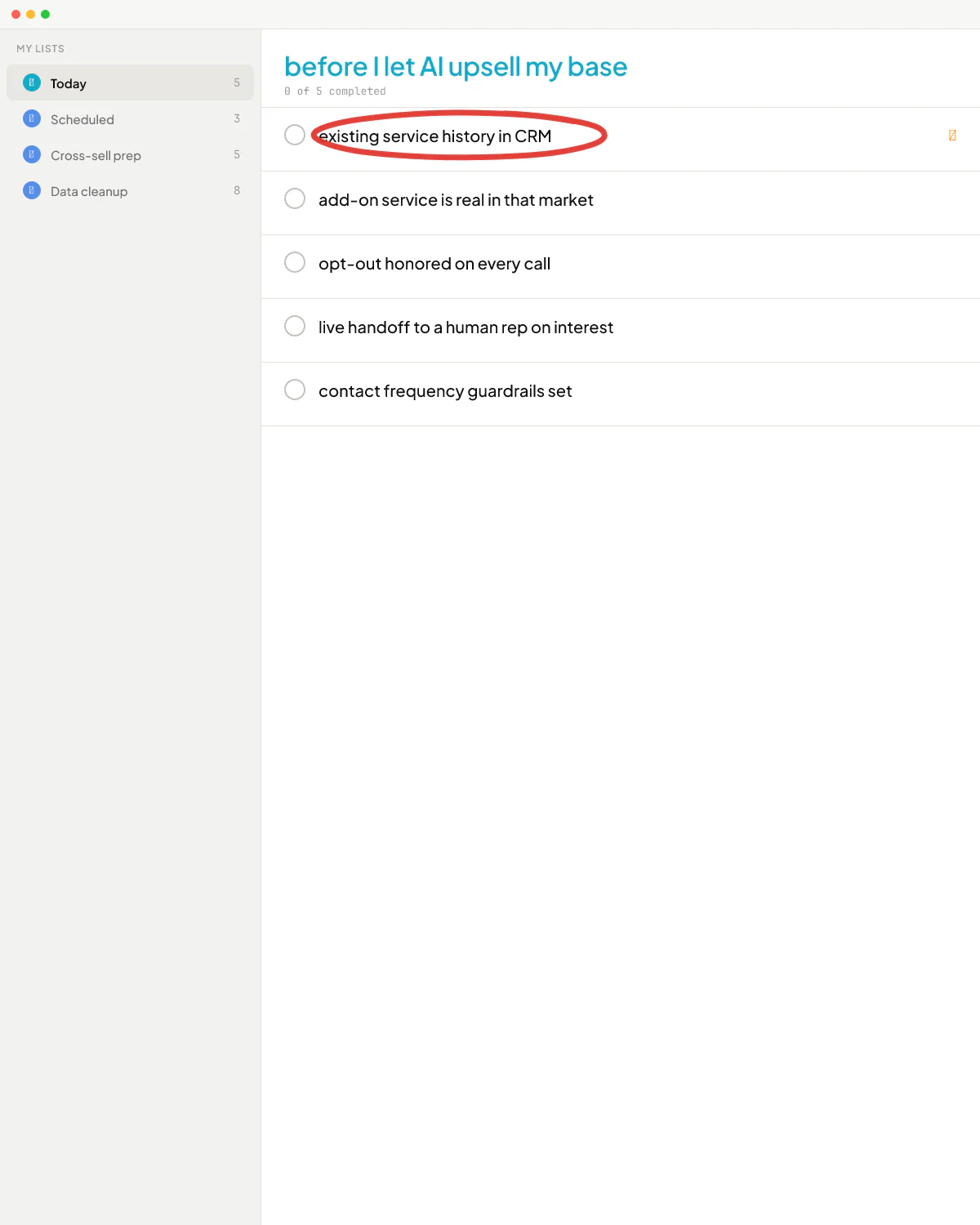
Where it doesn't work: if your customer data is a mess. If half your accounts have no service type recorded, or phone numbers are stale, no AI can fix that. The data problem is boring so nobody wants to deal with it, but it's the prerequisite.
Customer service and rescheduling
Tech running late, customer wants to reschedule, wasp nest emergency at 8pm. Your CSRs field the same 15 questions all day.
An AI voice or chat agent that handles reschedule requests, "when is my tech coming", "did my payment go through", and simple service questions is a real category now. It talks to your route optimizer, your CRM, and your payment processor and closes the loop without a human.
The trick that makes it land in pest control: customers can't tell it's AI when it's built right. Mike Johnson mentioned in the case study that customers were calling HomeTeam branch offices to confirm "Anna" was a real team member. That naturalness is what keeps trust high enough for the AI to convert on the upsell instead of getting hung up on.
Where it doesn't work: complex situations that need judgment. Angry customer wants to cancel a two-year contract. Termite bond dispute. Regulatory question about a product application. Send those to a human immediately, and build the handoff into the agent from day one (not as an afterthought).
Legacy CRM integration
Here's the thing most AI vendors won't tell you. The hard part about AI in pest control is not the AI. It's PestPac.
PestPac, ServSuite, and the older CRMs the industry runs on are 20-40 years old in some cases. The APIs are limited or nonexistent. Modern AI vendors show up, see the state of integration, and either walk away or ship a bad experience that dumps everything on human-in-the-loop.
At Sellify I built an integration with one of these legacy pest control CRMs. It was ugly work. It also became a competitive moat that let the company onboard a big enterprise client and grow substantially - Ivan Nikolaichuk, the technical co-founder, wrote about that time on LinkedIn.
The point for you as an operator: if a vendor tells you their AI works with your PestPac account, ask them to demo it against a real PestPac tenant. Ask what happens when a service order updates. Ask what breaks when PestPac has downtime. The answers tell you if you're buying a product or a slide deck.
Field ops toolsmaxxing
Before you commission anything custom, look at the tools you already pay for. This is what I call toolsmaxxing - using the features inside your existing stack before adding another one.
Your CRM probably already has:
- Simple text templates you can trigger on a status change ("Your tech is 15 minutes out")
- Basic route optimization that most branches don't fully use
- A payment autopay flow half your customers aren't enrolled in
- Report scheduling that emails margin by branch every Monday
If your team is copy-pasting between spreadsheets, PestPac, and QuickBooks every week, the first move is often not AI. It's using the reporting your CRM already ships with. Only when you've hit the wall of what your stack does should you start adding tools, and only when you've hit the wall of what tools do should you commission a build.
Sales call analysis
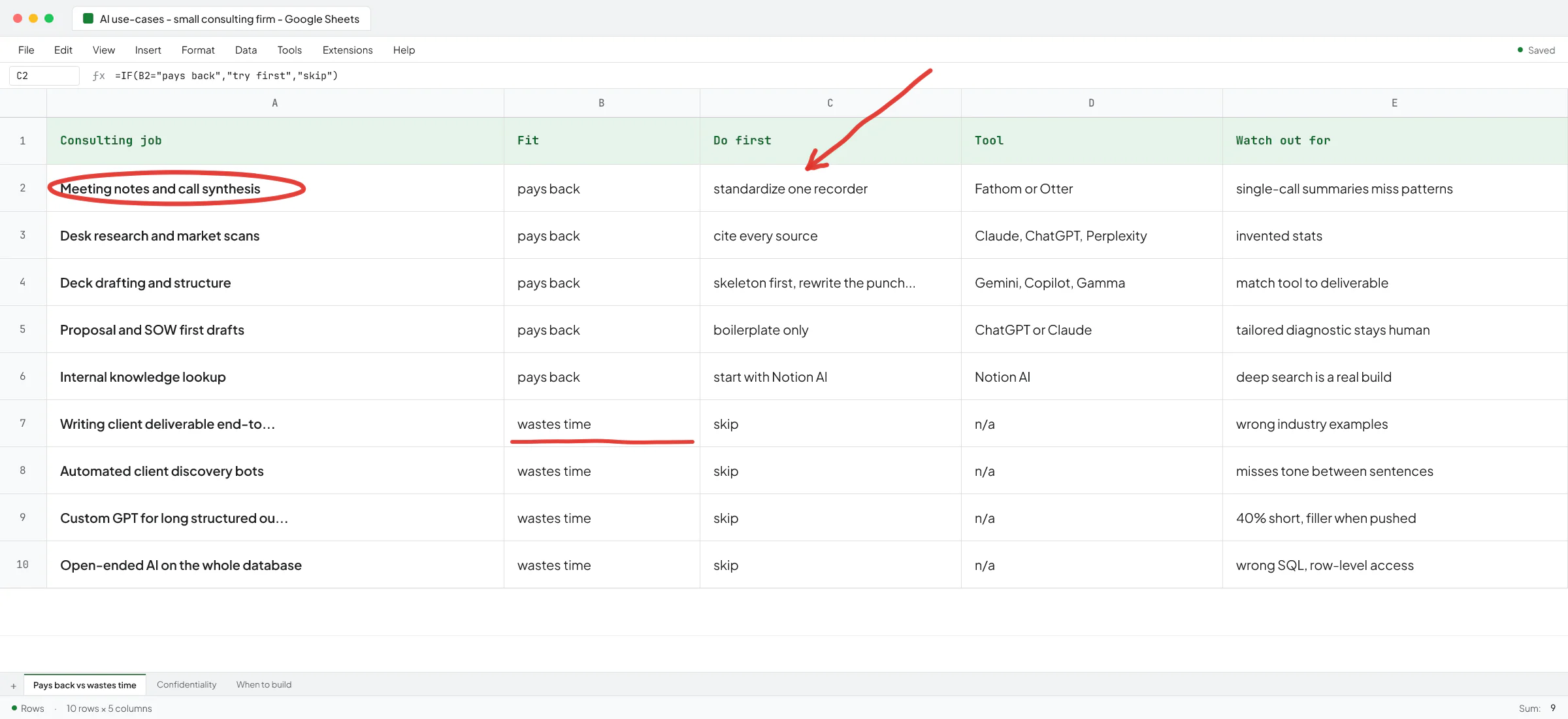
If your sales team records discovery calls with new commercial prospects, an AI analysis layer on top of Fathom or Otter gives you patterns across all calls that you can't see one call at a time. What objections come up most. Which reps close vs. talk. Which pest issue drives the highest deal size.
The gap between what Fathom and Otter give you natively and what a real analytics layer gives you is meaningful. I wrote a deeper piece on AI sales call analysis for small B2B firms if you want the specifics.
Where AI wastes your money
Three failure modes I see over and over:
- "Let's build an AI chatbot for our website." Cheap to spin up, adds nothing. Website visitors are early in the funnel and want a quote - a chatbot that can't quote is friction. If you want to add chat, put it inside your customer portal where the AI has account context.
- "Let's use AI to write our blog posts." Sure, but AI content that ranks in Google in 2026 needs editorial judgment and real experience. Generic AI slop about "5 signs of termites" won't move the needle. If content marketing matters, hire a human writer who uses AI as a tool.
- "Let's replace our CSRs with AI." Not yet, and not on the hard calls. Augment them. Give the AI the easy 60% (rescheduling, status checks, payment questions) so CSRs focus on the calls that need judgment.
Buy vs. build for a pest control company
Rough decision rule:
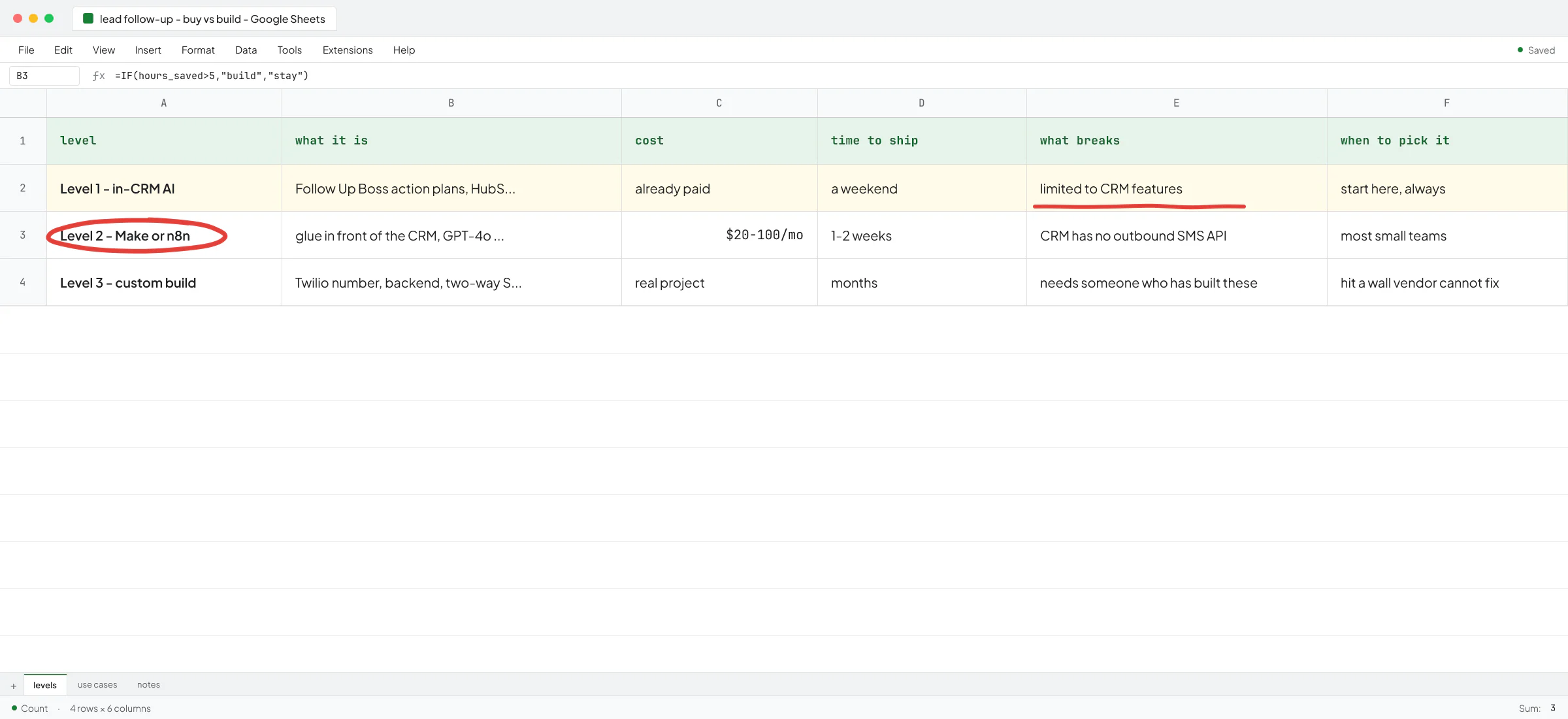
- Buy if: you need a standard capability (a notetaker, a CRM add-on, a route optimizer) that a vendor sells to hundreds of PCOs. You get the benefit of their scale.
- Build if: the value comes from your specific data and workflows. The HomeTeam-style cross-sell system isn't a product you buy - it's a system tuned to your CRM, your service catalog, your contact frequency rules, and your handoff to reps.
- Neither yet if: your customer data is bad. Fix the data first. AI on bad data is a faster way to make wrong decisions.
The build path scares people because AI vendor pitches make it sound like AI is one prompt away from working. It isn't. A production AI system in pest control needs eval harnesses, guardrails against the model going off-script, a real handoff flow, latency management, monitoring for when the model providers have an outage, and someone to fix things when they break.
Sellify's competitors, when they hit a complex workflow like "fill in the pest control agreement," dropped to human-in-the-loop. Sellify built the harder path - the AI does it end-to-end, with all the pain of managing enterprise-PCT-Top-100 expectations against undeterministic AI. That's what let the company charge high rates for a system that mostly runs on its own.
If you're evaluating a vendor and they can't tell you what happens when their model hallucinates on a service booking, you're looking at slideware.
The right first project
If you're a PCO owner reading this and you're not sure where to start, here's the order I'd go in:
- Audit your existing base. How many customers have you not upsold in the last 12 months? What add-on services are they eligible for that they don't have? This is a spreadsheet exercise, not an AI exercise. It tells you the size of the prize.
- Fix the data. Missing phone numbers, wrong service types, dead email addresses. Boring. Necessary.
- Pick one campaign. Not "cross-sell everything." One service, one segment, one geography. HomeTeam started somewhere, they didn't launch everywhere at once.
- Buy first, build second. If a vendor sells exactly this, try it. If they don't (or if they can't integrate with your CRM in a real way), that's when a custom build makes sense.
The clients I've seen get the biggest wins from AI in pest control aren't running the fanciest tech stack. They understood that the biggest untapped revenue was already in their CRM, and treated AI as a way to reach it at scale.
If you're a pest control operator looking at your existing customer base and wondering what an AI cross-sell system would look like for your PestPac, ServSuite, or FieldRoutes setup - book a call.
FAQ
Is AI actually being used by pest control companies today?
Yes. HomeTeam Pest Defense, one of the largest pest control operators in the US, uses Sellify AI's voice agents to run cross-sell campaigns against their existing customer base. Their public case study documents over $1M in new mosquito revenue in a single campaign month and 112%+ year-over-year mosquito sales growth in five months, with no new hires. There are others across the PCT Top 100.
Does AI work with PestPac and other legacy pest control CRMs?
It can, but it's hard, and it's the thing most AI vendors underestimate. The older pest control CRMs have limited or unofficial APIs. Building a real integration takes engineering work, not a Zapier hookup. If a vendor tells you they integrate with your CRM, make them demo it against a real tenant with a real service order.
Will customers know they're talking to AI?
If it's built right, most won't. HomeTeam's customers were calling branch offices to confirm "Anna" was a real team member. That naturalness matters - when the AI sounds obviously robotic, trust drops and conversion drops with it. You should still disclose when state law requires it, and make it easy to reach a human.
Should I hire an AI consultant or an AI engineer for this?
Depends on where you are. If you don't know what to build, an AI consultant helps you scope it. If you know what you want and need someone to build it, hire an engineer. For pest control specifically, the person you want has worked with the industry's CRMs before - PestPac, ServSuite, FieldRoutes. That experience is rare and it matters.
What's the smallest useful first step?
Audit your existing customer base for cross-sell eligibility. Do it in a spreadsheet, no AI. Count how many active customers don't have mosquito, termite, or rodent when they're eligible for it. That number is the size of your prize. Then decide whether a vendor tool, a custom build, or a manual campaign is the right first move.
How much does an AI cross-sell system cost?
Depends on scope, integrations, and whether you're buying a product or commissioning a build. That's a conversation, not a number I can put in an article - anchoring price before understanding the problem always ends badly. Book a call and I'll tell you what I'd charge for your specific situation.