If you sell real estate for a living, you already know AI is not optional anymore. Around two-thirds of agents now use AI in some part of their work, and most of them use it for listing copy and follow-up emails.
The question under that is where AI saves a working agent real hours, where it will burn your time or annoy your clients, and at what point a subscription stops being enough.
I'll go use case by use case. For each one I'll say what a chatbot subscription handles, what a workflow tool like Make or Zapier can do, and where a custom build starts to earn its keep. Along the way I'll flag the fair-housing tripwires and the CRM limits that catch small brokerages by surprise.
Where the hours actually go
Before picking tools, spend ten minutes writing down where your week goes. When I talk to owner-operators - a US realtor who also runs a property management arm and a small renovations business told me this on a call recently - the same buckets come up every time:
- Lead follow-up in the CRM (Follow Up Boss, kvCore, Lofty, HubSpot).
- Listing description drafts and rewrites for different portals.
- Answering tenant maintenance requests if you also manage rentals.
- Chasing receipts and expenses on renovation or turnover projects.
- Drafting purchase agreements, addenda, disclosures.
- Cross-selling and upselling your existing database.
Every one of those has an AI answer. For some, ChatGPT is enough. For others, you'll need a workflow tool. A couple only pay back if someone writes real code.
Listing descriptions and marketing copy
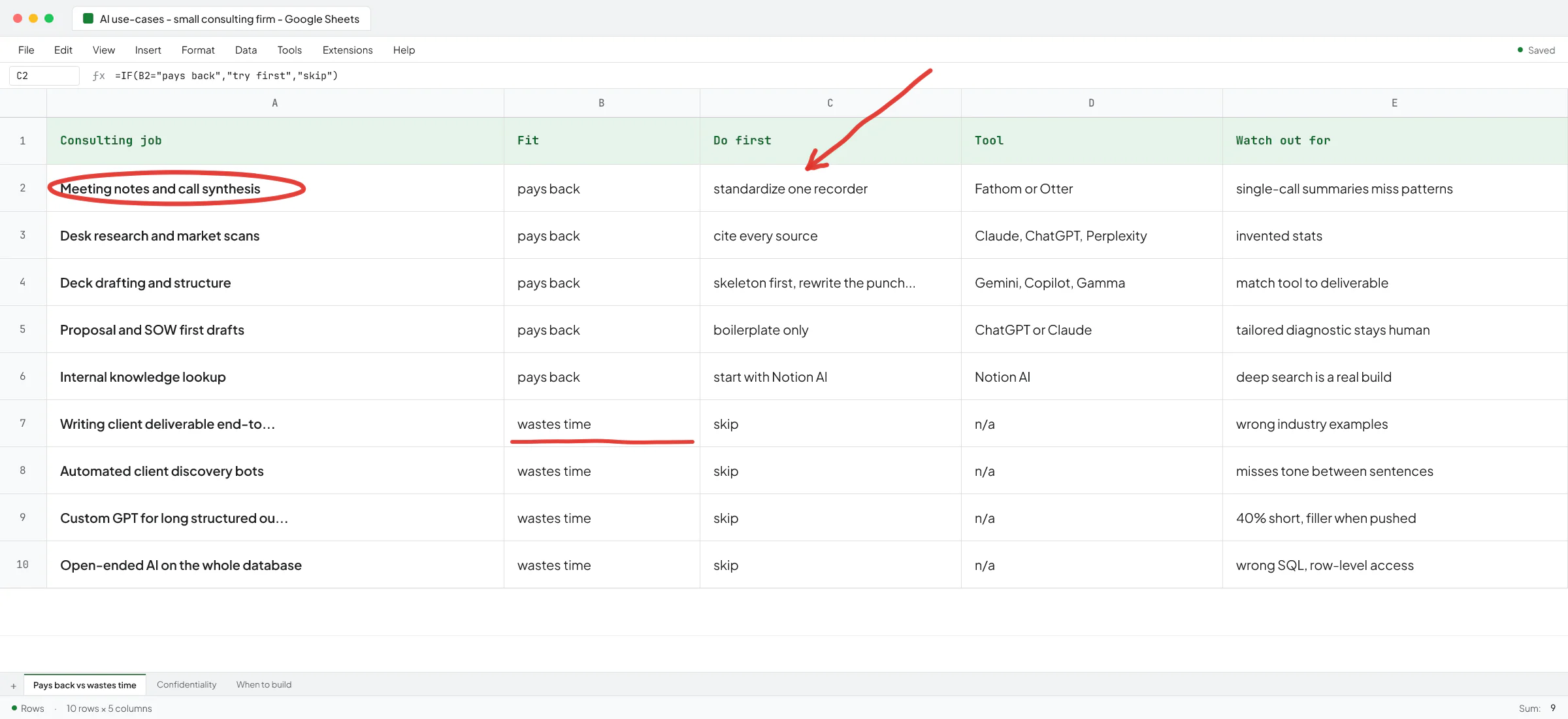
This is the easy one. ChatGPT Plus at $20 a month writes a decent MLS description if you feed it the facts - beds, baths, square footage, three or four distinctive features, target buyer.
Two practical notes:
- Don't paste in the seller's private notes, financials, or NDA-covered numbers on the free plan (it can use your inputs for training). On Plus and Business you can turn training off. I wrote a longer piece on what is safe to paste into ChatGPT if you want the plan-by-plan version.
- Fair-housing language is where AI gets you in trouble. Words like "family-friendly", "walking distance", "safe neighborhood", "great for young professionals" - the model will suggest them because the internet is full of them, and they can be discriminatory under the Fair Housing Act. Read the draft before you post it. This isn't paranoia: HUD published formal guidance in 2024 saying the FHA applies to housing decisions regardless of who or what made them - including AI-generated ads.
For most solo agents and small teams, this stays in ChatGPT or Claude. You don't need a "real estate AI writer" SaaS on top - those are usually a prompt wrapper with a $99/month price tag.
Lead follow-up: the CRM problem
Here's where it gets messy fast.
Every real estate CRM I've seen a client run - Follow Up Boss most often - can send email through automations. Very few of them let you send an SMS through an API. That US realtor I mentioned earlier said his CRM does text his leads, but he can't send outbound SMS through the API, and it drove him a little crazy.
If you check the Follow Up Boss API docs, the public REST API is real and useful, but it centers on people, deals, events, and notes - so the "AI SDR that texts my leads back in 30 seconds" dream runs straight into a wall when the CRM doesn't expose an outbound-text endpoint.
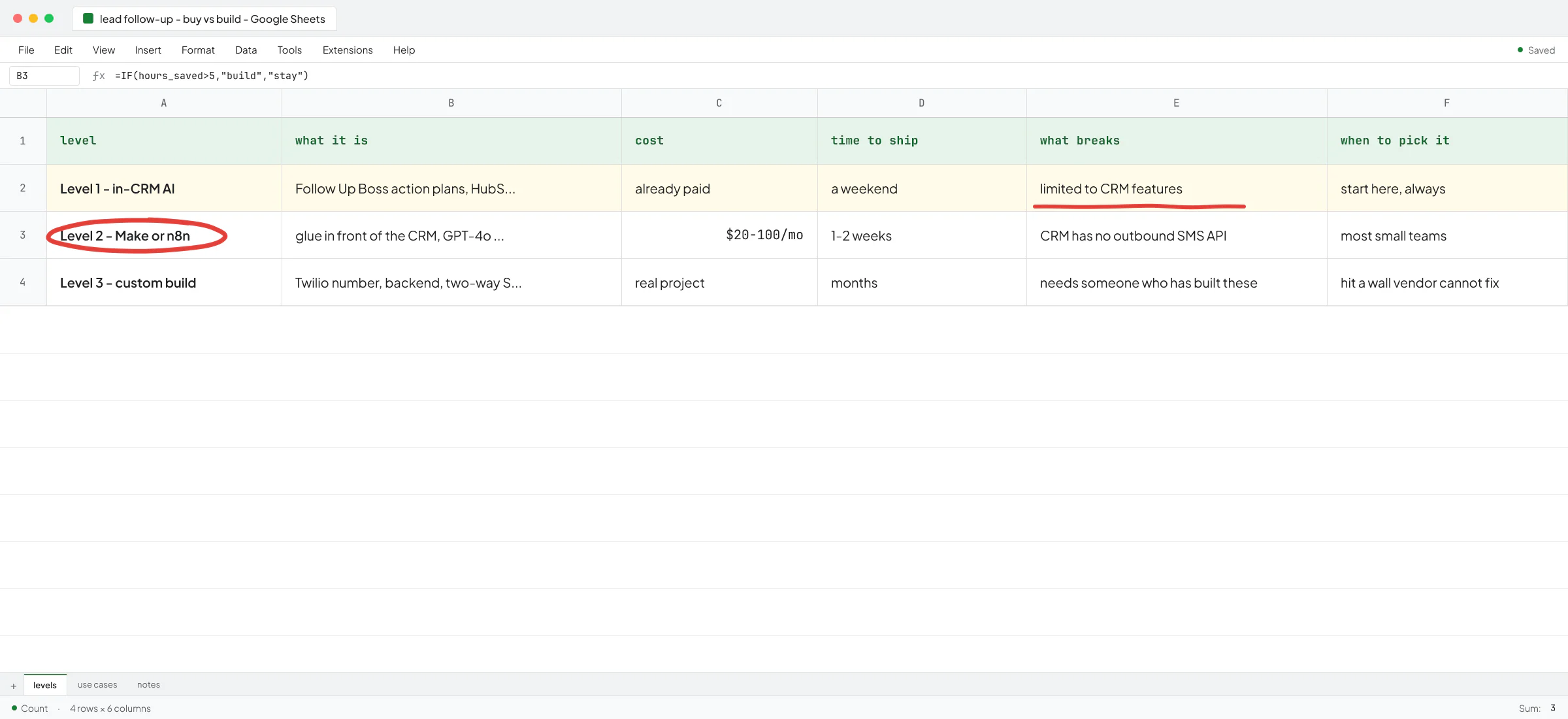
Three levels of what works:
Level 1 - stay inside the CRM. Use the built-in AI features you're already paying for. Follow Up Boss action plans, HubSpot's AI email drafts, kvCore's smart campaigns. This is toolsmaxxing - using the features of tools you already pay for before adding new ones. I wrote about the pattern in toolsmaxxing for small B2B firms. Boring, cheap, works.
Level 2 - Make or n8n in front of the CRM. When a new lead comes in from your IDX site, Zillow, or a Facebook lead form, a Make scenario can enrich it, draft a personalized first-touch email with GPT-4o, and drop it into your CRM as a queued send for you to approve with one click. This is where most small teams should live. I compared the two tools in n8n vs Make for small B2B firms.
Level 3 - custom. You want AI to text leads back, hold a two-way conversation, book showings on your calendar, and hand off warm ones to you. For that you need a Twilio number (not the CRM's number), a small backend, and someone who's built these before. That's a real project, not a Saturday afternoon.
The pest-control lesson for realtors
The biggest AI win I've watched up close wasn't in real estate - it was in pest control. But the pattern is exactly what most brokerages are sitting on and not using.
For two years I was an AI engineer at Sellify AI, building AI sales and customer-success systems for pest control companies. One of their clients, HomeTeam Pest Defense, had hundreds of thousands of existing customers and a sales team that stayed focused on new acquisition. The cross-sell to existing customers - selling mosquito treatment to people who already had a general pest contract - just wasn't happening at scale, because it would have meant hiring and training a whole new team.
They turned on an AI voice agent to work the existing database instead. In one campaign month they generated over a million dollars in new mosquito revenue and 112% year-over-year growth, with no new hires and their existing sales team untouched.
Now look at your brokerage database. Every past buyer is a future seller. Every past renter you helped is a future buyer, and every referral source has friends. That list is sitting in Follow Up Boss doing almost nothing right now. The technology to work it exists - pest-control folks just noticed first.
Tenant chatbots (if you also manage property)
If you sit on both sides of the fence - agent and property manager - the maintenance-request bucket eats hours.
The realtor I mentioned described the dream setup on a call: an AI chatbot on the tenant portal, gathering the details (where's the leak, which bathroom, can you send photos), auto-creating a project with the right template, and assigning it to a subcontractor. The pain is that tenants text and email him personally, and someone has to triage every single message.
Reality check, because this is the moment most agents get sold something they'll regret: you can't solve this with a raw ChatGPT-style chat widget. The chatbot needs to know your buildings and units, know which vendor covers which trade for which property, escalate correctly (water actively spreading is not "handle in three business days"), and log the ticket in your PMS (DoorLoop, Buildium, AppFolio) so nothing lives only in a chat log.
I have this exact conversation with clients a lot. A Norwegian founder I built an AI course-generation tool for had already burned two weeks with another freelancer who tried to solve his problem with a Custom GPT chatbot. It didn't work. He said on camera afterwards: "You were directly pointing to the issue that I experienced." (full interview) The pattern shows up in property management too. A ChatGPT chatbot answers questions; triaging a maintenance request into a PMS is a workflow with rules and integrations, and it's a different kind of problem.
For a small property-management op (a handful of buildings), you can get maybe 70% of the value from a Make scenario that reads the tenant's email, extracts the fields with GPT-4o, and creates the ticket. My deeper writeup on AI for property management companies walks through where each tool fits.
Receipts, expenses, and renovation project margin
If you do renovations or manage turnovers, you're probably chasing paper receipts across texts, emails, and glove-box crumples.
For this specific job, AI has gotten genuinely good. You can drop a folder of PDFs and photos into a Make scenario, run each one through GPT-4o or Claude with a structured extraction prompt (vendor, date, line items, total, category), and land the rows in a Google Sheet or QuickBooks. I wrote the how-to for this in AI invoice data extraction for small B2B firms.
Two rules that keep this from becoming a mess:
- Have the AI quote the exact line from the receipt it's pulling each number from. When something looks weird, you can check without opening the PDF.
- Always keep a "needs review" column for anything below a confidence threshold. Don't let a $4,000 subcontractor invoice get silently miscategorized as "office supplies" because the OCR was bad.
Contracts, addenda, and disclosures
ChatGPT drafts a first pass of a purchase agreement or addendum in seconds. The realtor I've been quoting told me he used to spend 30 minutes to an hour on these before AI, and now it's seconds.
Two disciplines to keep:
- Never rely on AI for the legal language itself. Your brokerage's approved forms and your state's mandatory disclosures are the source of truth. AI drafts the personalized clauses; the boilerplate stays boilerplate.
- Don't paste client PII (SSN, wire instructions, bank info) into a chat with training turned on. Business plans of ChatGPT and Claude for Work handle this differently, so check the plan before your assistant starts pasting.
Not legal advice - check with your broker and your real estate attorney on what your state and MLS allow.
When to stop shopping and build
Here's the decision I walk clients through. You're ready to build something custom (not buy another SaaS seat) when three things are all true:
- You've already tried the obvious tool and hit its wall. Not "I didn't like the UI" - hit a wall the vendor can't fix.
- The workflow runs at least a few times a day, or it blocks revenue when it doesn't run.
- The problem is specific to how you work, not how "real estate" works. If a hundred brokerages have the same problem, a SaaS is already being built for it.
If those aren't all true, you're better off staying in ChatGPT + Make + your CRM's built-in AI. A recruitment-AI startup I've been contracting with had their team wire up a database-backed LangChain agent for analytics before I got involved. Once I mapped the workflow, it turned out there were maybe five or six real analytics questions users ever asked. We swapped the "AI writes SQL" pattern for parameterized queries behind tool calls. Same user experience, way fewer late-night debugging sessions about why the AI wrote a broken join.
That trade-off comes up over and over. Custom builds are worth it when they replace real hours or unlock real revenue, and they're not worth it when they replace a $30/month tool that does the job.
What I'd tell a small brokerage owner today
- Pay for ChatGPT Plus or Claude Pro for every agent. That's the floor.
- Pick one workflow tool - Make if you're non-technical, n8n if you want to self-host. Wire up your lead intake first.
- Turn on whatever AI features your CRM already ships and use them for a month before adding anything.
- Read every AI-generated listing description and rental ad before it goes live. Fair housing is on you.
- When the same task eats more than five hours of your team's week every week, and off-the-shelf tools don't cover it, that's the moment to talk to someone about building.
If you're at step 5 and want a second opinion on whether the thing you're picturing should be a Make scenario, a SaaS you haven't found yet, or a real custom build, book a call. I'll tell you honestly which one it is, even if the answer isn't "hire me".
FAQ
What is the best AI for real estate agents in 2026?
For most solo agents and small teams, the best AI is the general chatbot you're already paying for - ChatGPT Plus or Claude Pro - plus whatever AI features your CRM ships. Real-estate-branded AI SaaS products are mostly prompt wrappers with a big markup. Spend the money on the base tools first, then add a workflow tool like Make when copy-paste starts to hurt.
Can I use ChatGPT to write MLS listings?
Yes, and it does a good job if you feed it real facts about the property. Two things to watch: check the draft for Fair Housing violations (words like "family-friendly", "safe", "walking distance to church") because AI happily suggests them, and don't paste confidential seller info on the free plan.
Will AI replace real estate agents?
No, and I say that as someone who builds AI systems for a living. AI is good at drafting, summarizing, and running repetitive workflows. The relationship, negotiation, and judgment work is not going anywhere soon. What will change is that agents who use AI well will do the work of two or three agents who don't. The threat isn't AI - it's the next agent over who adopted it first.
Is it safe to put client information into ChatGPT?
Depends on the plan. Free ChatGPT can use your inputs to train future models. ChatGPT Plus and Business let you turn training off, and Business + Enterprise ship with stronger data handling. Never paste SSNs, wire instructions, or bank details into any AI chat regardless of plan. I wrote a full plan-by-plan breakdown at is ChatGPT safe for confidential information.
How much does it cost to build a custom AI tool for a brokerage?
Cost depends on what "the tool" is - a Make workflow that drafts your first-touch emails is very different from a two-way SMS agent that books showings. That's a conversation, not a sticker price. Book a call if you want a straight answer for your specific case.
What is the Fair Housing risk with AI in real estate?
Two big ones. First, AI-written listing copy can slip in discriminatory phrasing that violates the FHA. Second, AI-based tenant screening tools can produce discriminatory outcomes through biased training data. HUD's 2024 guidance made it clear that the Fair Housing Act applies no matter who or what makes the decision. If you use AI, you're still on the hook.