Every missed call at a small firm is a lead going to a competitor. That's why most owners I talk to end up looking at an AI receptionist - a piece of software that picks up the phone, answers common questions, books appointments, and hands off to a person when it needs to.
The question is which one, and whether a $49-per-month plan will do the job in your specific setup.
This guide is for the small B2B or home-services owner who's already lost a few leads to voicemail and is now shopping around. I'll go through what an AI receptionist really does, where the off-the-shelf tools fit, where they break, and when it's time to stop shopping and build.
What an AI receptionist does
Strip the marketing away and the job is simple. An AI receptionist:
- Picks up inbound calls 24/7 so you stop losing leads to voicemail.
- Answers frequently asked questions using info from your website or a knowledge base you upload.
- Captures caller details (name, phone, reason for calling) and drops them into your CRM.
- Books appointments on a calendar you connect.
- Routes or transfers to a human when the call needs one.
A good tool does those things reliably. A bad one hallucinates hours, misspells names into your CRM, and books two appointments in the same slot. The gap between the two is where most of the buying pain lives.
The buying paths
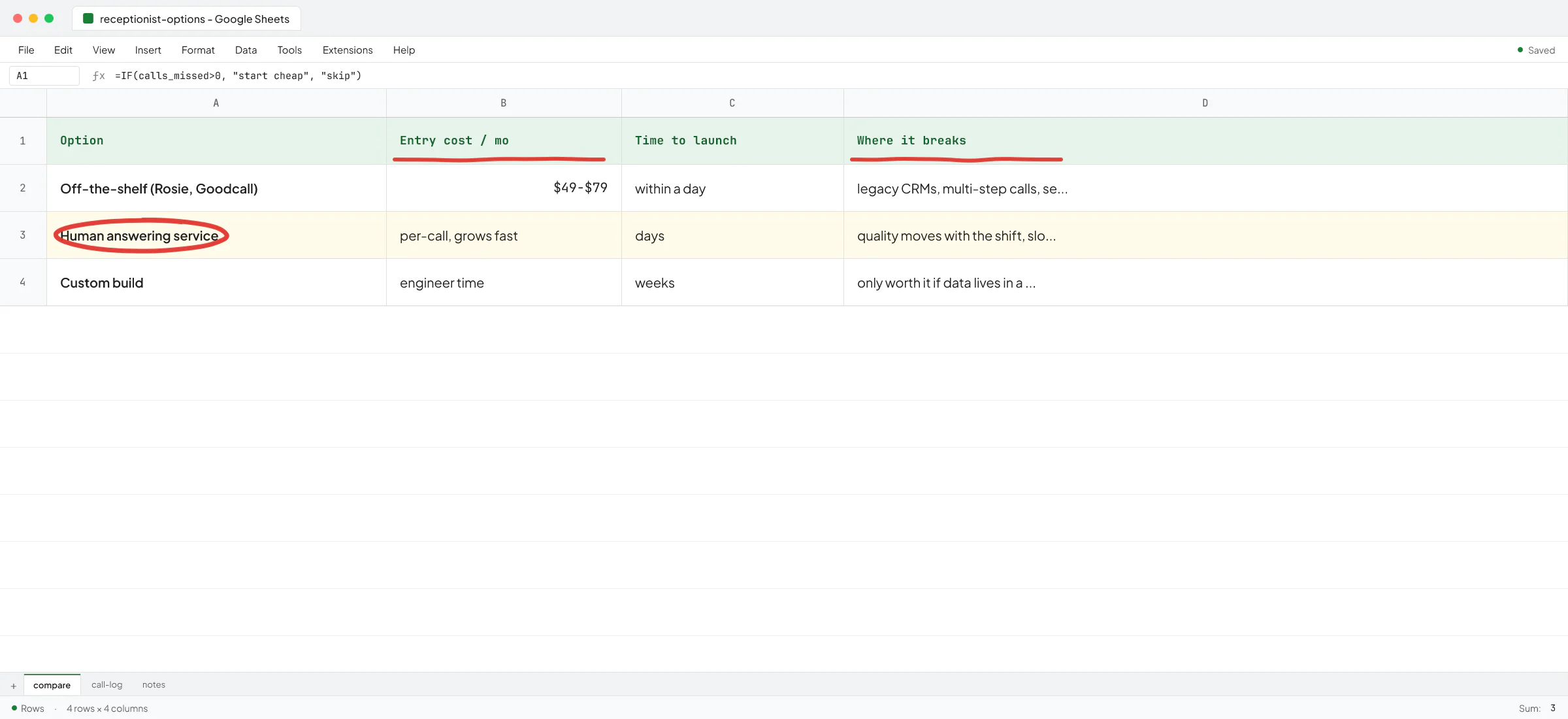
You have three realistic options: an off-the-shelf AI receptionist, a human answering service, or a custom build. Most owners should start with off-the-shelf and only move if they hit a specific wall.
Off-the-shelf AI receptionist
This is Rosie, Goodcall, and a growing pile of others. You pay a monthly subscription, point your business phone number at their platform, feed it your FAQ and calendar, and it goes live within a day.
Rosie's Professional plan is $49 per month, with Scale at $149 and Growth at $299. Goodcall's Starter is $79 per agent per month, with Growth at $129 and Scale at $249.
Cheap enough to test, fast enough to launch this week. Usually the right starting point for single-location firms doing under a few hundred inbound calls a month.
Human answering service
The old option. A real person picks up, takes a message, maybe books an appointment against your calendar. Warmer on the phone, more forgiving with weird callers, slower and pricier per call once volume grows, and the quality moves around with the shift.
Still the right answer if your callers are elderly, distressed (think medical, or legal intake around a family issue), or your industry has strict compliance where a mistake is a fine and not just an awkward callback.
Custom build
You hire an engineer to design a voice or chat agent tailored to your workflow - the one where the AI reads from your legacy CRM, checks the technician's route, quotes a price based on ZIP code, and drops a job card into your dispatch software.
The bar for going here is high, and I'll get to when it's the right call below.
Where off-the-shelf tools break
The tools do the simple job well. The failure modes are all at the edges, and they're consistent across vendors.
Legacy CRMs are the big one. Rosie and Goodcall integrate with the common systems (HubSpot, Zapier-connected CRMs, some field-service tools). If you run a 40-year-old vertical CRM - PestPac, ServSuite, an old real-estate MLS front-end, a hospital scheduling system - the off-the-shelf tool won't touch it, and you'll be back to manual copy-paste. I spent two years at Sellify AI, an AI startup for the pest control industry, building the CRM integration that let their AI book work into PestPac - and that integration alone was the thing that let a HomeTeam Pest Defense campaign generate over a million dollars of new mosquito revenue in a single month.
"Vlad has been incredible to work with. Very sharp and understands the intricacies and needs of our company. Have trusted him with important tasks, and he's always been able to get creative and deliver." - Thomas K. Lundberg, CEO of Sellify AI (Co-Owner of Fox Pest Control, which sold to Rollins for around $350 million) - full recommendation on LinkedIn.
Multi-step decisions are the next wall. If the caller says "I have ants in the kitchen and a wasp nest on the deck, and I need someone before Saturday because my in-laws are coming," an off-the-shelf agent will probably book the ant service and drop the rest. A trained human, or a custom-built agent, will handle both, check the technician's Saturday slots, and quote a bundled price. The default plans don't get that deep.
Voice quality matters when the caller is sensitive. The AI voice is fine for a plumbing call. It's less fine for a distressed family calling a small law firm to ask about a custody consult. Match the tool to the caller and not to the marketing demo.
Data going the wrong direction is the last one. Cheap plans push transcripts and lead info into the vendor's cloud. If you're a small law firm or accounting firm handling anything sensitive, read the vendor's data-processing terms before you sign. Some offer Business Associate Agreements or SOC 2 setups on higher tiers; most don't on the cheap plan.
Which one fits which firm
Some rough matching based on what I see in discovery calls:
- HVAC, plumbing, pest control, cleaning, small home-services - Rosie's Scale plan is a sensible default. Good with appointment booking, fine with FAQ. Confirm it can write to your dispatch tool before you buy.
- Property management firms - Off-the-shelf handles the "when is rent due" and "how do I submit a maintenance request" calls. Anything that needs to know the tenant's account status inside DoorLoop or AppFolio needs custom work. There's more on where AI fits versus breaks for property managers in the property management playbook.
- Real estate agents, small brokerages - Off-the-shelf works for basic lead intake if your CRM is Follow Up Boss or HubSpot. It won't do MLS lookups. See the real estate playbook for the deeper trade-offs.
- Small law firms - Start with a human answering service or an AI receptionist that offers an explicit BAA or confidentiality tier. Cheap plans are a bad fit here. Read is ChatGPT safe for confidential information for the same reasoning applied to text tools.
- Small accounting firms - Off-the-shelf for scheduling client meetings and answering "when is my return ready" calls. Anything account-specific stays with the human.
- Recruitment agencies - The receptionist is usually the wrong first spend. Most of the pain is in sourcing and screening, and not in phone intake.
When custom is the right call
There are three signals that tell you an off-the-shelf receptionist isn't going to cut it, and you should either hire someone to build one for you or accept living with the missed calls.
The first is that the receptionist has to make decisions using data that lives inside a system it can't reach. A pest control firm whose scheduling logic depends on route density in PestPac. A property manager whose "yes we can send someone today" answer depends on the tenant's payment status in DoorLoop. If the AI can't see the data, it can't answer well, and the caller ends up in voicemail anyway.
The second is that the workflow after the call is where the real money sits. On the Sellify AI account for HomeTeam Pest Defense, the AI wasn't just answering - it was running end-to-end cross-sell campaigns to existing customers and generating $1M+ of new mosquito revenue in a single month with 112% year-over-year growth. That doesn't come out of a receptionist plan. It comes out of a custom system that touches the CRM, the campaign engine, and the dispatch tool together.
The third is that you've already tried the cheap route and hit the ceiling. This is the most common one. A health company client of mine was using off-the-shelf AI to write Danish blog posts, got AI-slop output, and came to me. I built a custom tool that produced content scoring 0% on AI detectors while staying on topic. Same pattern applies to voice: the demo works, the daily use disappoints, and you eventually pay for the real build. Better to spot that turn early.
A recruitment-AI SaaS client I worked with had already spun up a naive LangChain agent that talked to their production database directly - which sort of worked, until it started generating wrong SQL when users asked slightly odd questions. We swapped it for a small set of hardcoded, parametrized queries wrapped in tool calls. Off-the-shelf receptionists sit close to the naive-LangChain end of that spectrum - a real build sits further along it.
Ove André Remme, founder of Terapivakten in Norway, had the same story from the other side. He hired a freelancer to build a ChatGPT-agent course generator, it didn't work, and he came back to me. Here he is on it:
"You were directly pointing to the issue that I experienced." - Ove André Remme, Founder of Terapivakten - full 6.5-minute interview on YouTube.
How to start without wasting money
Buy the cheap plan first. Rosie Scale or Goodcall Starter. Point one phone line at it for a month. Watch every transcript. Track two things: how many calls it handled cleanly, and where it fell over. That log tells you whether you're done or whether you have a custom problem.
If the fall-overs are all the same kind - the same CRM you can't reach, the same multi-step question, the same data lookup - you've found your build. If they're one-off weirdness, keep the subscription and move on.
Book a call and I'll go through your call log with you - my calendar is here. We'll figure out whether Rosie or Goodcall is enough, or whether the missed-call pattern points to a real integration problem worth building around.
FAQ
How much does an AI receptionist cost for a small business?
Entry plans start around $49/month (Rosie Professional) or $79/month (Goodcall Starter). Most small firms end up on the mid-tier plan - Rosie Scale at $149 or Goodcall Growth at $129 - once they need real appointment booking and call routing. Custom builds are a different conversation and depend on which systems you need it to touch.
Is an AI receptionist better than a human answering service?
For most home-services and small B2B firms doing routine calls, yes - it's cheaper, always on, and consistent. For law, medical, and cases where the caller is distressed or the compliance risk is real, a human service or a hybrid setup is safer.
Can an AI receptionist integrate with my CRM?
The common ones (HubSpot, Salesforce, Follow Up Boss, some field-service tools) are usually supported. Legacy vertical CRMs like PestPac, ServSuite, or older MLS systems typically are not - and that's the most common reason small firms end up needing a custom build instead of an off-the-shelf receptionist.
Will callers know they're talking to an AI?
Some will. In our Sellify AI work, HomeTeam callers sometimes rang branch offices to check whether "Anna" was a real person, then kept doing business anyway - because the conversation was useful. If your callers are the kind who'll hang up on any AI voice, either pick a hybrid setup or hire a human answering service.
Is my caller data safe with an AI receptionist?
Depends on the vendor and the plan. Cheap plans usually store transcripts in the vendor's cloud. If you handle sensitive data (legal, medical, financial), read the vendor's data-processing terms and pick a plan with a BAA or equivalent - or build something on infrastructure you control.