You sit down Monday morning, the new client said yes on Friday, and now you need a scope of work by end of day. You open ChatGPT, paste the call notes, and ask for a draft. Forty seconds later you have something that looks like a SOW. The question is whether what came out is the right SOW for the project.
That's the part an AI scope of work generator doesn't really solve. Writing the words is easy. Getting the scope right is where most of the work sits.
This page goes through the AI scope of work generators a small B2B firm is most likely to try (ChatGPT, Claude, dedicated tools like PandaDoc's AI, the "free AI SOW generator" pages that rank for the keyword) and where each one helps. There's also a point where the right move stops being "use a better tool" and starts being "get the scope right first, then let any tool format it for you".
What an AI scope of work generator does well
A SOW has two parts. The structure (objectives, deliverables, milestones, acceptance criteria, payment terms, change-request process, assumptions, exclusions) is a solved problem. Any modern LLM can fill that template in seconds if you give it the inputs.
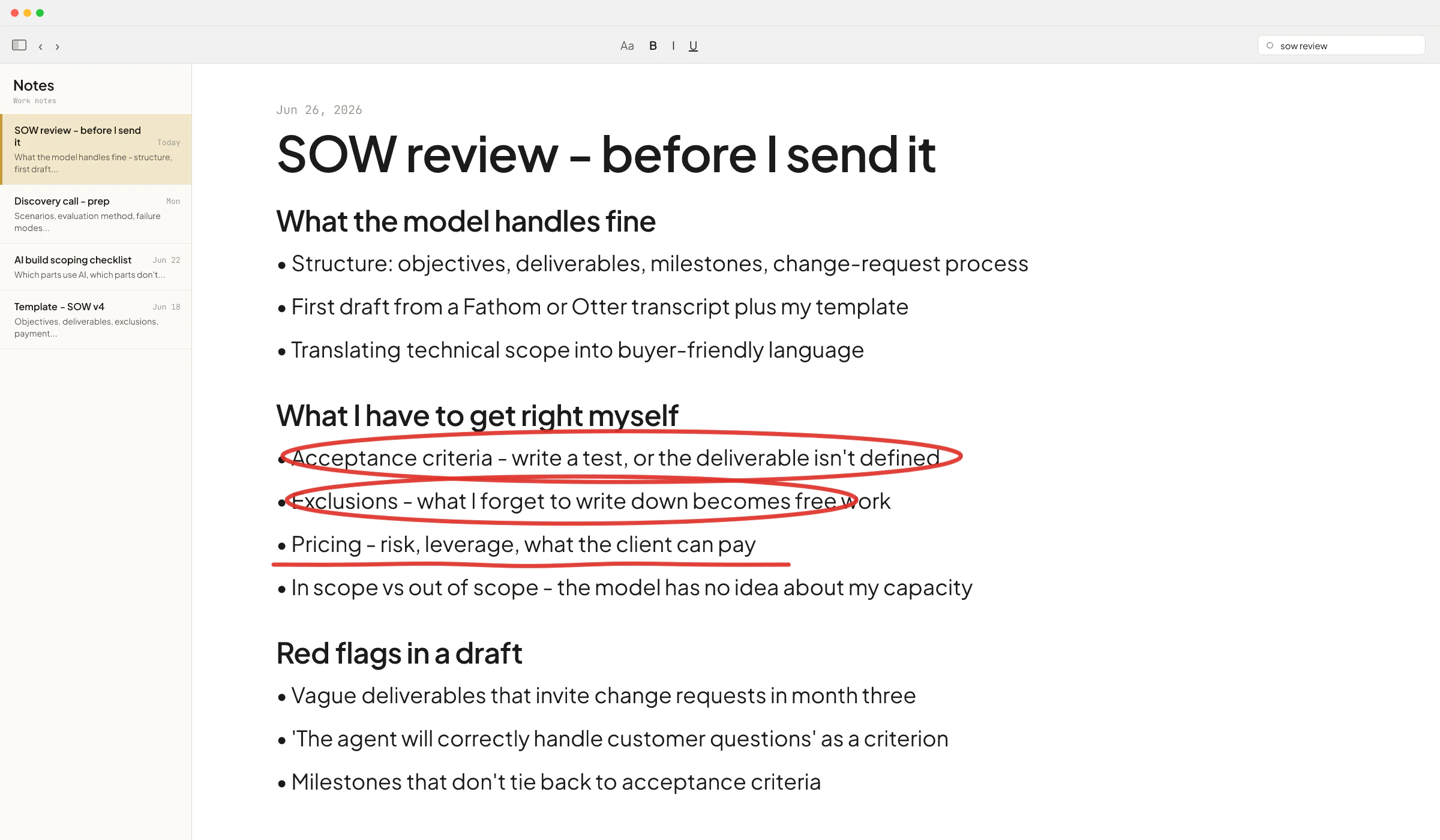
The inputs are where it gets tricky. Deliverables that are too vague will get you change requests. Milestones that don't tie to acceptance criteria will get you a client who feels the project drifted. Exclusions you forgot to write down become free work.
So when I see someone search "AI scope of work generator", I read it as one of two situations. Either they have the scope clear in their head and just want the formatting done, or they don't have it clear and they're hoping the tool will figure it out for them. Those are different problems with different answers.
ChatGPT and Claude: what you already pay for
If you already have a ChatGPT Plus or Claude Pro seat, you already have an AI scope of work generator. There's nothing a dedicated "AI SOW writer" SaaS does at the prose level that a $20/month chat model can't do at the same quality.
What works well:
- Paste the discovery-call transcript (Fathom and Otter both export them) plus your standard SOW template, ask for a first draft. Two minutes of editing and it ships.
- Ask the model to flag missing inputs. Something like "read this SOW, what's vague enough that a client could push back on it in three months?" - that single prompt catches more risk than most reviewers do.
- Translate technical scope into language a non-technical buyer will agree to without getting nervous.
What I wouldn't trust either model to do on its own:
- Decide what's in scope and what's out. The model will happily put everything the client asked for into deliverables, because it has no idea about your delivery capacity or margin.
- Write acceptance criteria for AI-heavy projects. "The agent will correctly handle customer questions" is the kind of acceptance criterion that destroys an engagement.
- Price the work. Pricing is a function of risk, leverage, and what the client can pay. A model that's never met the client can't do that for you.
If you already pay for one of these and your SOWs are bottlenecking on prose, you're done. Use it and move on. The Claude vs ChatGPT for small business comparison covers which seat to standardize on.
Dedicated AI SOW tools: PandaDoc, Proposify, Better Proposals
The proposal-software vendors all added AI buttons over the last couple of years. PandaDoc's AI will generate a SOW section inside the editor. Proposify has an AI assist for filling proposal blocks. Better Proposals will draft a section from a brief.
These earn their seat fee when:
- You send a lot of proposals (10+ a month) and need version control, e-signature, view tracking, and reusable content blocks.
- Multiple people on your team write SOWs and you want one template enforced across them.
- Your buyer expects a polished, on-brand document and not a Google Doc.
They don't earn it when you write a handful of SOWs a month and already have a template that works (the AI button inside the editor is the same family of model you can use for free in a chat window), or when the hard part of your SOWs is the technical scoping rather than the prose (a proposal tool doesn't know what's hard about your work).
For the small-firm price-sensitive buyer ("AI proposal generator free" ranks for a reason), a Google Doc template and ChatGPT does most of what these tools do. The rest is e-signature, tracking, and brand polish. If you need those things, pay. If you don't, don't.
I wrote a longer piece on the proposal side specifically: AI proposal generators for small B2B firms.
Free AI scope of work generators on the internet
Search the keyword and you'll find a dozen sites with a single text input and a "Generate SOW" button. Most are GPT wrappers monetizing the keyword with display ads or a signup wall.
There's nothing wrong with using them for a one-off, but a few things to keep in mind:
- You're pasting client information into a third party that may log it, train on it, or both. Read their privacy page before you paste anything covered by an NDA. The is ChatGPT safe for confidential information post covers the same issue for the major chat tools, and the rule is sharper for unknown wrappers.
- Output quality is bounded by the prompt the wrapper sends behind the scenes, which is usually generic. You can do better with the same model by writing your own prompt and pasting your template.
- The free tier is the marketing funnel. The paid upgrade is the product. If you wouldn't pay for the upgrade, the tool isn't built for you.
Where the AI scope of work generator stops being the answer
Here's the failure mode I see most. A non-technical buyer talks to a freelancer or agency, the freelancer says "yes I can build that with a custom GPT" or "yes I can do that with an n8n workflow", they write a SOW around that solution, ship it in two weeks, and it doesn't solve the actual business problem. The SOW was clean. The scoping was wrong.
I ran into this directly with Ove Andre Remme, founder of Terapivakten in Norway. He had hired another Upwork freelancer with 20+ five-star reviews to build a course-content generator. That freelancer scoped it as a custom GPT, spent two weeks, and shipped something that generated 40% less content than Ove needed and produced unnatural output when pushed harder. The scope of work was satisfied on paper. The problem wasn't. Ove came back and hired me. In his words from the video interview: "You were directly pointing to the issue that I experienced." What he needed wasn't a better SOW template. He needed someone in the scoping conversation who knew a custom GPT wouldn't produce 10,000-word Norwegian-language lessons reliably, and would say so before the contract was signed.
You can't generate that with an AI scope of work generator. The model doesn't know which approaches will fail in production. It will write whatever you put in front of it into clean SOW language.
A second pattern, from a current client of mine (a recruitment AI SaaS): their team had wired a LangChain SQL agent directly to their production database for analytics. The original scope said "natural-language analytics agent" - a perfectly reasonable SOW. When I got context on the project, I saw that the realistic surface was five or six analytics use cases that didn't need AI-generated SQL at all. They needed tool calls with parametrized SQL queries. Less AI was the right call here, and the right scope was a different scope (not a better-written version of the same one).
When you scope it right, any AI scope of work generator works
The pattern I keep landing on across pest control work at Sellify AI (Thomas K. Lundberg's recommendation, and the technical co-founder Ivan Nikolaichuk's recommendation on the same page), the recruitment AI client, and a handful of one-off builds: once the scope is right, the SOW writes itself in minutes with whatever tool you have open.
A working scope for an AI project usually has these things nailed down before you let any tool generate the document:
- The concrete scenarios the system must handle. Not "handle customer questions" but the actual scenarios with sample inputs and the expected outputs.
- Which parts use AI and which parts don't. Almost every reliable production AI system is mostly deterministic code, with AI in the narrow places it earns its keep.
- The evaluation method. How do you know the system is working? If you can't write a test for it, the deliverable isn't really defined.
- The failure modes. What does the system do when the model is slow, down, or wrong? The contract should say.
- The data boundary. What data goes into the model, what stays out, where it's stored, and who can see it.
If those things are in your SOW, the prose can be generated by any tool you like. If they're not, no SOW generator will save the project.
A working buy-vs-build decision
For small B2B firms writing SOWs for client work or internal projects, here's how I'd think about it:
- 1-5 SOWs a month, simple scope, already paying for ChatGPT or Claude: use the chat tool with your template. Don't pay for anything new.
- 5-20 SOWs a month, multi-person team, brand and tracking matter: PandaDoc, Proposify, or Better Proposals earn their seat. Use their AI features if you want, but don't expect them to beat the chat tools at prose.
- Any volume, where the scopes are technical and you've already shipped what was written but it didn't solve the problem: the generator isn't your bottleneck. The scoping conversation is. Bring in someone who has built and broken the kind of system you're scoping, and let them sit in the discovery call. The SOW after that conversation will be shorter and more right.
Ove paid one freelancer for two weeks of work that didn't solve his problem before he hired me. What you pay for a wrong scope isn't the SOW - it's the build that comes after it.
If you're staring at a draft SOW for an AI build right now and you're not sure if the scope is right, send it over before the contract goes out. A short conversation is cheaper than two weeks of building the wrong thing.
FAQ
Is there a free AI scope of work generator that's any good?
The free ones that rank for the keyword are mostly GPT wrappers. The same model is available to you in ChatGPT's free tier, or for $20 in Plus, with no signup wall and better privacy terms. If you already pay for ChatGPT or Claude, you already have the best free AI scope of work generator available to you.
Can ChatGPT write a statement of work from a discovery call?
Yes. Export the transcript from Fathom or Otter, paste it with your SOW template, and ask for a first draft. It will be most of the way there at the prose level. The part that needs your judgment is what's in scope, what's out, what the acceptance criteria are, and what the price is.
Should I pay for PandaDoc or Proposify just for the AI SOW feature?
Not for the AI feature alone. Pay for them if you also need e-signature, view tracking, version control, brand templates, and reusable content blocks. The AI button inside those tools uses the same family of models you can prompt yourself in a chat window.
What's the difference between a scope of work and a statement of work?
In most small-firm B2B work the two terms get used interchangeably. A SOW (either expansion) defines the deliverables, timeline, acceptance criteria, and pricing for a specific engagement. Some industries treat "statement of work" as the contractual document that contains a "scope of work" section. For most readers of this page, the distinction doesn't change the answer.
When should I hire someone instead of using an AI SOW generator?
When the cost of the wrong scope is bigger than the cost of the scoping conversation. For a small logo project, generate the SOW with ChatGPT and ship it. For an AI build that touches customer data, get someone in the scoping conversation who has shipped the kind of system you're scoping. The SOW is the cheap part of the project. The build that comes after it is the expensive part.