Your team is already using ChatGPT, you keep seeing posts saying Claude writes better, and someone on the leadership team has asked whether you should switch or pay for both. The marketing pages sound interchangeable, the price tags are close, and nobody is giving you a straight answer about which one a small B2B firm should pick.
For most small firms the chatbot you pick matters less than which paid plan you're on and how the team uses it. ChatGPT has the wider feature set (voice mode, image generation, deep research, GPTs, more connectors) and Claude has the better default for long writing and code. Both ship business plans that don't train on your data. If your team is split between the two camps, paying for one and letting people use the free tier of the other is usually the right move.
How the plans compare
Both companies have the same three-tier shape: a free consumer tier, a paid individual tier, and a business tier that bumps the data-handling guarantees.
ChatGPT's paid individual tier is Plus at $20/month with a higher-tier Pro plan for heavier users. ChatGPT Business (formerly Team) is $25 per user per month billed monthly, $20 billed annually. Enterprise is custom and sales-led.
Claude's paid individual tier is Pro at $20/month, with a Max plan above it. Claude Team is $20 per seat per month on standard seats (Premium seats are $100 for 5x more usage), and Enterprise is also sales-led.
So at the team tier both vendors land at roughly $20 per user per month for the entry plan. The decision is rarely about the headline price.
What ChatGPT does better
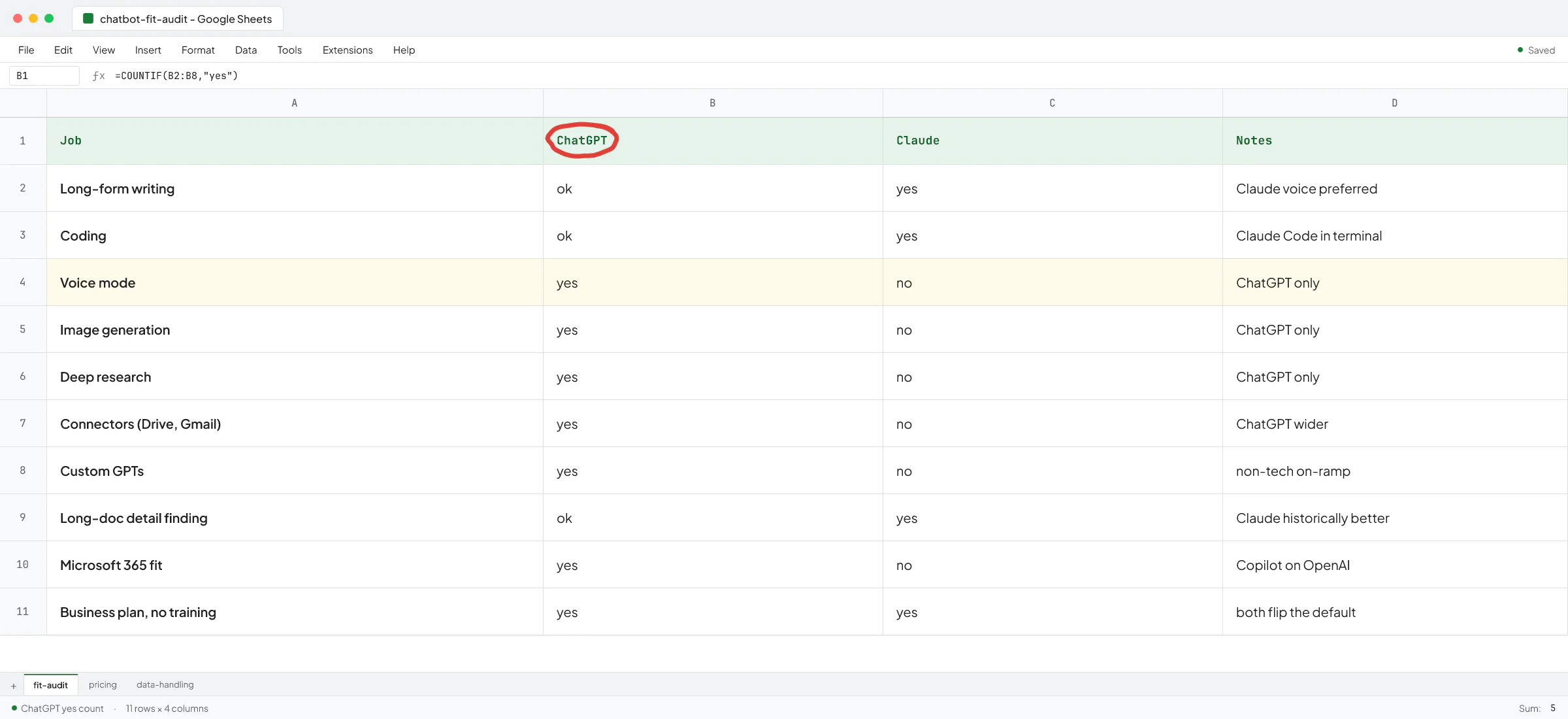
The feature surface is wider. ChatGPT ships voice mode, image generation, video generation, deep research, code interpreter, GPTs (custom assistants you build inside ChatGPT), and a Connectors feature for pulling in Google Drive, Outlook, Gmail, and a few others. For a small firm where one person needs to draft a proposal, another wants to generate a hero image for a deck, and a third is summarizing meeting transcripts, ChatGPT covers more of those jobs in one subscription.
The non-technical on-ramp is easier too. The Norwegian therapy founder I worked with - Ove André Remme, who runs Terapivakten - originally tried to solve his course-content problem by building a custom GPT inside ChatGPT, because that's what the freelancer he hired first recommended. The build didn't fit the problem (I'll get to why), but the reason ChatGPT was the starting point is fair: custom GPTs are the easiest way for a non-technical owner to package "the way we want AI to do this for our firm" without writing any code.
Reach inside other tools matters too. Microsoft 365 Copilot is built on the same OpenAI models, and most of the SaaS tools that have shipped an AI assistant in the last two years started with OpenAI under the hood. If your stack is Microsoft-heavy, ChatGPT is the more natural fit.
What Claude does better
Long-form writing. Claude's default writing voice is closer to "intelligent human" than ChatGPT's, which leans formal and hedged. For drafting client emails, proposals, research notes, and anything where the output gets read by another human, most of the writers I've worked with end up preferring Claude once they've tried both. This is taste, so I'd test both on your own copy before committing.
Coding and structured output. Claude is the better default if anyone on the team is writing code, generating long structured documents (markdown, JSON, contracts), or doing data analysis where the model needs to follow a strict format. Anthropic ships Claude Code, a coding agent that runs in the terminal, and most engineers I know who pay for one chatbot pay for Claude.
Following instructions. Both models drift, but Claude drifts less when you give it a long system prompt with rules. For internal use cases where you've written a playbook and want the AI to follow it, that matters.
Long-context document work. Both models have large context windows now, but Claude has historically been better at finding a specific detail in a 200-page document without losing track. For contract review, legal research, and long PDF analysis, that pays off.
Data handling - the part that matters most
This is where the free tier ends and the business tier earns its money.
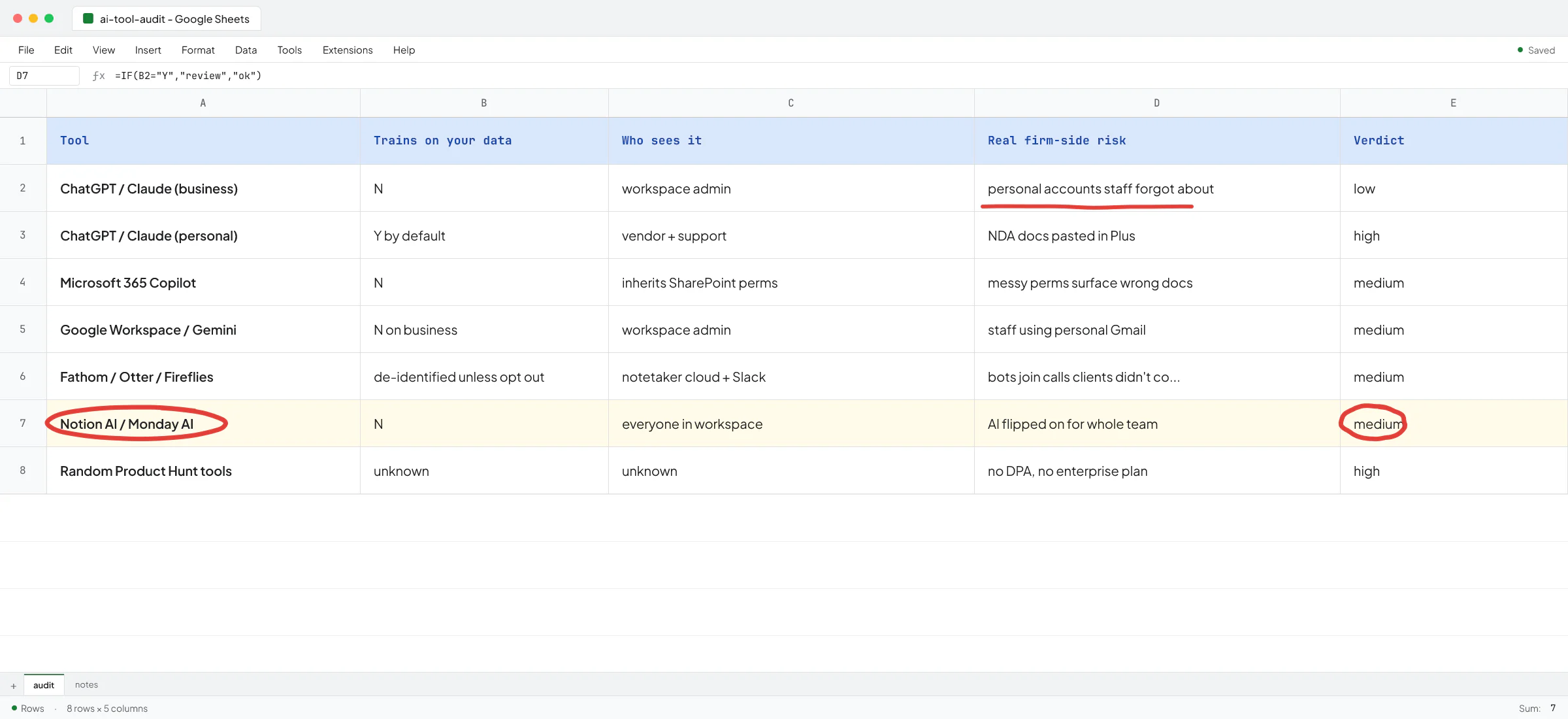
On the consumer plans (free and Plus/Pro for both vendors), your chats can be used to train the model unless you turn it off in settings, and the lines on what that means in practice are blurry. For a B2B firm handling client data under an NDA, that's the wrong default.
On the business and enterprise plans the defaults flip. OpenAI states that data from ChatGPT Business, Enterprise, and the API is not used to train models by default. Anthropic's Commercial Terms say the same: "Anthropic may not train models on Customer Content from Services." Both vendors offer SSO, admin controls, and audit logs on the business tiers. Both have a HIPAA-ready offering on the higher plans.
Practically: if your team is pasting client info into a chatbot, you should be on a business plan of one of these two and not on Plus or Pro. I wrote a longer piece on whether ChatGPT is safe for confidential information that goes through the failure modes, and the same logic applies to Claude.
A working example where neither chatbot was the answer
Ove came to me after another freelancer spent two weeks building him a custom GPT inside ChatGPT for generating long Norwegian course lessons. The custom GPT generated about 40% less content than he needed, and when he asked it to write more, the output got unnatural and unusable. That freelancer had 20+ five-star reviews on Upwork. The tool was wrong for the job.
A custom GPT is basically a chat interface with a system prompt and a few uploaded files. For a workflow where a non-technical client needs to produce 10,000-word structured course modules in Norwegian, with consistent format and presentation export through Gamma, you need a real application: a UI shaped around the task, a pipeline that breaks generation into stages, and integrations the chatbot can't do on its own. We built that, and Ove recorded a short video about working with me. His line from that interview:
"You were directly pointing to the issue that I experienced."
The takeaway is not that ChatGPT is bad. It's that "buy a chatbot subscription" and "build an AI workflow" are two different decisions, and a lot of small firms confuse them. If your problem is that your team needs a better thinking and writing tool, a chatbot subscription solves it. If your problem is that you have a repeatable workflow you want AI to run end-to-end, a chatbot subscription won't get you there.
When both chatbots stop being enough
The line where a chatbot runs out is more useful than the line between the two vendors. A few signals you've crossed it:
- The same prompt gets pasted into ChatGPT or Claude five times a day by five different people. That's a tool waiting to be built.
- You need the AI to read from a system (Salesforce, your CRM, a database) and write back into it. Chatbots can't do that on their own, and connectors get you part of the way before breaking on edge cases.
- You need to run AI over hundreds of inputs at a time (every new lead, every PDF that arrives, every job posting). At a recruitment AI client I rebuilt their pipeline to swap reasoning models for non-reasoning small ones when their scale grew - quality dropped slightly, latency and cost dropped a lot, and the system became usable. None of that lives in a chatbot.
- Customers or tenants need to interact with the AI directly. At Sellify AI we built an end-to-end AI sales system for the US pest control industry that talks to homeowners as "Anna" - so naturally that customers were calling branch offices to confirm she was a real team member. That system helped HomeTeam Pest Defense generate over $1M in new mosquito revenue in a single campaign month. Thomas K. Lundberg, the CEO of Sellify AI and former co-owner of Fox Pest (which Rollins acquired for around $350M), wrote on LinkedIn: "Vlad has been incredible to work with. Very sharp and understands the intricacies and needs of our company." That work is custom code and not something you get from a Claude or ChatGPT subscription.
Once you're at any of those signals, keep the chatbot subscriptions for individual use and look at workflow tools like n8n or Make for the simpler stuff, or a real engineer for the harder pieces.
A decision rule
Use this in order. Stop at the first one that fits.
- If your team is pasting client info into chatbots on personal accounts, your first move is to pay for the business tier of one of them (either one) and turn off training on the rest. The leak risk is bigger than the feature gap.
- If your team's main job is writing, coding, or working with long documents, default to Claude Team.
- If your team needs voice, image generation, deep research, or sits inside the Microsoft 365 stack, default to ChatGPT Business.
- If you can't pick and the team is split, pay for one team plan and let people who prefer the other vendor use that vendor's free tier with training turned off. The cost of being wrong is small.
- If what you need is a workflow that runs without a human typing the prompt every time, neither subscription is the answer. Look at the toolsmaxxing options in your existing stack first, then at custom work.
Most small B2B firms I talk to are at step 1 and haven't done it yet. A few are stuck between steps 2 and 3 and keep tool-shopping instead of shipping. A small but growing group is at step 5 and is paying for two chatbots when they should be paying for one chatbot plus an engineer.
What it looks like in practice
The pattern I see most often: a founder pays for ChatGPT Plus on the personal account, the team starts using it, results are good for a quarter, then growth stalls because nobody has rebuilt the actual workflows around the tool. Switching to Claude won't fix that. Adding Claude on top won't fix it either. What does fix it is picking one chatbot for the team, paying for the business plan, and then sitting down for an afternoon to write down which three or four repeated tasks should move out of the chatbot and into something that runs on its own.
If you're stuck between Claude and ChatGPT, or you suspect you're past the point where either subscription is enough, book a call with Vlad and we'll walk through your current setup and the next two problems on your list.
FAQ
Is Claude better than ChatGPT for small business?
Neither is better in general. Claude is stronger for long-form writing, coding, and structured document work. ChatGPT is stronger for voice, image generation, deep research, and integration with Microsoft 365 and the wider SaaS world. For most small B2B firms the right move is to pick one based on what your team does most, pay for the business plan, and let people use the other one's free tier.
Should I pay for both Claude and ChatGPT?
Usually no. Pay for the business plan of one and let curious team members use the other on the free tier with training turned off. Paying for two team plans is worth it only if you have two distinct user groups (say, writers who live in Claude and analysts who live in ChatGPT) and the duplicate cost is small compared to the time saved.
Is Claude safer than ChatGPT for confidential data?
On the business and enterprise tiers, both vendors say they don't train on your data by default and both offer SSO, admin controls, and audit logs. The safety difference between them is small at that tier. The real safety jump is going from a personal Plus or Pro plan to a business plan, regardless of which vendor.
Can Claude or ChatGPT replace a custom AI build?
For repeated chat-style tasks that one person does at their desk, yes. For workflows that read from your CRM, run on hundreds of inputs at a time, or interact with your customers directly, no. A chatbot subscription is a thinking and writing tool, while a custom build is a system that runs without you.
Claude vs ChatGPT for coding - which one?
Claude. Most engineers who pay for one chatbot pay for Claude, and Anthropic ships Claude Code, a coding agent that runs in the terminal. ChatGPT can write code too, but for any non-trivial coding work Claude is the stronger default.
How much does Claude Team cost compared to ChatGPT Business?
Both land around $20 per user per month on their entry team tier. Claude Team standard seats are $20/seat on annual billing, and ChatGPT Business is $20/user on annual billing or $25 monthly. The pricing is close enough that it shouldn't drive the decision - what your team does with the tool should.