If you have a 1-5 person sales team and you keep hearing that AI is going to change sales, this is the working version of that answer for a small B2B firm.
Most of what gets called "AI for sales teams" online is one of two things. A ChatGPT subscription that drafts emails a bit faster. Or an enterprise platform sized for a 50-rep team that needs a six-month rollout. Neither is what a small sales team needs.
The useful question is narrower: which sales jobs can AI do for a small B2B firm right now, where does it pay back in weeks instead of months, and where does it quietly waste budget?
At Sellify AI - the startup I worked at for two years as an AI engineer - we built AI sales systems for US pest control companies, including HomeTeam Pest Defense. HomeTeam generated over a million dollars in a single mosquito-service campaign month, confirmed publicly by Mike Johnson, VP of Operations, in Sellify's case study. The CEO of Sellify, Thomas K. Lundberg - co-owner of Fox Pest before its $350M sale to Rollins in 2023 - wrote a LinkedIn recommendation saying I'd been trusted with important tasks and gotten creative to deliver. So the playbook below is grounded in what shipped, not in what an AI vendor's landing page promises.
The sales jobs AI does well for a small team
These are the sales jobs where I've seen AI pay back fast for a small B2B firm. The list is short on purpose - most of the rest is marketing noise.
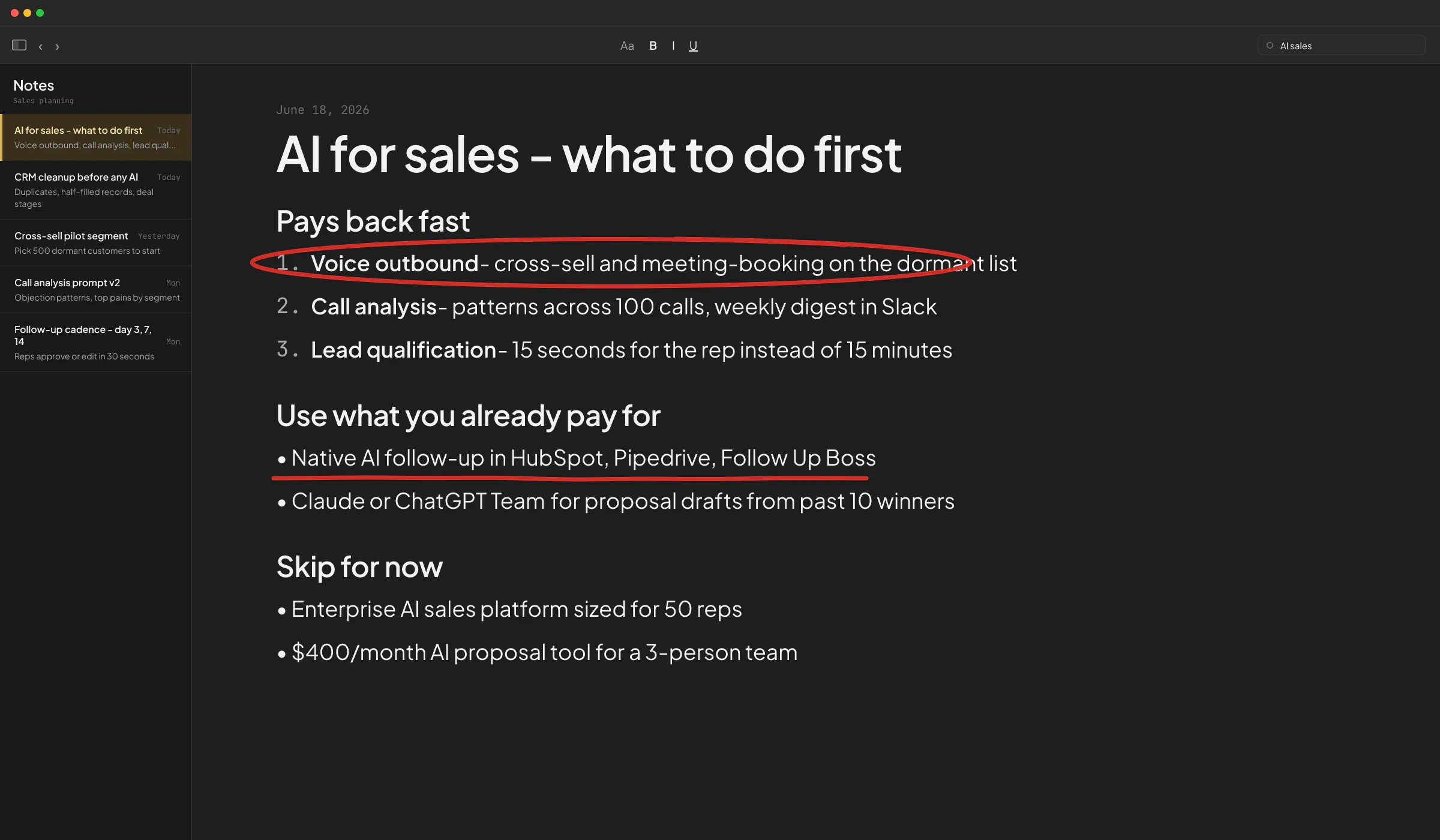
Outbound calls and meeting-booking at scale
This is the biggest payoff and the hardest to believe until you see it. An AI voice agent calls your existing customer list (cross-sell), past leads (revival), or net-new prospects, has a real conversation, qualifies them, and books a meeting or transfers the call to a rep.
At HomeTeam, the sales reps were focused on new customer acquisition, so the existing customer base wasn't getting cross-sell outreach. Sellify's AI ran the cross-sell campaign. In the first five months, mosquito service sales were up 112% year over year. In Phoenix - a market the local team had written off because "we don't have mosquitoes here" - the AI sold mosquito services. As Mike Johnson put it in the case study: "It opened up the eyes of the local teams to what's possible."
The detail that matters for a small firm: most HomeTeam customers thought they were talking to a real person named Anna. People called branch offices to confirm Anna worked there. That naturalness is what drives conversion. A cheap robocaller will not do this.
When this fits: you have a list (existing customers, old leads, segmented cold) that nobody is calling because there isn't time, you have a real offer, and you can take inbound transfers or follow up on booked meetings.
When this doesn't fit: complex enterprise deals with 5+ stakeholders, products that require a 60-minute discovery, or anything where the first call has to come from a senior person.
Sales call analysis across all your calls
Most teams already record calls in Fathom, Otter, Gong, or Zoom. That gives you per-call summaries. What it doesn't give you is the pattern across 100 calls.
A founder of a US fitness coaching brand told me on a call that he could see individual call summaries but had no way to see overviews of all the calls. He wanted to know who his customers were, what objections kept showing up, which limiting beliefs his coaches needed to handle better. None of that lives in a per-call summary.
A small AI pipeline on top of your call recordings does this well. Feed transcripts into Claude or GPT with a prompt that pulls out objection patterns, top pains by segment, and the language prospects use to describe the problem. The output goes into Slack as a weekly digest.
For a deeper look at this specific job, I wrote it up here: AI sales call analysis for small B2B firms.
Lead qualification and CRM enrichment
The expensive version is a sales rep spending an hour qualifying a lead that turns out not to be a fit. The cheap version is AI reading the inbound form, checking the company site, looking at the prospect's LinkedIn, and writing a one-paragraph qualification note into your CRM before the rep ever opens the record.
I built the recruitment version of this for an AI SaaS client - an end-to-end agent that monitored job portals, filtered new postings against each recruiter's criteria, pulled candidates from Apollo, and pushed a WhatsApp notification with the shortlist. Same kind of job: filter at the top of the funnel so humans only see what's worth their time.
The prospecting version of this exists too. For a SaaS founder serving hotel renovation contractors I built an AI agent that finds leads by reading every Google review - it locates two-star motels in a radius, reads the reviews for signs of worn-out furniture, and scores each lead while quoting the reviews behind its score. His previous plan was hiring people to read and categorize the reviews by hand.
For a small B2B firm this looks like: inbound form fires, n8n or Make routes it to an AI step, AI scores it against your ICP and drops the rep a Slack note with three sentences and the CRM link. Fifteen seconds for the rep instead of fifteen minutes.
Follow-up that gets sent
A construction project manager from one of my discovery calls said the quiet part out loud - it would be nice to have reminders of whether the offer was accepted. Follow-ups die in busy sales teams. The deal goes cold because no one had time to check in on day 3, day 7, day 14.
AI handles this well because the work is repetitive and the judgment is small. AI watches your CRM for proposals sent, drafts the day-3 nudge in the rep's voice, the day-7 nudge with a different angle, the day-14 last-chance email. The rep approves or edits in 30 seconds, and reply rates go up because the timing is consistent instead of random.
This is one of the highest-leverage AI-in-existing-tools moves before you ever build anything custom - what I call toolsmaxxing. HubSpot, Pipedrive, and Follow Up Boss all ship with native AI follow-up features now. Use them first.
Proposal and contract drafting
Last because it's the one everyone reaches for first, and it's the smallest payoff for the time invested.
A property management owner told me he uses ChatGPT to draft contract addendums - what used to take him 30-60 minutes now takes seconds. Real time saved, but bounded. He's saving an hour a week, not transforming sales output.
For a small B2B firm, the AI proposal step lives inside ChatGPT Team or Claude. You feed your past 10 winning proposals as context, give it the new prospect's details, get a 70% draft. The rep finishes it in 15 minutes. Anyone selling you an "AI proposal platform" for $400/month for a 3-person team is overselling.
Where AI for sales teams goes wrong in small firms
Three failure modes I've watched play out:
- Buying a platform sized for a 50-rep team. The enterprise AI sales tools assume you have an ops person to configure them. A small firm doesn't. The tool sits unused for three months and gets canceled.
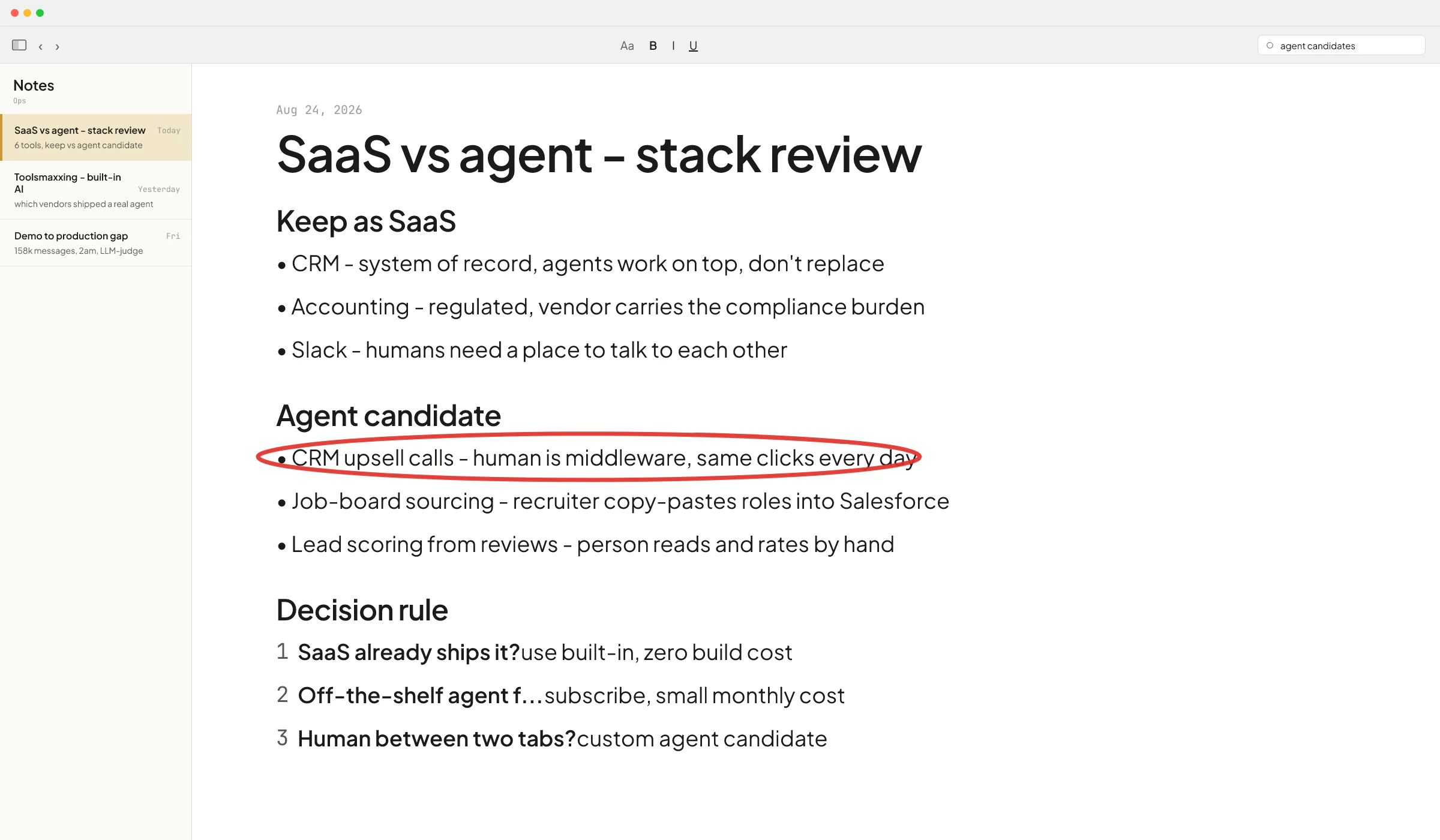
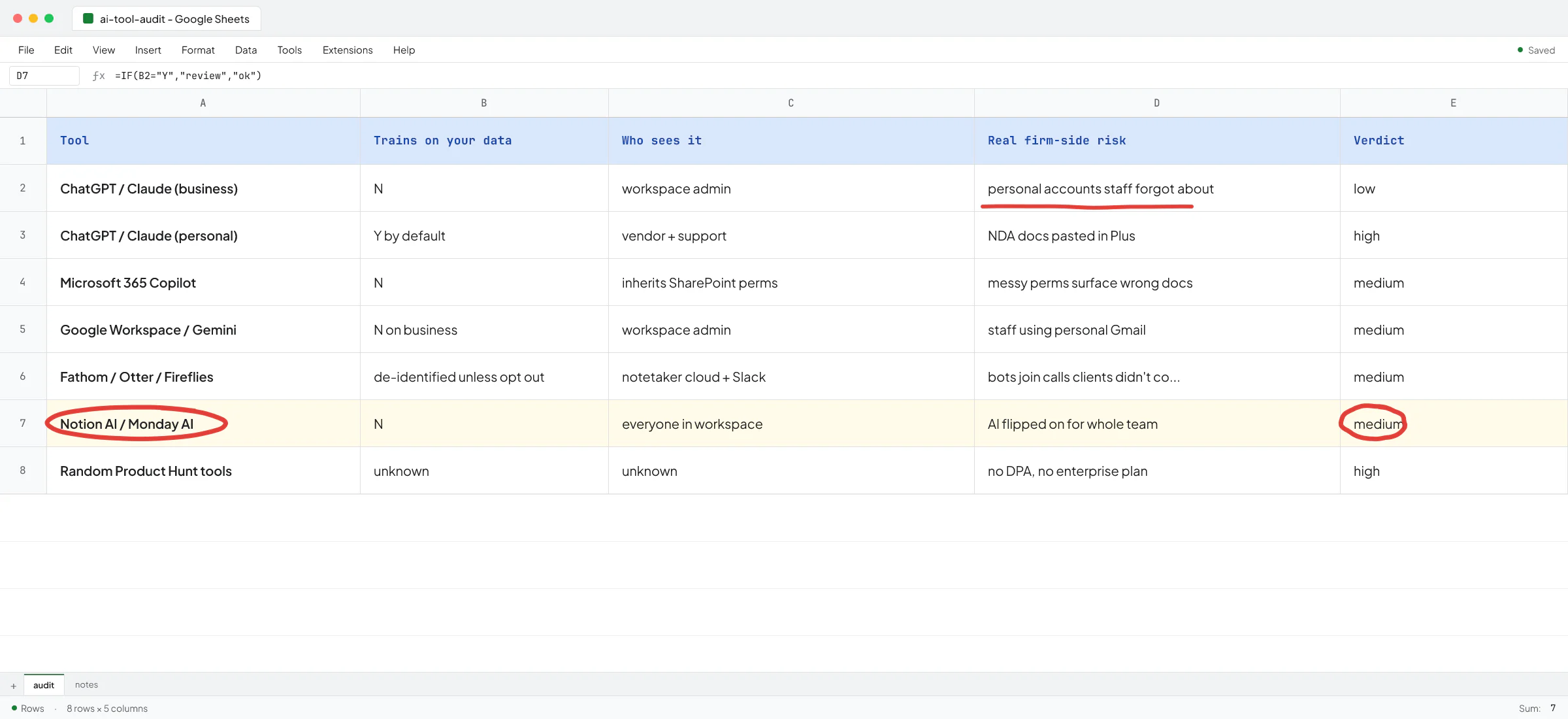
- "AI all the time, but it's not connected." A Norwegian real-estate development CEO described it on a call - his team uses Copilot, ChatGPT, and Notion AI separately, but the systems aren't talking to each other. So they ask AI to do something, copy the answer, paste it into the next tool, and the time saved gets canceled by the copy-paste. The fix is workflow design, and I wrote about that pattern here: AI workflow automation for small B2B firms.
- Skipping the data problem. AI sales tools work on your data. If your CRM has half-filled records, duplicate contacts, and a deal stage everyone defines differently, the AI gets garbage in. The data problem is boring so nobody wants to deal with it, so people jump on building AI agents on top of bad data and hit a wall. Clean the CRM first, even crudely. It pays back more than any AI subscription.
Start with tools, build custom only when you hit a wall
For most small B2B firms, the sequence is:
- Turn on the AI features inside the CRM and call-recorder you already pay for. Native AI in HubSpot, Pipedrive, or Follow Up Boss covers follow-up drafts and call summaries.
- Add ChatGPT Team or Claude Business for the team. That handles proposal drafts, prospect research, and ad-hoc analysis. For the trade-offs between the two, see Claude vs ChatGPT for small business.
- Use Make or n8n to wire the inbound form → AI qualifier → CRM enrichment → Slack notification chain. Roughly a one-week build.
- Only after that, look at a custom AI outbound or call-analysis pipeline.
Custom comes in when off-the-shelf hits a wall. For Sellify's pest control clients, the wall was integrating with a 40-year-old pest control CRM that no platform talked to. I built that integration. It took months, and it also created a moat - other AI sales platforms couldn't onboard those clients.
If your sales process touches a niche CRM, a legacy spreadsheet workflow, or a domain (specialty trades, regulated industries, non-English-language pipelines) that nothing off-the-shelf supports, that's the build-custom signal.
For Terapivakten in Norway, the founder Ove André Remme first tried a freelancer who delivered a ChatGPT custom GPT for Norwegian long-form course generation. It generated 40% less content than needed and slipped into unnatural Norwegian when asked for more. I rebuilt it as a proper pipeline. Ove described the experience in a video testimonial - the issue was that the job was too complex for a chat interface, and the chat interface kept being the wrong answer. Same lesson applies to sales: when your sales job is bigger than what a chatbot does well, you need someone who can tell you that before you spend the money, not after.
A working decision rule
Use this to pick what to do this quarter:
- Sales team is 1-2 people, generic B2B, modern CRM: turn on native CRM AI, add Claude or ChatGPT for the team, stop there.
- Sales team is 3-5 people with a list of dormant customers or old leads bigger than the team can call: AI voice outbound is your highest-payoff move. Pilot with a small segment first.
- You record calls but can't see patterns across them: build the call-analysis pipeline. Roughly one week of work.
- Your CRM or process is legacy or niche enough that no SaaS fits: this is where custom AI engineering earns its keep. Bring in someone who's shipped it before.
Most small B2B sales teams don't need a custom build. The ones that do, need one badly enough that DIY drags on for a year. Knowing which side you're on is the question worth answering first.
If you want a second pair of eyes on which AI move pays back fastest for your sales team - or you want to skip the tool-shopping and go straight to a working pipeline - book a call. Bring your CRM, your sales process, and the things you wish your team didn't have to do anymore.
FAQ
What does AI for sales teams do today?
The jobs that pay back for a small B2B team are AI voice outbound (cross-sell and meeting-booking), call analysis across all recorded calls, lead qualification and CRM enrichment, follow-up drafting, and proposal drafting. Most other things marketed as "AI for sales" are usually one of these with a different wrapper.
Can a 3-person sales team really use AI sales agents?
Yes, but the wrong way to start is with an enterprise AI sales platform. Start with the AI features inside the CRM you already pay for, add a team Claude or ChatGPT subscription, then wire the inbound flow with Make or n8n. Custom AI agents make sense once you have a dormant list bigger than the team can call, or a niche CRM no platform supports.
Will customers know they're talking to AI?
Often no. At HomeTeam, customers called branch offices to confirm "Anna" was a real team member. That naturalness drives conversion. The trade-off is that this only works for well-defined sales conversations like cross-sell, qualification, and booking, and won't carry complex multi-stakeholder enterprise deals.
How is AI for sales teams different from a notetaker like Fathom or Otter?
Notetakers handle one job - recording and summarizing the call you just had. AI for sales teams covers the whole funnel: finding patterns across all calls, qualifying leads, doing outreach, following up. A notetaker is one starting point inside a much bigger picture.
Should I hire an AI consultant or buy a SaaS tool first?
For most small B2B firms, buy the tool first. Native CRM AI plus a team Claude or ChatGPT subscription will cover 60-70% of what you need. Bring in outside help when you have a specific sales job that no SaaS supports - usually a legacy CRM integration, a non-English pipeline, or AI voice outbound at meaningful volume. More on the hire-or-tool decision in AI consulting for small B2B firms.