If you run a small recruitment firm, sourcing eats your week. You open LinkedIn Recruiter, write a Boolean string, scroll through 200 profiles, save the 12 that maybe fit, message half of them, hear back from two. Then the next role lands and you start over.
Every vendor now slaps "AI" on the box. Some of them save you real hours. Some give you a worse version of what Sales Navigator already does. And a few only pay back once you stop trying to buy a product and start wiring your own pipeline.
This piece walks through the tools by category, says where each one fits, and gives you a rule for when an off-the-shelf tool stops being enough.
What "AI candidate sourcing" usually means
When recruiters say AI sourcing, they normally mean one of these jobs:
- Searching. You describe the role in plain English; the tool returns a ranked candidate list. I built a ChatGPT-style candidate search for a staffing agency's WordPress site that does this job - employers type what they want in plain language and see matching candidates.
- Matching. You upload a JD; the tool scores your existing ATS or a public database against it.
- Enrichment. You hand it a name or a LinkedIn URL; it finds the email, phone, and current title.
- Outreach. It writes the first message, personalizes it per candidate, and follows up.
Most tools claim all of these. In practice each one is good at one or two. The trick is matching the tool to the job you have, and not the job their marketing page describes.
A recruitment AI startup I built the core sourcing pipeline for last year had this exact problem at scale. Their job-monitoring agent watched portals, scored each job against recruiter preferences, then found matching candidates in Apollo and pinged the recruiter on WhatsApp. Looked simple on paper. Six LLM calls per job, per recruiter. Once they rolled it from 3 pilot recruiters to dozens, latency blew up and so did the bill. The fix was redesigning the pipeline around small non-reasoning models with tight outputs, and I covered the same quality-versus-latency tradeoff in more depth in the workflow automation playbook for small B2B firms. That sequence (try a tool, hit a wall at scale, rebuild around the real constraint) is the loop most firms go through.
The four categories, ranked by where they earn their keep
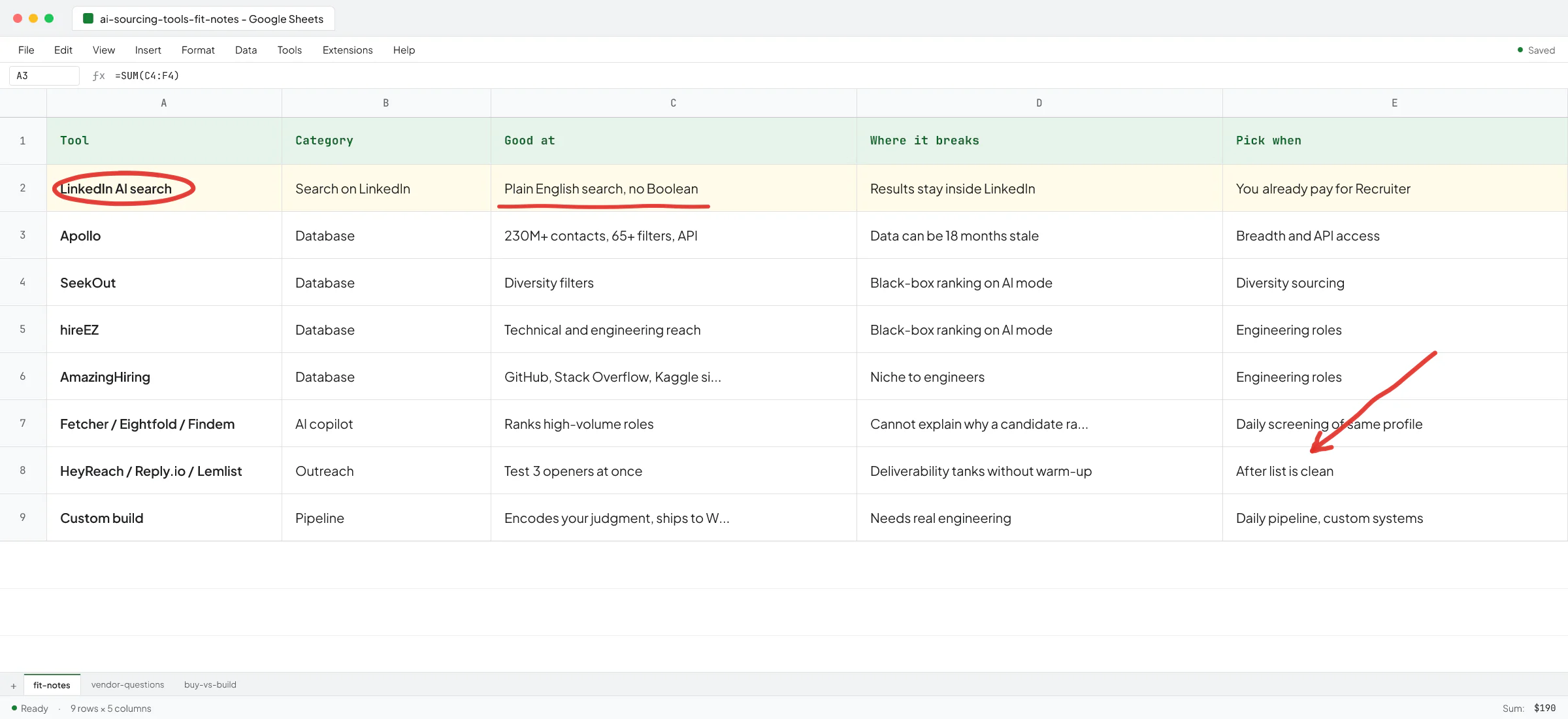
Search-on-top-of-LinkedIn tools (LinkedIn Recruiter, Sales Navigator with AI search)
LinkedIn's own AI search lets you type something like "senior backend engineer in Berlin, fintech background, open to remote" and skips the Boolean.
Where it fits: most small firms already pay for Recruiter or Sales Nav. Toolsmaxxing (getting more out of what you already pay for) usually starts here. If your team is still writing Boolean strings by hand in 2026, turning on the natural-language search is the cheapest win available. There's a longer write-up on toolsmaxxing the stack you already own if you want the full framing.
Where it breaks: results stay inside LinkedIn. You cannot push them into Salesforce, Bullhorn, or a WhatsApp notification without copy-paste. And LinkedIn restricts the automated layer pretty hard - their User Agreement bans scraping, bots, and any automated method to add or download contacts. So the moment your sourcing workflow needs to leave LinkedIn, this category runs out of road.
Database-driven sourcing (Apollo, SeekOut, hireEZ, AmazingHiring)
These tools maintain their own candidate database (hundreds of millions of profiles built from public web sources) and let you search across it with filters that go deeper than LinkedIn's UI.
Apollo advertises 230M+ verified contacts and 65+ filters, which is the most you can wring out of a self-serve sourcing seat at small-firm prices. SeekOut and hireEZ skew technical and diversity-focused. AmazingHiring is strong on engineers because it pulls in GitHub, Stack Overflow, and Kaggle signals.
Where it fits: technical and niche roles where the candidate has a public footprint outside LinkedIn. The recruitment startup I worked with picked Apollo specifically because we needed an API that could be called from inside the sourcing agent, and not a UI a recruiter opens.
Where it breaks: data freshness. A profile in Apollo can be 18 months stale. You will email people who left the company a year ago. Build a verification step into your process or this category quietly burns your sender reputation.
AI-native sourcing copilots (Fetcher, hireEZ AI, Eightfold, Findem)
These products sit between you and the database, add AI to score and rank, and try to learn your preferences over time.
Where it fits: high-volume roles where you screen the same kind of profile every day. The "learning" part needs a few hundred labeled decisions to start helping, so a firm doing two roles per quarter will never get there.
Where it breaks: black-box ranking. When the tool shows you a candidate and you ask "why this one?", the answer is "the model said so". For 9 out of 10 placements that's fine. For the one that matters (a senior role where the client asks how the shortlist was built) you need to be able to explain it. Most of these tools cannot, which matters a lot more in legal, healthcare, and finance recruiting.
AI outreach layers (HeyReach, Reply.io, Lemlist with AI personalization)
Strictly speaking these are outreach tools and not sourcing tools. They get bundled into the same conversation because the bottleneck most small firms hit is reaching the candidates and getting a reply, and not finding them.
Where it fits: the moment you have a clean list and you want to test 3 versions of an opener at the same time. AI personalization at this layer is mostly fine because the worst case is a slightly off message and not a broken pipeline.
Where it breaks: deliverability. The same tools recruiters use, sales teams use for cold outreach, which means Gmail and Outlook have learned to filter them aggressively. Warm up your sending domain or your reply rate craters in a month.
A simple decision rule
For most small recruitment firms (under 30 people), the right starting stack looks like this:
- Toolsmaxx what you have. Turn on the AI search in Recruiter or Sales Nav. Try the AI features inside your ATS (Bullhorn Copilot, Loxo, Manatal). You already pay for these.
- Add one database tool with API access if you need volume or technical reach. Apollo for breadth, AmazingHiring for engineering, SeekOut for diversity work.
- Add one outreach layer only after steps 1 and 2 are producing a clean candidate list. Adding outreach to a bad list just floods bad candidates faster.
You commission a custom build when one of these is true:
- You have a repeatable sourcing pipeline that runs every day for every recruiter, and the manual orchestration between tools is killing you.
- The candidate flow needs to land inside a system that no off-the-shelf tool integrates with (your own ATS, a Salesforce instance with custom objects, a WhatsApp-first internal workflow).
- A specific judgment ("this candidate fits this role for this client") needs to be made by software, and no SaaS lets you encode it.
The recruitment startup I worked with hit all of these. Hundreds of new job postings per day, Salesforce and WhatsApp as the system of record, and they needed AI to filter jobs against per-recruiter preferences before the recruiter ever saw them. No off-the-shelf tool did that. We built it: monitor portals, parse with AI, score against preferences, find candidates in Apollo, ship to WhatsApp. The Sellify AI technical co-founder I worked under for two years on the pest-control side put it well in his LinkedIn recommendation - "handle complex engineering tasks independently" - which is what this kind of work needs because it does not look like a Make.com flow with three nodes.
The trap of "let's just build it in ChatGPT"
Almost every recruitment owner I talk to has the same instinct. "I already pay for ChatGPT Plus. Why can't I just build a custom GPT that does sourcing?"
You can build a custom GPT that drafts outreach. You cannot build one that monitors job portals every five minutes, calls Apollo, writes to Salesforce, and notifies the right recruiter on WhatsApp. That work needs integrations and orchestration that live outside ChatGPT entirely.
A founder I worked with in Norway, Ove André Remme at Terapivakten, hired another freelancer first to build a course-generation tool as a custom GPT. Two weeks in, the custom GPT was generating 40% less content than he needed, and when he pushed it harder the content went weird. He came back, we threw out the custom-GPT approach, and built it as a proper application. He walks through the decision and what changed in a short video interview on YouTube. Sourcing has the same pattern: if the workflow has more than two tools in it, a custom GPT is the wrong layer.
What to ask a vendor before you sign
Most sourcing tools demo well. The questions that separate working tools from dashboard art:
- How fresh is your candidate data? Show me the last-updated timestamp on 20 random profiles.
- What is your API rate limit on the plan I'm buying?
- If a candidate asks to be removed from your database, what is the process and how long does it take?
- Where is the data hosted, and does your DPA cover GDPR and US state privacy laws like CCPA?
- What happens to my sourced lists if I cancel?
A vendor that hedges on any of those is a vendor you will be migrating away from in a year.
Where AI candidate sourcing will not help you
A few real limits, because pretending AI fixes everything is how recruitment owners end up with shelfware.
AI sourcing tools do not know your clients. They cannot tell you that this client always rejects candidates from a particular competitor, or that the hiring manager only meets candidates with a specific certification. That context lives in your head and in your CRM notes, and getting it from there into an AI-readable form is a build project that no off-the-shelf license covers.
AI outreach also has a ceiling. It writes faster than a recruiter who knows the candidate's portfolio, and the messages it produces are not better. If your reply rates are already low because your positioning is generic, AI personalization will just produce generic-personalized messages at higher volume.
And AI cannot run the conversation once a candidate replies. The Sellify AI work in pest control got close - the HomeTeam case study shows an AI agent named "Anna" outselling top human reps, and customers calling the branch to confirm she was real - but that took two years of engineering against one specific industry workflow. For recruitment in 2026, AI handles sourcing, screening, scheduling, and follow-up nudges well; humans still close the placement.
When to bring in help
If you are a 2-10 person agency, start with toolsmaxxing and one database tool. You do not need a consultant for that.
If you are 10-30 people, you have repeat clients, you have a recurring sourcing pattern, and the manual work between LinkedIn, your ATS, and your CRM is eating a full headcount of time, that is the moment custom work starts paying back faster than the next SaaS seat. The buyers who waited too long are the ones still paying for five tools to do what one orchestrated pipeline could do, and explaining to their team why the same candidate just got messaged three times by three different systems.
If you want to talk through which bucket you're in, and which path is cheaper for your firm, book a call and bring your current stack. Half an hour is usually enough to know whether you need a tool, a build, or just to turn something on you already own.
FAQ
What is AI candidate sourcing?
AI candidate sourcing is using software with machine-learning models to find, rank, enrich, or message candidates. In practice it covers four different jobs (searching a database, matching to a JD, finding contact details, and writing outreach) and most tools are good at one or two of them.
Are there free AI candidate sourcing tools?
LinkedIn's natural-language search is included with any Recruiter or Sales Navigator seat you already pay for, which is the closest thing to free for most firms. Apollo has a free tier capped at a few hundred contacts a month. Most other tools that advertise as free either limit you to 10-20 searches or use your queries to train their models.
Will AI replace recruiters?
No, not for the work that closes placements. AI handles sourcing, first-pass screening, scheduling, and follow-up nudges very well today. Reading a candidate, reading a hiring manager, and bridging the gap between them is still a human job, and will be for the foreseeable future.
How do I choose between Apollo, SeekOut, and hireEZ?
Apollo is best for breadth and API access on a small-firm budget. SeekOut is strong for diversity sourcing and has good filters for veterans, women in tech, and underrepresented groups. hireEZ skews technical and engineering. Pick by the role you source most often, and not by which vendor demoed best.
When should I build a custom AI sourcing pipeline instead of buying a tool?
When you have a repeatable workflow that runs every day, the data needs to land in systems no off-the-shelf tool integrates with (your own ATS, a custom Salesforce setup), and a specific judgment in the pipeline needs to encode rules that live only in your head. Below that bar, an off-the-shelf tool wins on cost and speed every time.