You're recording every sales call. Your team is already in Fathom, or already in Otter, and someone is asking why you pay for both, or which one to put the whole firm on. Worth getting right, because the wrong default ends with three years of transcripts you can't search, sitting in two tools nobody fully owns.
Pricing, the parts that matter for a small B2B firm, where each one fits, and the line where a notetaker stops being the answer.
The short answer
For most small B2B firms, Fathom is the safer default. The free plan gives you unlimited recordings and transcriptions, and the paid plan is priced per user at $19/month, billed annually at $15. That fits the way a 5-50-person firm grows - you let reps record without thinking about a minute budget, then upgrade the ones who need AI follow-ups and CRM sync.
Otter wins in a couple of specific situations: you're a coaching or research firm that needs strong speaker separation across long internal meetings, or you already live inside the Otter + HubSpot/Salesforce loop and ripping it out costs more than keeping it.
If you're on one already and it's working, the right move is usually to stop shopping and put the energy into what you do with the transcripts (more on this below).
What each plan gives you
Fathom
Free covers what most B2B reps need: every call gets recorded and transcribed, you get an AI summary, you can search across calls. That's already more than what Otter's free plan gives you.
Premium at $20/month adds the AI action items, follow-up email drafts, and the assistant that lets you ask questions across a single call. Team at $19/user/month (or $15 annual) adds shared search across the team and SSO. Business at $34/user/month adds CRM field sync and a deal-pipeline view. Numbers are on Fathom's pricing page.
On data: Fathom's policy is that they may use your meeting content to train their own in-house models, you can opt out in account settings, and third-party AI providers (OpenAI, Anthropic, Google) are not allowed to train on your data. Worth knowing before you push it firm-wide.
Otter
Free gives you 300 monthly transcription minutes and 3 lifetime imports. Enough to evaluate, not enough to standardize a sales team on. Pro at $16.99/month adds 1,200 in-app recording minutes, and HubSpot/Salesforce integrations show up on higher tiers. Business at $19.99/user/month is where the minute caps lift to unlimited and admin features appear.
On data: Otter's privacy policy says they train their AI on de-identified audio recordings. Manual review needs explicit opt-in (the box you check when rating transcript quality), so for routine use the data flows to their training pipeline by default. If your firm signs NDAs that cover call content, read that carefully.
Where each one fits
A few scenarios I see most often.
Sales-led B2B firm, 5-50 people, recording client calls
Fathom. The free plan removes the per-minute anxiety that comes with Otter, and the paid plan's CRM field sync is built for the workflow most B2B firms run: rep takes a discovery call, AI writes the summary, summary lands in Follow Up Boss or HubSpot, rep edits and moves on. One fitness-coaching founder I talked with had over 100 client calls sitting in Fathom and the bottleneck wasn't capture - it was that Fathom shows him one call at a time when he needs the pattern across all of them. I'll come back to that line.
Coaching firm, healthcare adjacent, long internal meetings
Otter, often. Long meetings with multiple speakers are where Otter's speaker labeling earns its keep, and coaching firms tend to use the transcript as a working document the client can reread, not just a summary the rep skims. If you're on the Business plan anyway for unlimited minutes, the Otter ecosystem is a good fit.
Property management, accounting, or recruitment firm doing mostly short client calls
Fathom free. You don't need the AI action items yet. You need a folder of searchable transcripts so when a tenant disputes what the property manager said in a maintenance call, or a candidate misremembers what the recruiter promised, the answer is one search away.
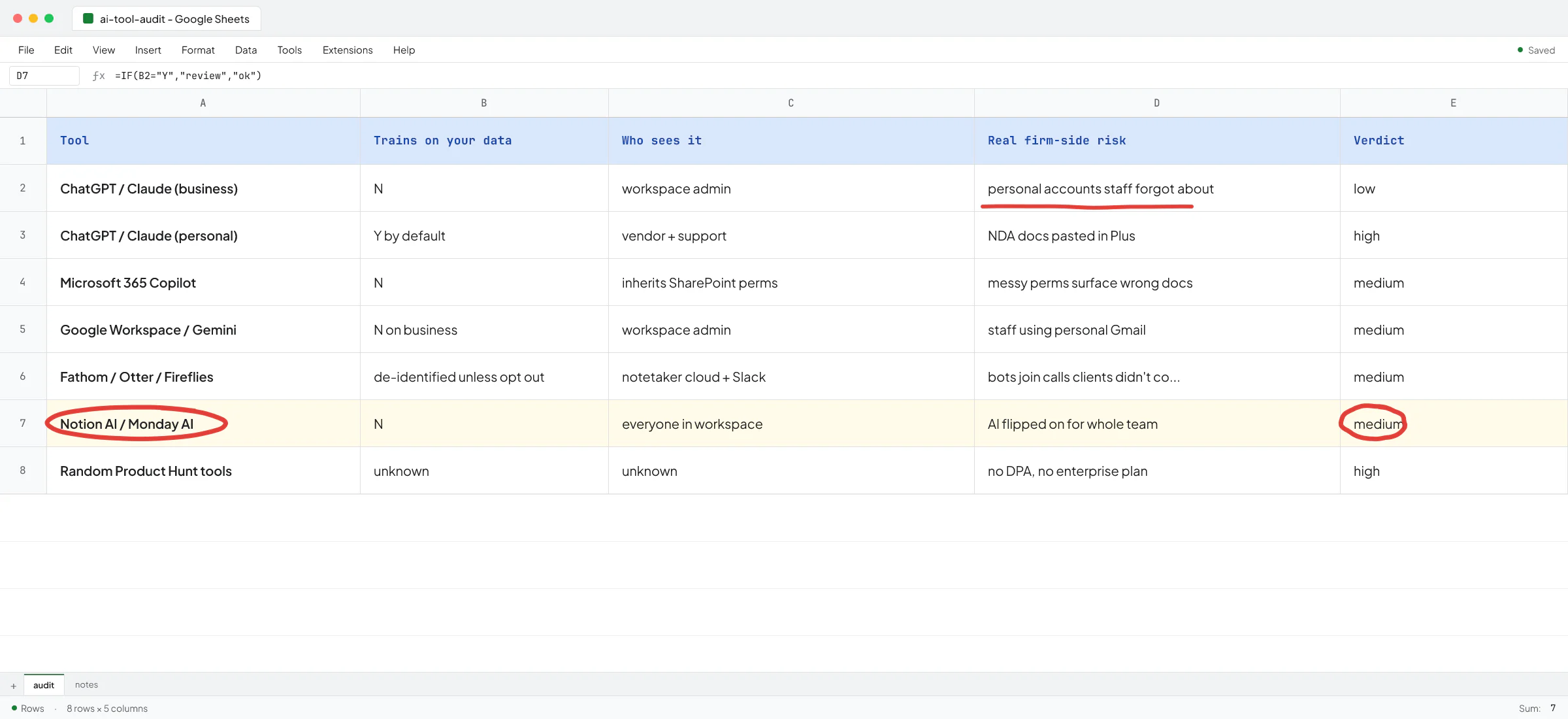
You already pay for Microsoft 365 or Google Workspace and Copilot/Gemini is on by default
Probably neither, at first. Teams and Meet now produce decent transcripts and summaries built in. I'd run a four-week test with what you have before paying for a third notetaker - that's the toolsmaxxing approach, getting value out of what you're already paying for before stacking another seat license.
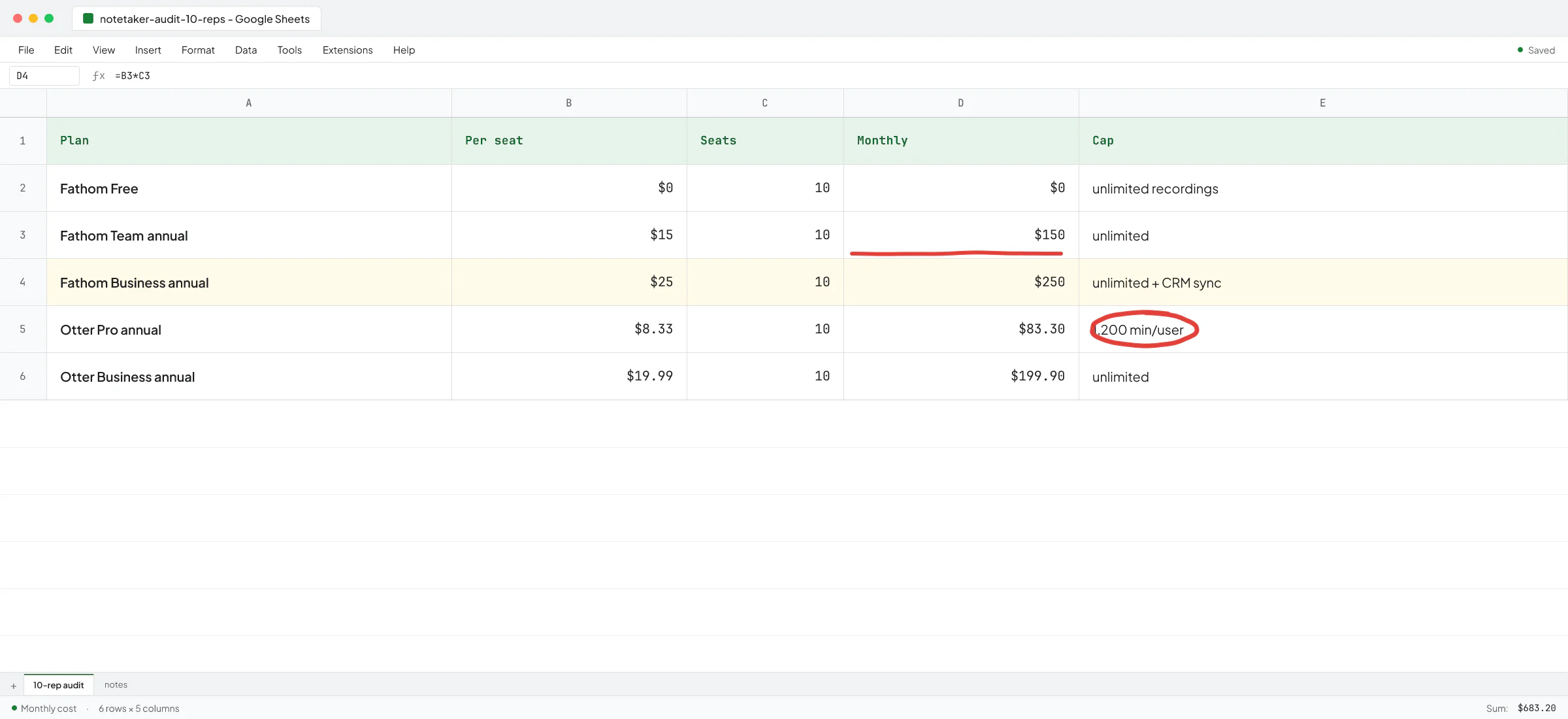
Pricing, side by side, for a 10-person firm
10 reps, all recording, all needing the AI follow-up features.
- Fathom Team annual: 10 × $15 = $150/month
- Fathom Business annual: 10 × $25 = $250/month
- Otter Business annual: 10 × $19.99 = $199.90/month
- Otter Pro annual: 10 × $8.33 = $83.30/month, but you're capped at 1,200 recording minutes per user
Note the Otter Pro line. It looks like the cheapest serious option until you remember that an active sales rep does 20+ hours of calls a month easily - 1,200 minutes is 20 hours, and you're paying overage or capped after that. Fathom's Team plan is the closest like-for-like at higher volume, and Otter Business is the like-for-like for unlimited.
If 10 reps and the choice between $150 and $200 a month is what's gating this, you've already won. Pick one and move on.
What both tools don't do (and where a small firm hits the wall)
Fathom and Otter are notetakers. They're good at turning one call into one summary, one searchable transcript, one set of action items. They're not built to turn a hundred calls into one report that answers "what are the three objections we're losing on this quarter?"
This is the wall the fitness-coaching founder I talked with hit, and every B2B firm I've seen with more than ~30 calls in their notetaker hits it eventually. The line I keep hearing from founders is something like "I can see the individual call stuff, but I can't see overviews across all the calls."
You can solve it three ways, in order of effort.
- Toolsmaxx first. Export 20-30 transcripts as text, paste them into Claude or ChatGPT (on a plan with privacy controls - see is ChatGPT safe for confidential information), ask for the cross-call analysis you want. This works once. It does not work on a weekly cadence with 100+ new calls.
- Build a small pipeline. A scheduled job pulls new transcripts from Fathom or Otter's API, sends each through a model with a fixed prompt that extracts objections, asks, and next steps, then aggregates into a weekly report that lands in Slack. Two to three weeks of work for someone who knows what they're doing. At Sellify AI I helped build CRM-integrated pipelines on top of pest control software where the AI ran the customer-side conversations end-to-end; Thomas K. Lundberg, the CEO, wrote the recommendation for that work. Cross-call reporting is the easier cousin of that.
- Custom build, when the report itself is the product. A few firms I've talked with want this as a customer-facing dashboard, not an internal report. Different conversation - sketch it on a call before you spend money.
The mistake I see most often is the firm in #2 getting sold #3. If you have a weekly internal report problem, you don't need a six-month custom build. You need the smallest pipeline that does the job, sitting on top of the notetaker you already have.
How I'd decide, in five minutes
- Are you already on one of them and not actively unhappy? Standardize on that. Don't migrate for marginal feature gains.
- Sales-led B2B firm picking from scratch? Fathom free, upgrade to Team annual when you outgrow it.
- Coaching firm with long internal meetings and HubSpot? Otter Business.
- Microsoft 365 or Google Workspace shop with Copilot/Gemini already on? Spend four weeks with the built-in transcription before paying for a third tool.
- You can already answer the "which notetaker" question, and the real problem is that you can't see across calls? Skip the comparison. The notetaker isn't the bottleneck.
For #5 - that's where I've shipped work. I built the integration into a legacy pest control CRM at Sellify AI that the technical co-founder Ivan Nikolaichuk recommended me on, and an end-to-end job-monitoring agent for a recruitment AI client where the same cross-call pattern problem shows up on the candidate side. Ove Andre Remme, founder of Terapivakten, described in a video interview what it was like when he first tried to solve his problem with a custom ChatGPT agent and it didn't work - same shape of decision a lot of firms face when they outgrow the notetaker.
Not legal advice on data handling - check with your privacy counsel before standardizing a firm-wide policy on either tool.
If you're at the point where the comparison isn't the question anymore, book a call and we'll figure out the smallest thing that gets you the report you want.
FAQ
Is Fathom or Otter better for sales calls?
For most small B2B sales teams, Fathom. The free plan gives unlimited recordings, the AI summaries are tuned for sales calls out of the box, and the CRM sync on the Business plan fits the standard discovery-call workflow. Otter is stronger when your "sales calls" are long consultative meetings with multiple speakers - then the speaker labeling matters more than the summary.
Does Fathom have a free plan with unlimited recordings?
Yes. Per Fathom's pricing page, the free plan includes unlimited recordings and transcriptions, AI summaries, clips, playlists, and call search. You only pay when you need AI action items, follow-up email drafts, team search, CRM sync, or admin controls.
Is Otter safe for confidential client calls?
Otter trains its AI on de-identified audio recordings by default - manual review is opt-in only. For a B2B firm under client NDAs, read Otter's privacy policy before standardizing on it. If the policy language doesn't fit what you signed with clients, stay on Fathom (which restricts third-party AI training) or talk to your legal counsel about the right contract terms.
How much does Otter cost for a small business?
Otter Pro is $8.33/user/month annual or $16.99 monthly, with a 1,200-minute recording cap per user. Otter Business is $19.99/user/month annual and lifts the cap to unlimited. The free plan tops out at 300 monthly minutes, which is not enough for a working sales team.
Can I switch from Otter to Fathom (or back)?
Yes, but you'll lose your existing transcript history in the source tool's search and dashboards. Both tools let you export individual transcripts, but bulk export is awkward. The right time to switch is when you're starting fresh or after a slow period, not mid-quarter with three months of unprocessed calls sitting in the old tool.
Do I need a custom AI tool instead of Fathom or Otter?
Almost never to replace them - they're cheap and the recording layer works. You need something custom when the problem is cross-call analysis, weekly reporting, or feeding call content into a workflow neither tool supports (a CRM that's not on their integration list, an internal dashboard, a multi-step agent). That sits on top of Fathom or Otter, not instead of them.