You run an online coaching brand. Ads bring in booked calls, your sales team closes some, coaches deliver the program, and the whole thing runs on Slack, Meta Ads, a call recorder, and a Google Drive full of transcripts. You keep seeing AI demos on Instagram and thinking you'd love to build that. This piece is a straight answer to where AI pays back in a business shaped like yours, where it wastes time, and when a stock tool stops being enough.
I've talked to enough founders in this space to see the pattern. One recent conversation was almost the exact ICP: a coaching brand for men, more than 100 sales calls recorded in Fathom, Meta ads running, everything sitting in Slack and Google Drive. The founder kept coming back to the same gap - he could see individual call summaries but had no way to see patterns across all the calls. That gap is where AI starts earning its keep.
Where AI pays back fast
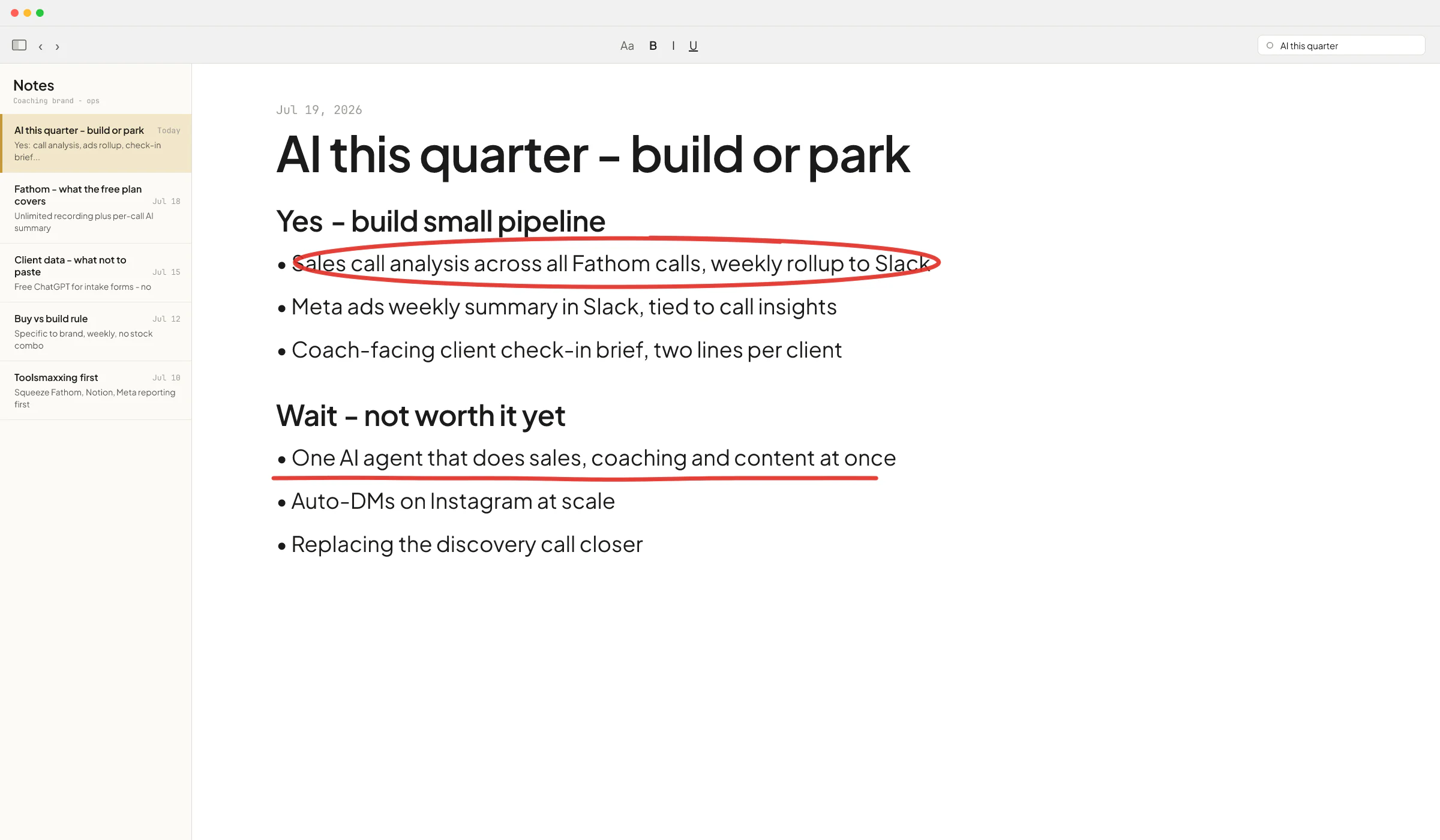
Not everything is worth automating. Here's what I'd do this quarter.
Sales call analysis, across all calls at once
Every online coaching business I've seen has the same setup. A call recorder like Fathom or Otter runs on every discovery call and gives you a summary of that one call. What it doesn't give you is patterns across a hundred calls - the objections, the phrasing prospects use for their pain, the reasons they hesitate.
Fathom's free plan already covers unlimited recording and instant AI summaries per call, so most coaching brands have the raw material sitting there. The missing piece is aggregation. This is where a small pipeline pays back: pull the transcripts, run them through Claude or ChatGPT with a prompt tuned to your ICP, and drop a weekly rollup into Slack. Top objections this week. Top pain phrases. What changed vs last week.
If this is your problem, I wrote a longer piece on the setup and where it breaks: AI sales call analysis for small B2B firms.
Ad performance weekly summaries
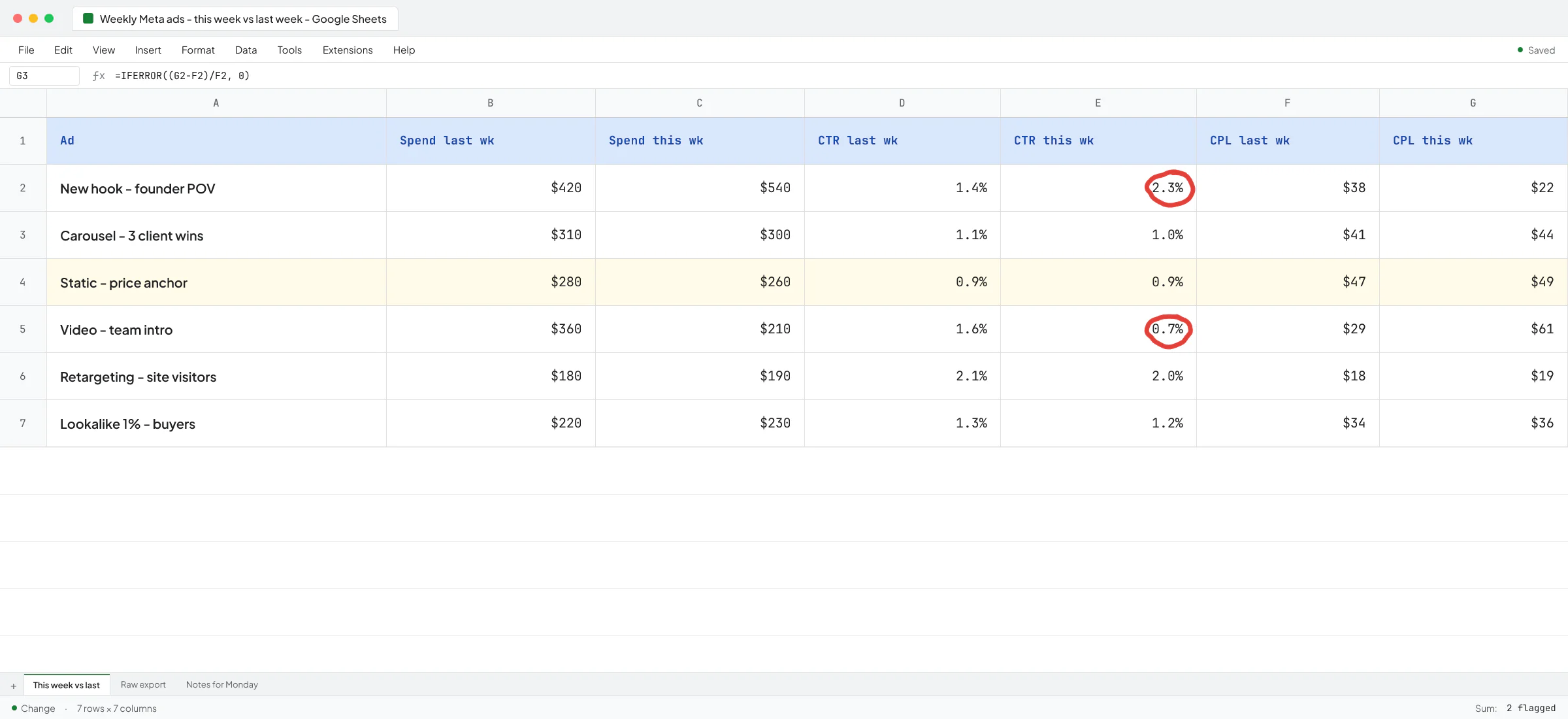
Meta Ads reporting is dense and lives in a UI nobody wants to open on a Monday. What you want to know is which creatives are working, which are dying, what changed vs last week, and where the creative team should focus. A weekly report that pulls Meta's data, adds context from your sales call analysis, and lands in Slack takes a founder from "I need to log into Ads Manager" to "here's what to test this week."
The brands that get this right make better creative decisions in less time. Not because AI writes the report, but because the summary lives where the team already talks.
Client check-ins and coaching handoffs
Your coaches want to know how each client is really doing before the weekly session. Clients fill in a form, send messages, log workouts. AI can summarize that into a two-line brief per client for the coach - what's on track, what's off, what to ask about first. General apps like Trainerize's AI Workout Builder help on the programming side, but the coach-facing brief usually needs a bit of custom work because every brand's check-in template is different.
Content and ad copy drafting
Coaches with a big audience already know this one. Claude or ChatGPT drafts hooks, ad angles, email variants, blog outlines. The trick is not "AI writes it and you post it." The trick is a prompt tuned to your brand voice, with real examples of your best-performing hooks pasted in as reference. Ove Andre Remme, who runs a Norwegian training business, put it well in a video interview about a build I did for him: the first freelancer he hired shipped a ChatGPT agent that generated content 40% too short and got weird when asked to expand. Content quality problems usually come from thin setup, not from the underlying model.
Where AI wastes your time
Not every use case pays back. Here's where I've watched coaching brands burn weeks.
- A single "AI does everything" agent for sales, coaching, and content. These demos look great and break the moment you try to run them for real customers. Different jobs need different prompts and different guardrails, so split the work.
- Auto-DMs on Instagram at scale. A fast route to a restricted account. Meta's platform rules move faster than any AI vendor's compliance page.
- Replacing the discovery call closer. You sell coaching partly on trust, and prospects buy from a human they connect with. Automating the setter is fine; automating the closer usually is not.
- A fully AI-generated program shipped to a client without a coach reviewing it. Fine as a first draft, risky as the final delivery unless you're pricing at self-serve rates.
The pattern behind all of these: the more critical the client relationship, the more you want AI supporting a human rather than replacing them.
A quick word on client data
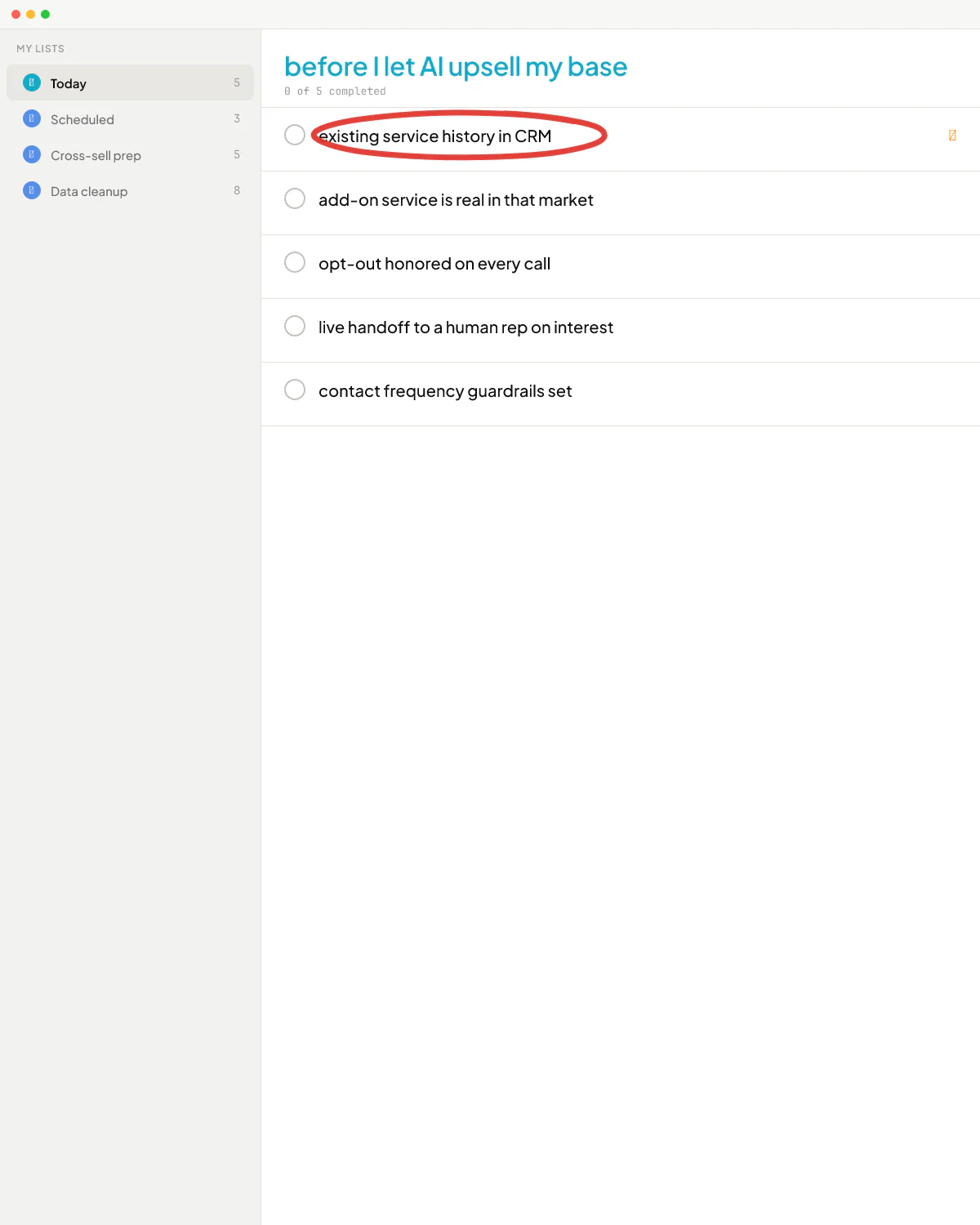
If you use Fathom or Otter, calls are transcribed and stored on their servers. If you drop a transcript into a public ChatGPT chat, the plan you're on matters for what happens to that data. Worth thinking through before you paste anything client-related into any AI tool. I wrote a full guide on what's safe on ChatGPT for confidential info - the short version is: pay for a business tier where training on your data is off by default, and pick one tool your whole team uses.
For anything more sensitive than a discovery call transcript, like health screening data or intake forms, you probably want a proper pipeline where the data never touches a public AI tool at all. That's a build conversation.
Not medical or legal advice - loop in your compliance person for the specifics.
Buy, build, or wait
For a coaching brand your size, here's how I'd think about it.
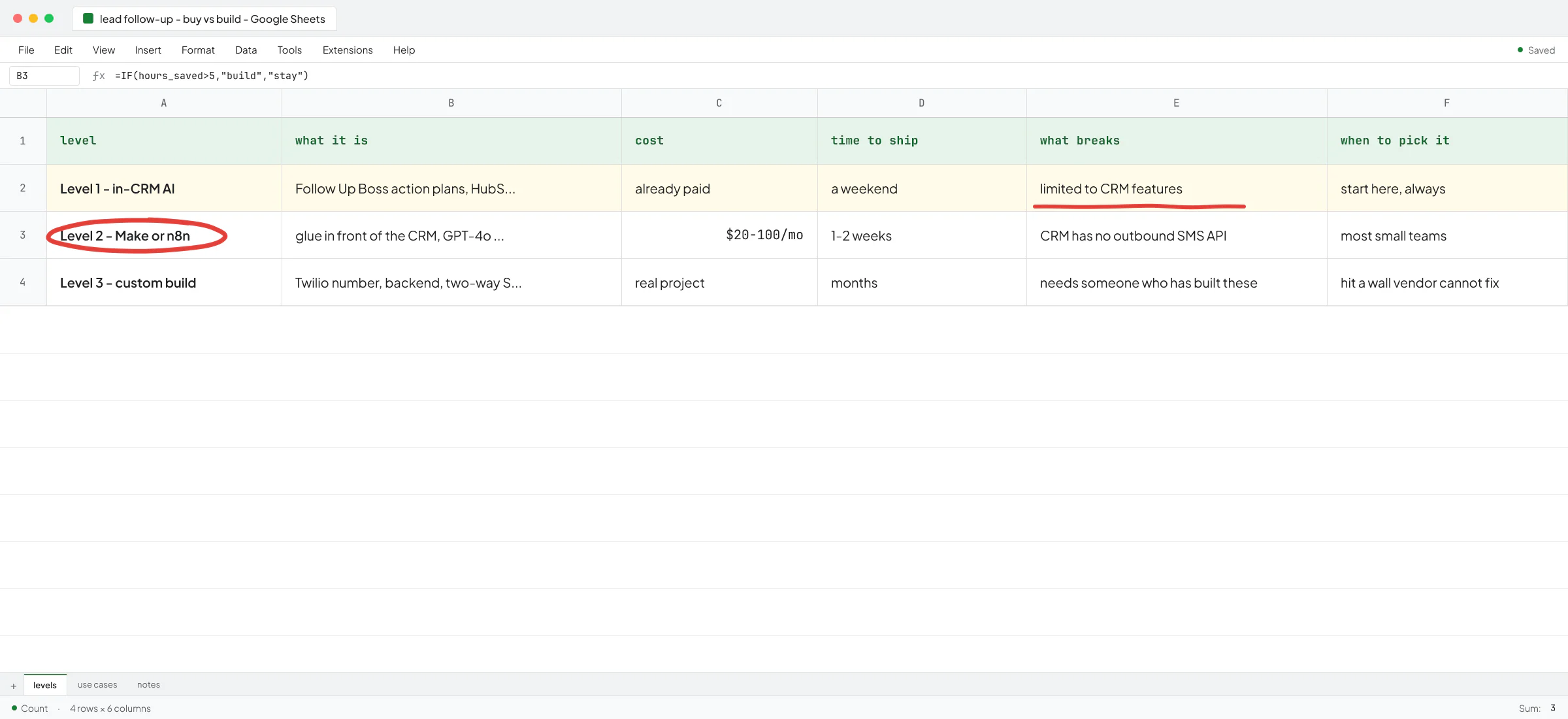
Use the tools you already pay for first. Fathom, Notion, Meta's own reporting, ChatGPT or Claude. Squeeze the built-in features hard before you sign up for another SaaS. I wrote a piece called toolsmaxxing about exactly this move.
Buy a stock tool when the job is generic - a workout builder, a general call recorder, a proposal drafter. These are solved problems and someone has already shipped the app.
Build (or hire someone to build) when three things are true:
- The job is specific to your brand - your voice, your ICP, your check-in format, your Slack setup.
- You're doing it every week and it costs you real hours.
- No stock tool combines what you need without duct tape.
Sales call aggregation is often the first custom build for a coaching brand because it hits all three. Same for a Meta Ads weekly rollup that references your call insights. When Ivan Nikolaichuk, the technical co-founder of Sellify AI, wrote about the two years we worked together, most of what he described as complex engineering tasks started life as "we can't buy something that does this the way our clients need it." That's the moment you're looking for.
What good looks like in practice
Here's the shape of a first project I'd scope with a coaching founder, if the calls-across-all-calls problem is the one keeping them up.
- Pull transcripts from Fathom nightly.
- Run them through Claude with a prompt tuned to your ICP - what to look for, what to ignore, how to weight new patterns vs established ones.
- Cluster by objection, hesitation, and language pattern.
- Post a Monday morning report in Slack. Top objections this week. Change vs last month. Two prospects worth listening to in full.
- Keep it dumb and reliable. No fancy dashboard, Slack is where the team already is.
This is a short build for a competent AI engineer, plus ongoing prompt tuning as you learn what you want to see. The output is the founder walking into Monday knowing what the market has been telling them all week, without opening a single call.
If that's the kind of build you're weighing, book a call and we can figure out whether it's a build, a toolsmaxxing exercise, or a "wait six months" answer. All three are honest outcomes.
FAQ
What is the best AI tool for online fitness coaches?
There isn't one best tool - it depends on the job. Fathom or Otter for call recording. Claude or ChatGPT for content drafting and analysis. Trainerize's AI Workout Builder for programming. Meta's own reporting for ad basics. The mistake is shopping for one app that does everything. Pick the best tool per job and connect them.
Can AI replace a fitness coach?
No, and framing it that way is a good way to lose clients. AI can draft programs, summarize check-ins, and free your coaches from admin work so they can spend more time on the coaching relationship. Full replacement of a human coach on a paid coaching product is rare and usually shows up in trust and retention numbers.
Is it safe to put client health data into ChatGPT?
Not on the free plan. On paid business tiers, training on your data is off by default with most vendors, but you still want to think about what the tool's provider is legally responsible for if something leaks. For anything close to health screening or intake data, run it through a pipeline where the data doesn't touch a public tool. This isn't legal or medical advice - loop in your compliance person.
How much does an AI setup for a coaching business cost?
It depends on scope. A weekly Slack report pipeline built by a single engineer is small. A full sales operating system integrated into your CRM, calendar, and coaching platform is bigger. The right first move is a short scoping call, not a menu.
When should I hire someone to build custom AI instead of buying a tool?
When the job is specific to your brand, you're doing it every week, and no stock tool combines what you need without a mess of Zapier duct tape. Sales call aggregation, ad and call insights combined into one report, and coach-facing client briefs tuned to your check-in format are typical first custom builds for coaching brands.